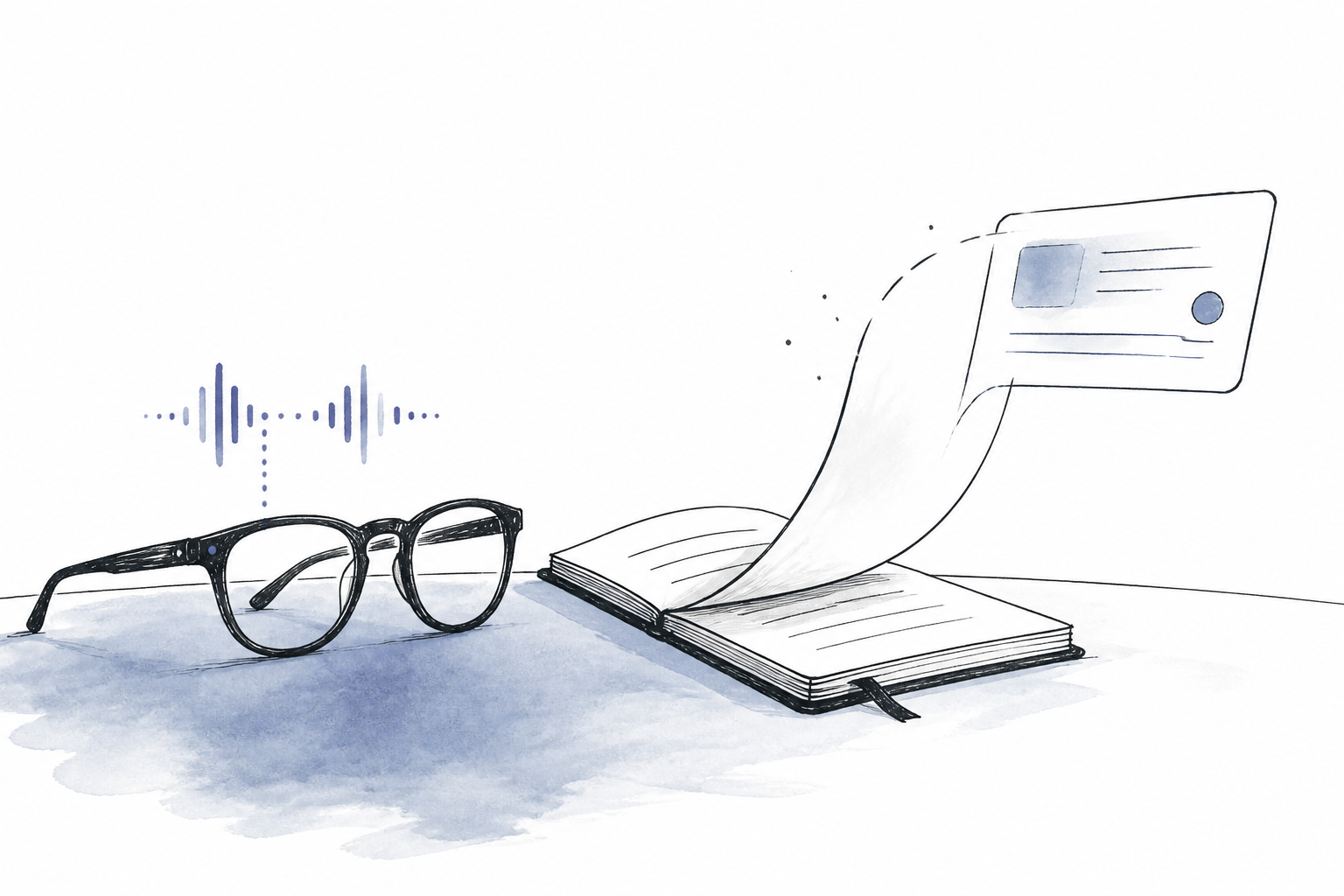
RayNeo iO is being sold as human-augmented AI glasses, but its most concrete near-term job is simpler: capture the day while the user is already wearing the device. ifanr describes three core AI aims for the product: strengthening human knowledge, strengthening human expression, and preserving human memory. The memory part is the tell. RayNeo iO's all-day intelligent memory feature continuously records communications and inspirations with extremely low power consumption, then generates a daily summary and pulls key nodes from large amounts of conversation at day's end.
That makes the glasses less like a phone replacement and more like a wearable note-taker.
The pitch still carries big AI-and-AR energy. RayNeo iO includes Qianwen 3.7 Max and DeepSeek V4 Pro, according to ifanr, and 36kr lists a launch hand price starting at 1996 yuan. But the practical promise is not a floating interface. It is whether captured context becomes dependable memory.
What RayNeo iO is actually built to do
RayNeo iO is built less like a phone replacement and more like an always-worn input device. 36kr notes that the name comes from I/O in computer language, meaning Input & Output, and that framing matters: the glasses are meant to catch speech, context, and prompts before they disappear.
- October 2021RayNeo was founded
- 2021RayNeo defined smart glasses as AI+AR
- around 2025Li Hongwei expected the smart-glasses iPhone moment
- Q1 2026Global smart glasses shipments increased 130.1% year on year
- August 21RayNeo officially launched the iO series
- 2027Li Hongwei said the iPhone moment may now arrive
ifanr describes RayNeo iO as human-augmented AI glasses, with capabilities organized around strengthening human knowledge, strengthening human expression, and preserving human memory. The most concrete feature is all-day intelligent memory: the glasses continuously record users' communications and inspirations with extremely low power consumption, then generate a daily summary and extract key nodes from large amounts of conversation at the end of the day.
That makes the sensor package central, not decorative.
According to 36kr, RayNeo iO carries 4 array microphones and 1 bone-conduction microphone. Model access is also part of the product pitch: ifanr says Qianwen 3.7 Max and DeepSeek V4 Pro are built in, while 36kr says the initial support is DeepSeek V4 Pro and Qwen 3.7 Max, with later plans to connect to Kimi K3 and RayNeo's self-developed RayNeo AI large model.
The optical and physical specs point to a device trying to stay wearable through ordinary days. 36kr lists an equivalent 33-inch display, 1800 nits of eye-entering brightness, full-range DC dimming, and TÜV SÜD flicker-free and low-blue-light certifications. It also says the front-frame edge averages 2.25 millimeters, the thinnest part of the titanium alloy temples is 1.15 millimeters, and whole-device weight is 34g.
The commercial details are equally practical. 36kr reports myopia lens fitting from 0 to 1000 degrees, two days of ultra-long battery life, an official price of 2499 yuan, and a launch hand price starting at 1996 yuan. Sales run from August 21 through JD.com, Tmall, Douyin, and multiple offline optical channels.
Near-term AI glasses value: capture workflows versus platform-replacement claims
| Dimension | RayNeo iO AI glasses | Smartphone market context | Workflow/agent reliability evidence | Edge AI chip constraint |
|---|---|---|---|---|
| Core positioning | Positioned as human-augmented AI glasses; key capabilities are strengthening human knowledge, strengthening human expression, and preserving human memory | IDC lowered its 2026 global smartphone shipment forecast to 1.09 billion units, down 13.9% year on year | Siyi argues AI products entering real business still face unresolved questions about data cleanliness, permissions, exception handling, result acceptance standards, fallback processes, and accountability | Rockchip RK1828, RK3588, and Guangyu Xinchen TC1020 are described as edge large-model inference chips rather than finished glasses products |
| Near-term useful jobs | All-day intelligent memory continuously records users' communications and inspirations; it generates a daily summary and extracts key nodes from large amounts of conversation | Not covered | Siyi argues expression, social, content, and companionship products should be evaluated by whether users keep the result, how much they revise it, whether they share it, and whether they return | Not covered |
| AI models or inference | Built-in Qianwen 3.7 Max and DeepSeek V4 Pro model versions; later plans to connect to Kimi K3 and RayNeo's self-developed RayNeo AI large model | Not covered | The Stanford 2026 AI Index reports 66.3% accuracy for the leading Agent on OSWorld, 89.4% average success across 18 short-horizon RLBench tasks, and 12.4% complete task success in the 2025 BEHAVIOR-1K challenge | RK1828 runs 3B model inference at more than 100 tokens/s; RK3588 runs the same model at only more than 10 tokens/s; TC1020 decodes 7B models at more than 200 tokens/s |
| Wearability and optics | Whole-device weight is 34g; average front-frame edge width is 2.25 millimeters; thinnest part of the titanium alloy temples is 1.15 millimeters; OC area transmittance reaches 93%; non-display area transmittance reaches more than 98% | Not covered | Not covered | TC1020-class chips have whole-chip power consumption of 8-15W, while a 50-gram AI glasses device has an average whole-device power budget at the hundreds-of-milliwatts level |
| Battery and hardware trade-off | Supports two days of ultra-long battery life; RayNeo actively gave up using a camera, a large chip, and an Android system in order to focus on AI and all-day battery life | Not covered | Not covered | Power budget mismatch is explicitly noted between TC1020-class chips and a 50-gram AI glasses device |
| Input and context capture | Equipped with 4 array microphones and 1 bone-conduction microphone; the name iO comes from I/O, meaning Input & Output | Not covered | MiniMax Hub asks users about core directions at key nodes; Siyi argues node confirmation should occur at irreversible points or where rework is expensive | Not covered |
| Privacy signaling | RayNeo iO actively gave up using a camera | Not covered | Siyi describes a useful AI pause button as mechanisms where the system knows when not to continue, humans can understand why it stopped, context is preserved during handoff, and the system can return after handling | Not covered |
| Cloud and service handoff | Plans to work with Alipay, JD.com, Amap, and Tongcheng for parking payment, express delivery inquiries, and flight information | Not covered | Siyi argues real business deployment must resolve permissions, fallback processes, and accountability | Not covered |
| Pricing or commercial signal | Launch hand price starts at 1996 yuan; official price is 2499 yuan | Average selling price of smartphones reached $550 in 2026, $100 higher than in 2025; AI glasses cost about 1500 yuan on average according to the woshipm author | Not disclosed in sources | Not disclosed in sources |
| Market traction | Counterpoint and IDC data show RayNeo ranked first in AR glasses shipments in China and globally in the first quarter of 2026; RayNeo won single-product sales champion title during China's 618 shopping festival and North America's Prime Day | China's smart glasses shipments increased 77.7% year on year in 2026; global AI glasses shipments increased 72% in 2026; global smart glasses shipments increased 130.1% year on year in Q1 2026 | Not covered | Not covered |
| AR replacement narrative | RayNeo aims to change the lives of 1 billion people worldwide through AR glasses; RayNeo defined smart glasses as AI+AR in 2021 with three scenarios: migration of smartphone scenarios, AI assistants, and integration of virtual and display | The woshipm author argues new smart hardware categories cannot absorb smartphone demand lost in 2026 because AI glasses cost about 1500 yuan on average and China's annual market size is less than 5 million units | Siyi argues high scores on structured benchmarks cannot directly prove stable long-term operation in open business processes | Not covered |
The cloud is the real computer
RayNeo iO's model story sounds local at first. According to ifanr, the glasses have built-in Qianwen 3.7 Max and DeepSeek V4 Pro; 36kr describes initial support for DeepSeek V4 Pro and Qwen 3.7 Max, with later connections planned for Kimi K3 and RayNeo's own RayNeo AI large model. That is the language of a computer on the face. The hardware choices point somewhere else.
Li Hongwei told ifanr that RayNeo iO gave up a camera, a large chip, and an Android system to focus on AI and all-day battery life. That tradeoff matters because the device's job is continuous context capture, not workstation-class inference. Ifanr says its all-day intelligent memory continuously records users' communications and inspirations with extremely low power consumption. The glasses are closer to a sensor and trigger layer than a self-contained AI box.
The power math is the wall.
Woshipm's author uses edge inference chips to show why. Rockchip RK1828 stacks DRAM directly on the NPU, offers 2.5GB or 5GB options, has theoretical bandwidth of about 1TB/s, and runs 3B model inference at more than 100 tokens/s. Rockchip RK3588 runs the same model at only more than 10 tokens/s. Guangyu Xinchen's TC1020 goes further: a 3D-stacked near-memory computing architecture, 56 TOPS@INT8, and more than 200 tokens/s on 7B model decoding.
Those chips still do not fit the glasses bargain. Woshipm says TC1020-class edge large model inference chips consume 8-15W at the whole-chip level, while a 50-gram AI glasses device has a whole-device average budget in the hundreds-of-milliwatts level. RayNeo iO's 4 array microphones and 1 bone-conduction microphone therefore matter more than model badges: they collect the meeting, wake the service, and hand the hard part to the cloud.
The AR endgame is later than the work use case
RayNeo's own framing makes the gap visible. According to ifanr, Li Hongwei said RayNeo defined smart glasses as AI+AR in 2021, with three scenarios: moving smartphone tasks onto glasses, AI assistants, and integrating virtual content with display. That is still the endgame. It is just not the part most likely to carry work adoption first.
The practical value arrives before the full AR promise.
Meetings, translation, prompts, reminders, and recall do not require glasses to replace the phone. They require the device to sit where context happens. A worn camera, microphone, and display can capture a discussion, surface a next step, or translate a phrase with less friction than pulling out another screen. That is why the work use case can mature while the broader AI+AR stack is still waiting on harder components.
Li's timeline has moved. Ifanr reported that he said in 2021 he expected the smart-glasses "iPhone moment" in about three to five years, around 2025. He now says it may arrive in 2027, and that AI has advanced faster than expected while smart glasses overall have moved slower than expected. He also said product forms may converge into one form in 2029 or later. The lesson for practitioners is simple: buy for the workflow that works now, not the category myth.
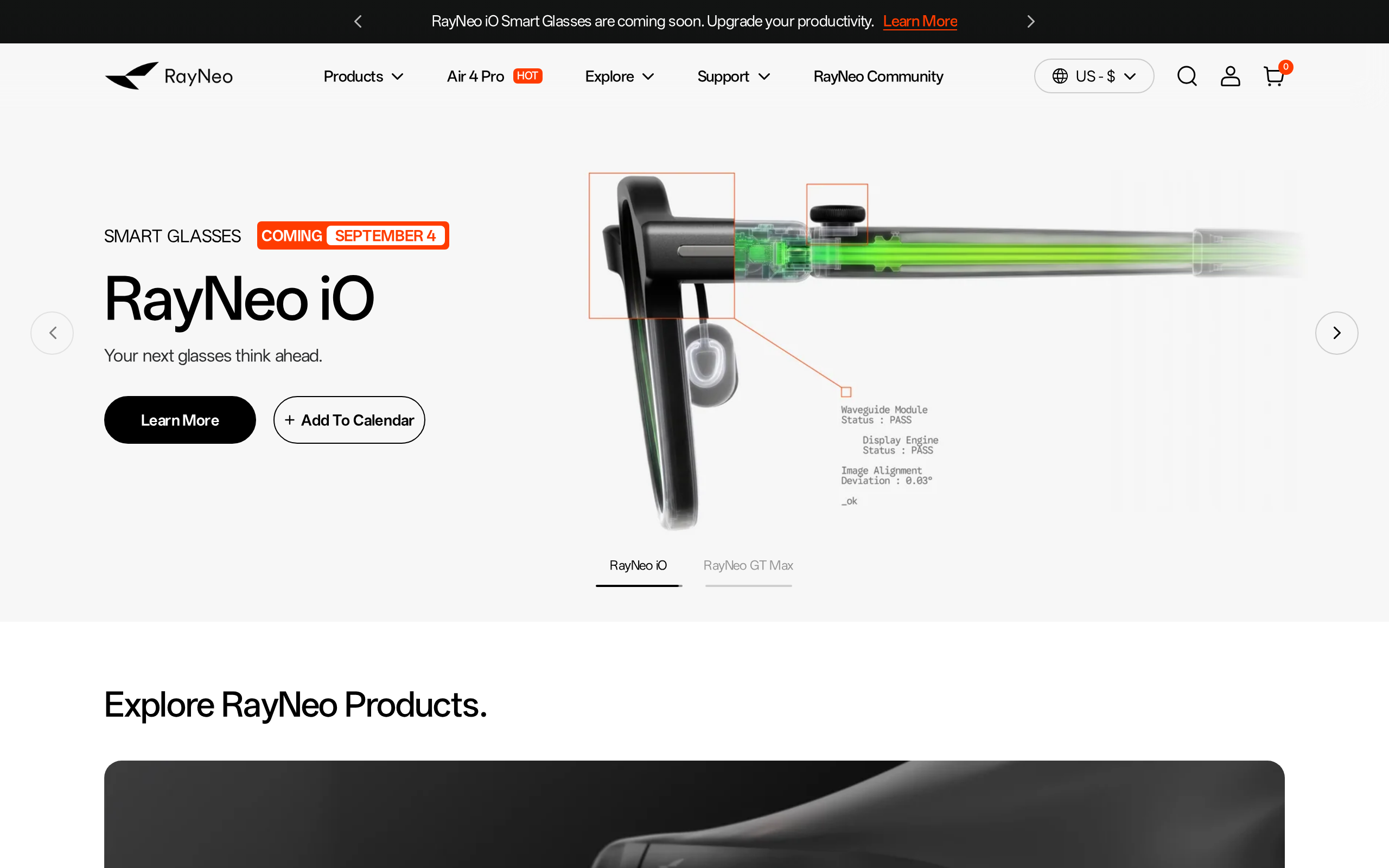
RayNeo is still investing in the larger architecture. Ifanr reported that its AI Native team has more than 40 people, with model training capabilities, focused mainly on Agent capabilities and a model for understanding the physical world. Li also named optical display technology, AI, and chips, batteries and related spatial computing technology as the core breakthroughs for fully realized smart glasses.
The display work matters, but it points to a later stage. According to 36kr, RayNeo iO's Blue Lake optical waveguide uses a three-layer optical structure and multilayer micro-nano patterns. Its OC area transmittance reaches 93%, non-display area transmittance reaches more than 98%, and color difference is Delta E 2.52. It offers an equivalent 33-inch display, 1800 nits of eye-entering brightness, full-range DC dimming, and TÜV SÜD flicker-free and low-blue-light certifications.
RayNeo's planned services underline the nearer path. 36kr says the company plans work with Alipay, JD.com, Amap, and Tongcheng on parking payment, express delivery inquiries, and flight information. Those are glanceable tasks. They are useful because they reduce steps, not because they prove the phone is gone.
Privacy design narrows the first workflow
RayNeo iO's privacy story starts with omission. According to ifanr, Li Hongwei said the glasses deliberately gave up a camera, a large chip, and an Android system so the product could focus on AI and all-day battery life. That choice makes the first workplace use case narrower, but cleaner: meetings, translation, reminders, and text prompts are easier to pilot than first-person environmental sensing.
The hardware reinforces that boundary. 36kr reports that RayNeo iO uses 4 array microphones and 1 bone-conduction microphone. It also says the OC area transmittance reaches 93%, while the non-display area reaches more than 98%. ifanr adds Li's claim that the display is close to imperceptible, with little visible rainbow pattern and high light transmittance.
That is useful, and also risky.
Glasses that look ordinary reduce social friction for the wearer, but they can also reduce the signal that a system is recording or assisting. The no-camera design helps because it removes the most sensitive class of first-person capture from the pilot. It does not remove the consent problem. Audio can still carry names, customer details, side conversations, and internal disputes.
This is where RayNeo's near-term workflow and long-term ambition pull in different directions. ifanr says Li described RayNeo's AI Native team as working on Agent capabilities and on a model whose core purpose is understanding the physical world. A model like that eventually wants richer context. The first enterprise deployments should resist that direction until the rules are boring and explicit.
Woshipm's Siyi frames the missing layer well: real business use still has unsettled questions around data cleanliness, permissions, exception handling, result acceptance standards, fallback processes, and accountability. For glasses, that means consent-heavy audio and text first. The "pause button" also has to be a real product mechanism, not a slogan: the system must stop, explain why, preserve context for handoff, and return only after handling.
When AI glasses are useful now - and when to wait
- You need low-friction capture for meetings, conversations, inspirations, prompts, reminders, or daily memory. Consider RayNeo iO-style AI glasses when the workflow benefits from something worn all day: RayNeo iO is positioned around strengthening human knowledge, expression, and memory; it has an all-day intelligent memory feature that continuously records communications and inspirations, generates a daily summary at the end of the day, and extracts key nodes from large amounts of conversation.
- Your use case depends on full AR, rich spatial computing, camera input, or Android-app migration. Do not treat this generation as a full phone replacement. RayNeo says it actively gave up using a camera, a large chip, and an Android system in order to focus on AI and all-day battery life. Its own CEO has said fully realized smart glasses still need breakthroughs in optical display technology, AI, and chips, batteries, and related spatial computing technology, and that product forms may converge in 2029 or later.
- You want a device that can be worn like ordinary glasses without obvious display artifacts. Evaluate comfort and optical subtlety before AI features. RayNeo iO is claimed to look basically no different from ordinary glasses when worn, with almost no rainbow patterns and high light transmittance; reported specifications include 34g weight, OC area transmittance of 93%, non-display area transmittance of more than 98%, and a color difference index controlled at Delta E 2.52.
- You need AI outputs to enter operational workflows, not just demos. Require review points, fallback paths, and acceptance standards. Source commentary on AI products entering real business highlights unresolved issues around data cleanliness, permissions, exception handling, result acceptance standards, fallback processes, and accountability. The same source argues that high benchmark scores do not prove stable long-term operation in open business processes.
- Your deployment requires strong on-device inference for large models within a glasses form factor. Be cautious. The sources describe a power mismatch: TC1020-class edge large model inference chips have whole-chip power consumption of 8-15W, while a 50-gram AI glasses device has an average whole-device power budget at the hundreds-of-milliwatts level. RayNeo iO initially supports DeepSeek V4 Pro and Qwen 3.7 Max, and later plans to connect to Kimi K3 and RayNeo's self-developed RayNeo AI large model, but the sources do not disclose how much inference is local versus cloud.
How to pilot AI glasses without trusting the demo
A pilot for AI glasses should start with the least glamorous question: what happens when the demo conditions disappear? Caixin reporters observed at WAIC 2026 that crowds formed around smooth robot demonstrations and left faster when accidents appeared, such as unstable gripping. An industry practitioner gave the useful warning: steady gripping may depend on fixed rack position and lighting, while real environments change.
Treat RayNeo iO the same way. Do not begin with a broad memory assistant promise. Begin with a narrow capture task, then score whether the summary is accurate enough to keep, how much users revise it, and whether they return to the feature next time. Woshipm's Siyi argues those are the right tests for expression, social, content, and companionship products; they also fit workplace memory trials.
The benchmark gap is the reason to be strict. According to the Stanford 2026 AI Index cited by woshipm, the leading Agent on OSWorld reached 66.3% accuracy, while EquAct averaged 89.4% across 18 short-horizon, controlled simulation tasks in RLBench. In the 2025 BEHAVIOR-1K long-horizon household task simulation, the leading team completed tasks at 12.4%.
That is not a ban. It is a checklist.
Before captured memory enters a workflow, test translation under poor connectivity, summary drift after long meetings, prompt timing, export format, deletion, and employer controls. Test integrations separately: RayNeo plans scenarios with Alipay, JD.com, Amap, and Tongcheng, including parking payment, express delivery inquiries, and flight information, but each handoff adds a permission boundary.
The safest pilot design includes a pause mechanism. Siyi describes this as product behavior: the system should know when not to continue, show why it stopped, preserve context for human handoff, and resume after handling. Require confirmation before irreversible or costly steps. In practice, that means no automatic external release, no silent tool call with permissions, and no accepted action item unless a person can see and correct the source memory.
Run an AI-glasses pilot like SeedMit frames early entrepreneurship: use AI analysis with human judgment to validate demand before spending more resources. Pick a narrow job where false demand is easy to expose, such as meeting capture or live translation, then check whether people trust the output enough to change their routine.
Watch the assistant layer, not the pitch deck. 36kr listed Guiji Liandong as TOP4 in Project Recommendations Weekly Ranking Issue 14 because it enters a daily outfit-decision scenario with an AI styling assistant; SeedMit was TOP5 for calibrating market opportunities. The useful signal is the same: does the device remove a frequent decision burden, or merely describe one?
For readers outside China
- Availability: RayNeo iO was officially launched on August 21 at the 2026 RayNeo AI glasses new product launch event. It is on sale from August 21 through JD.com, Tmall, Douyin, and multiple offline optical channels. The sources mention a North America's Prime Day sales title for RayNeo, but do not disclose RayNeo iO availability outside China.
- Pricing: RayNeo iO has a launch hand price starting at 1996 yuan and an official price of 2499 yuan. One source says AI glasses cost about 1500 yuan on average, but that is an author's market-level characterization, not RayNeo iO's price.
- Closest Western equivalents: Meta Ray-Ban-style smart glasses, for the idea of eyewear as an always-worn capture and assistant device rather than full AR; Plaud-style AI recording hardware, for the meeting-recording and summarization workflow; the sources say Plaud's AI recording hardware has reached annual revenue of about $250 million and cumulative sales of more than 1 million units; Early AR/viewing glasses, for lightweight optical display expectations, though the source material frames RayNeo iO specifically as AI+AR and human-augmented AI glasses
- Data residency: The source material does not disclose data residency, retention, encryption, enterprise administration, or whether RayNeo iO's memory, summaries, and model calls are processed locally or in the cloud. It does say RayNeo iO has built-in Qianwen 3.7 Max and DeepSeek V4 Pro model versions, initially supports DeepSeek V4 Pro and Qwen 3.7 Max, and later plans to connect to Kimi K3 and RayNeo's self-developed RayNeo AI large model.
Sources
- 36kr 科氪 | 你的下一副眼镜,会思考:雷鸟 iO 正式发布,首发 1996 元起 https://36kr.com/p/3950603951258756
- woshipm 2026 智能硬件浪潮深度复盘:与 2015 年的本质差异、被低估的两个约束,以及会起决定性作用的技术 https://woshipm.com/it/6452227.html
- ifanr 对话雷鸟创新李宏伟:智能眼镜的终局仍然是「AI + AR」,AI 是我们现在最重要的事丨多样性公司 https://ifanr.com/1676571
- 36kr 36氪项目推荐周榜|第14期,本期热度TOP10 https://36kr.com/p/3949071263562881
- woshipm AI产品设计新维度:给用户一个'好奇模式'开关 https://woshipm.com/share/6434060.html
- woshipm 逛完 WAIC,反而没那么焦虑了 https://woshipm.com/ai/6432916.html
The evidence: 81 facts from 6 Chinese articles
Each line below was extracted from the article it sits under, in Chinese, before any of this was written. The writing is done from these and never from the source prose - that separation is structural, not a promise. How we work.
36kr科氪 | 你的下一副眼镜,会思考:雷鸟 iO 正式发布,首发 1996 元起
- RayNeo held the 2026 RayNeo AI glasses new product launch event on August 21.
- RayNeo officially launched the RayNeo iO series on August 21.
- RayNeo iO is the first new product in the RayNeo iO series.
- RayNeo iO has a launch hand price starting at 1996 yuan.
- RayNeo iO provides myopia lens fitting options from 0 to 1000 degrees.
- The name iO comes from I/O in computer language, meaning Input & Output.
- RayNeo iO's new Blue Lake optical waveguide uses a three-layer optical structure and multilayer micro-nano patterns.
- RayNeo iO's OC area transmittance reaches 93%, and its non-display area transmittance reaches more than 98%.
- RayNeo iO's color difference index is controlled at Delta E 2.52.
- RayNeo iO provides an equivalent 33-inch display, 1800 nits of eye-entering brightness, full-range DC dimming, and TÜV SÜD flicker-free and low-blue-light certifications.
- RayNeo iO uses a lightweight magnesium-aluminum alloy front frame and double-layer titanium alloy temples.
- RayNeo iO compresses the average front-frame edge width to 2.25 millimeters, makes the thinnest part of the titanium alloy temples 1.15 millimeters, and lowers the whole-device weight to 34g.
- RayNeo plans to work with Alipay, JD.com, Amap, and Tongcheng to launch new scenarios such as parking payment, express delivery inquiries, and flight information for RayNeo iO.
- RayNeo iO supports two days of ultra-long battery life.
- RayNeo iO initially supports DeepSeek V4 Pro and Qwen 3.7 Max, and later plans to connect to Kimi K3 and RayNeo's self-developed RayNeo AI large model.
- RayNeo iO is equipped with 4 array microphones and 1 bone-conduction microphone.
- RayNeo iO's official price is 2499 yuan, and it is on sale from August 21 through JD.com, Tmall, Douyin, and multiple offline optical channels.
36kr36氪项目推荐周榜|第14期,本期热度TOP10
- 36Kr Project Recommendations Weekly Ranking Issue 14 listed Wanxun Technology as TOP1.
- Wanxun Technology focuses on a general-purpose "flexible charging" engine for energy replenishment of unmanned equipment in plateau, complex terrain, and special-operation scenarios.
- 36Kr Project Recommendations Weekly Ranking Issue 14 listed Yingheng Technology as TOP2.
- Yingheng Technology focuses on data connectivity and collaboration problems in county-level healthcare.
- 36Kr Project Recommendations Weekly Ranking Issue 14 listed BioMap as TOP3.
- BioMap continues to build in the intersection of AI and biopharmaceutical research and development.
- BioMap targets high-value areas including drug discovery, molecular design, and research-and-development efficiency improvement.
- BioMap reached a NewCo transaction with Biogend Therapeutics.
- 36Kr Project Recommendations Weekly Ranking Issue 14 listed Guiji Liandong as TOP4.
- Guiji Liandong uses an AI styling assistant to enter the outfit-decision scenario.
- 36Kr Project Recommendations Weekly Ranking Issue 14 listed SeedMit as TOP5.
- SeedMit combines AI analysis capabilities with human judgment for demand validation in the early stages of entrepreneurship.
ifanr对话雷鸟创新李宏伟:智能眼镜的终局仍然是「AI + AR」,AI 是我们现在最重要的事丨多样性公司
- RayNeo was founded in October 2021.
- RayNeo has product lines including the X series full-function smart glasses, the GT and Air series viewing glasses, the V series camera glasses, and the iO series designed for AI.
- RayNeo iO is positioned as human-augmented AI glasses.
- RayNeo iO's key AI capabilities are strengthening human knowledge, strengthening human expression, and preserving human memory.
- RayNeo iO has built-in Qianwen 3.7 Max and DeepSeek V4 Pro model versions.
- RayNeo iO's all-day intelligent memory feature continuously records users' communications and inspirations with extremely low power consumption.
- RayNeo iO generates a daily summary at the end of the day and extracts key nodes from large amounts of conversation.
- Li Hongwei is the founder and CEO of RayNeo.
- Cheng Sijie is RayNeo's AI lead.
- Li Hongwei said in 2021 he thought the smart glasses "iPhone moment" would arrive in about three to five years, around 2025.
- Li Hongwei said RayNeo defined smart glasses as AI+AR in 2021, with three scenarios: migration of smartphone scenarios, AI assistants, and integration of virtual and display.
- Li Hongwei said RayNeo currently has an AI Native team of more than 40 people with model training capabilities.
- Li Hongwei said RayNeo's AI Native team mainly works on Agent capabilities and on a model whose core purpose is understanding the physical world.
- Li Hongwei said RayNeo iO actively gave up using a camera, a large chip, and an Android system in order to focus on AI and all-day battery life.
woshipm2026 智能硬件浪潮深度复盘:与 2015 年的本质差异、被低估的两个约束,以及会起决定性作用的技术
- IDC lowered its 2026 global smartphone shipment forecast to 1.09 billion units, down 13.9% year on year.
- China's smart glasses shipments increased 77.7% year on year in 2026.
- Global AI glasses shipments increased 72% in 2026 under the Sigmaintell measurement scope.
- Global smart glasses shipments increased 130.1% year on year in Q1 2026.
- China's Ministry of Commerce data showed that online retail sales of smart glasses increased 151.7% in the first half of 2026.
- The average selling price of smartphones reached a record high of $550 in 2026, $100 higher than in 2025.
- Nearly 70 smart hardware companies in China received financing in 2014, with total financing of about $500 million.
- Jawbone's main lender BlackRock cut its valuation of Jawbone shares from $5.97 per share to less than 1 cent before Jawbone was ultimately liquidated.
- Pebble was acquired by Fitbit, and Fitbit was later acquired by Google.
- Plaud's AI recording hardware has reached annual revenue of about $250 million and cumulative sales of more than 1 million units under publicly reported figures.
- Rockchip RK1828 stacks DRAM directly on the NPU, offers 2.5GB or 5GB options, has theoretical bandwidth of about 1TB/s, and runs 3B model inference at more than 100 tokens/s.
- Rockchip RK3588 runs the same model at only more than 10 tokens/s.
- Guangyu Xinchen's TC1020 uses a 3D-stacked near-memory computing architecture, reaches 56 TOPS@INT8, and decodes 7B models at more than 200 tokens/s.
- Micron stopped a key consumer-facing business at the end of 2025 and shifted capacity to AI.
- IDC forecast that 60% of smartphone shipments in Q1 2026 would come from models priced above $800.
- TC1020-class edge large model inference chips have whole-chip power consumption of 8-15W, while a 50-gram AI glasses device has an average whole-device power budget at the hundreds-of-milliwatts level.
woshipm逛完 WAIC,反而没那么焦虑了
- WAIC 2025 had an exhibition area exceeding 100,000 square meters.
- WAIC 2025 displayed 4486 exhibits.
- Siyi visited WAIC 2025 on July 18 from after 9 a.m. to 6:30 p.m.
- Siyi works in AI and is doing FDE work.
- The Stanford 2026 AI Index reports that the leading Agent on OSWorld had an accuracy rate of 66.3%.
- The Stanford 2026 AI Index reports that the leading method EquAct had an average success rate of 89.4% across 18 short-horizon, controlled simulation tasks in RLBench.
- The Stanford 2026 AI Index reports that the leading team in the 2025 challenge had a complete task success rate of 12.4% in the BEHAVIOR-1K long-horizon household task simulation.
- Siyi saw a "Today's Life Receipt" at WAIC with the sentence "You do not have to be perfect today, but you have to start."
- Zhang Xiaolong discussed in a 2016 WeChat Open Class speech that product values affect the final product.
- MiniMax Hub's display board included the words "review and control, deliver high-quality finished videos."
- MiniMax Hub connects canvas workflows, Skills reuse, local materials, and finished video delivery.
- MiniMax Hub's official product page says the Agent asks users about core directions at key nodes and lists "merge, edit, and export" as one step in the process.
- Siyi saw a smart pharmacy display with real shelves, boxed products, and two robots at WAIC.
woshipmAI产品设计新维度:给用户一个’好奇模式’开关
- NetEase Youdao's LobsterAI booth at WAIC 2026 had a long queue.
- A technician at the NetEase Youdao LobsterAI booth asked the AI to connect to a local project and run a test script.
- A coffee AI at WAIC 2026 completed an order in three seconds after a visitor requested the same recipe again.
- The Qiyuan meeting room at WAIC 2026 featured two robots, T1 and Q1, without a fixed performance schedule.
- A visitor leaving the Qiyuan meeting room said he wanted to look again to see what the robots could still do.
- Caixin reporters observed at WAIC 2026 that crowds gathered when robot demonstrations were smooth and dispersed faster when accidents occurred, such as unstable gripping.
- An industry practitioner said a robot gripped steadily because the rack position and lighting were fixed, while those conditions can change at any time in real environments.
- At WAIC 2026, StepFun's STEPX Neo booth had a half-hour queue.
- The piece was originally published by Haqishe on 人人都是产品经理 and states that reposting without the author's permission is prohibited.