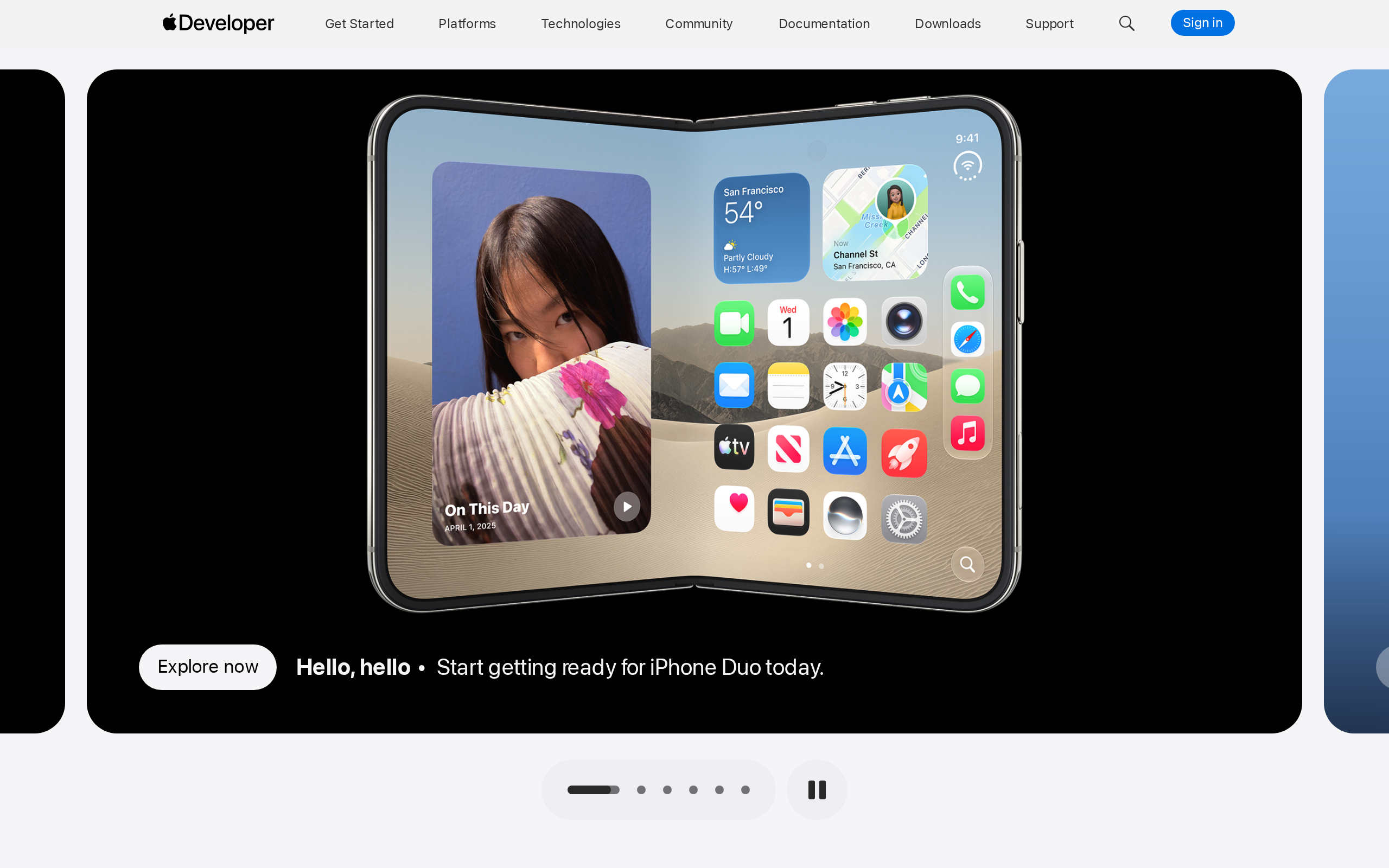
iPhone Duo puts a 5.4-inch outer display beside a 7.6-inch inner display, making the larger surface a workspace that apps must justify. ifanr reports that it can split the inner screen evenly between two apps, or between two windows from the same app, and save frequently used pairings. That makes expansion a deliberate move rather than the default cost of opening the device.
The hardware supports that restraint. sspai lists iPhone Duo at 5.2 mm unfolded and 254 g, while woshipm says battery life reaches up to 31 hours on the inner display and up to 44 hours on the outer one.
The useful question is therefore not how thin a foldable can become. It is which familiar phone tasks should remain intact on the outer display, and which interfaces can turn the inner screen into genuinely useful parallel work. iPhone Duo's split view offers a clear model, but it also raises the harder test: custom app interfaces must adapt before extra screen space can become productivity.
A foldable starts with a familiar phone
At 5.2 mm unfolded and 254 g, iPhone Duo begins by protecting the feel of a phone rather than asking users to carry a permanently tablet-like object. Its 5.4-inch outer display is the continuity surface: the place for the familiar, contained task when the device stays shut. The 7.6-inch inner display is available when a task genuinely benefits from more room.
- 2019Samsung released its first-generation Fold
- 2020Microsoft released the dual-screen Surface Duo
- September 9, 2026Apple officially launched iPhone Duo
- September 12iPhone 18 Pro models opened for pre-orders
- September 18iPhone 18 Pro models officially went on sale
- OctoberApple will ship iPhone Duo with iOS 27.1 preinstalled
That distinction also appears in battery expectations. According to woshipm, video playback can reach up to 44 hours on the outer display, compared with up to 31 hours using the inner display. The larger workspace has a cost.
The trade-off gives the folded posture a practical role, rather than treating it as a compromised waiting room before opening the device. A user can keep a single app in the outer display's conventional phone format, then open iPhone Duo for work that needs parallel views. ifanr reports that the inner display supports a 50/50 split-screen mode for two apps or two windows from the same app, and that commonly used combinations can be saved.
Split screen therefore promotes the inner panel without making it the default for every interaction. The device can remain a familiar phone for short, focused use, while its larger surface becomes a progressive workspace when simultaneous apps or windows earn the added area. That is the hardware bargain: thinness and an outer display preserve continuity; the inner display offers expansion with a measurable battery trade-off.
The screen geometry is close, not identical
The iPhone Duo is described as a conventional 5.4-inch iPhone when folded, then a 7.6-inch device when opened horizontally. woshipm compares that unfolded size with an iPad mini, while iplaysoft likewise identifies a 5.4-inch outer display and a 7.6-inch inner display. The important design signal is continuity: opening the device appears to enlarge a familiar phone-shaped workspace rather than rotate the user into a radically different, squarer tablet format.
The proportions, however, are described differently. That difference matters.
Based on publicly available resolutions, ifanr puts the outer display at about 1.46:1 and the inner display at about 1.42:1. iplaysoft states that the two displays share the same aspect ratio. These accounts can point toward the same practical idea without establishing exact geometric identity: the screens are close enough in shape that many layouts may have less dramatic reflow work when the device opens.
Close proportions do not make a larger canvas automatically appropriate. A familiar narrow layout can preserve its basic reading direction and relative component placement as it expands from 5.4 inches to 7.6 inches. Yet the added area still asks an interface to decide what deserves room. An app built around fixed-width panels, tightly positioned controls, or a composition that only works at phone scale may remain merely enlarged. The near-match in aspect ratio reduces one source of disruption; it does not determine whether the interface has a useful reason to occupy the extra display.
Expansion should reveal useful work
Arrangement Views give iPhone Duo a way to expand an existing interface rather than swap it for a tablet-sized redesign. According to ifanr, the system selects a side-by-side Split layout when space permits and an overlaid Overlay layout when it does not. The same app can therefore keep a compact path available while revealing a second pane only when the geometry can support it.
Toolbars need the same discipline. iOS 27.1 adds toolbarCompressionBehavior, letting developers choose the order in which toolbar and tab-bar controls compress as room narrows. visibilityPriority provides a related rule: lower-priority buttons can move into an Overflow Menu instead of forcing every control to remain visible. That makes expansion reversible.
More space should expose useful work, not duplicate the phone screen at a larger scale.
The posture itself can also become an input. ifanr reports that onHingeChange lets an app read the hinge angle in real time, so a layout can respond as the device opens or closes. Scene Accessories goes further by allowing different tasks on the inner and outer displays simultaneously. Those APIs make progressive expansion possible because the app can treat each display state as a distinct working condition.
External output extends that idea beyond the device. iPhone Duo includes a USB 3 10Gb/s port and supports 4K HDR output through DisplayPort. An app that has already separated its tasks across the inner and outer displays has a clearer model for deciding what belongs on an attached display, rather than treating every larger surface as the same interface stretched wider.
iPhone Duo app paths: from compatibility to posture-aware workspace
| Apps built for iOS 26 or earlier | Apps upgraded to the iOS 27 SDK | Apps built with the iOS 27.1 SDK / specifically adapted for Duo | |
|---|---|---|---|
| Inner-display use | Run only in compatibility mode and cannot fully use the larger inner display | Can reflow under the new system size rules and use most of the display | Can fill iPhone Duo's inner display |
| Visible layout treatment | Safe area with black borders | Blank space remains at the right edge of the status bar | not covered |
| Default interface behavior | not covered | Preserves a reflowed interface under new size rules | Can move top toolbars to the side and dynamically change interfaces based on hinge state |
| Space-constrained controls | not covered | not covered | toolbarCompressionBehavior sets toolbar and tab-bar compression order; visibilityPriority can move lower-priority buttons into an Overflow Menu |
| Posture and geometry support | not covered | not covered | onHingeChange reads hinge angle; Reserved Regions can query unavailable curved areas with GeometryProxy |
| Multi-display and camera capabilities | not covered | not covered | Scene Accessories can assign different tasks to inner and outer displays; CameraCaptureAccessory supports dual-screen camera experiences |
| Development support | not covered | not covered | Apple will provide a Duo simulator in iOS 27.1 and a new version of Xcode |
Compatibility mode exposes custom-interface debt
Compatibility mode makes the cost of a highly custom interface visible. According to sspai, apps built with an older SDK and left unadapted for iOS 27 appear within a safe area on iPhone Duo, surrounded by black borders. ifanr similarly says that apps built for iOS 26 or earlier can run only in compatibility mode and cannot fully use the larger inner display. The application still works, but the new workspace is effectively withheld.
Updating is not a single threshold. Apps upgraded to the iOS 27 SDK can reflow under the system's new size rules, according to ifanr. sspai says adapted iOS 27 apps use most of the display, though blank space remains at the right edge of the status bar. Only apps built with the iOS 27.1 SDK can fill the inner display. That distinction matters because a screen-filling result depends on both system rules and the SDK an app targets.
Duo-specific adaptation goes further. An app can shift a top toolbar to the side and alter its interface as hinge state changes.
That is where custom-interface debt emerges. Standard layouts can accept the system's reflow rules; bespoke navigation and fixed toolbars may need their own posture-aware redesign before the added width becomes useful. The available evidence establishes these compatibility states, but does not quantify how many real apps rely on custom navigation or toolbars. So black borders and unused space are a clear warning, not a count of the problem.
Choosing between compatibility, reflow, and a Duo-specific workspace
- Your app needs to remain usable immediately on the 5.4-inch outer display and has not been redesigned for the foldable. Preserve the conventional iPhone workflow first. Apps built for iOS 26 or earlier run in compatibility mode and cannot fully use the larger inner display, so this is a continuity path rather than a way to create a large-screen workspace.
- Your existing interface is mostly standard and can benefit from more room without inventing a separate foldable experience. Upgrade to the iOS 27 SDK and let the interface reflow under the new system size rules. Use Arrangement Views to choose side-by-side Split or overlaid Overlay layouts according to available space, and use toolbarCompressionBehavior and visibilityPriority to keep essential controls visible when space tightens.
- Two documents, two tools, or two views of the same app are routinely used together. Design around the 50/50 split-screen mode, which supports two apps or two windows of the same app, and let users save common app combinations. This is the clearest fit for the inner display's progressive-workspace role rather than treating its extra area as a merely enlarged phone screen.
- Your interface has custom top bars, posture-specific controls, or content that must account for the foldable's geometry. Build a Duo-specific adaptation. Apps specifically adapted for Duo can move top toolbars to the side and change interfaces based on hinge state; onHingeChange exposes hinge angle, while Reserved Regions displacement mode lets developers query unavailable curved areas with GeometryProxy. Without this work, even an iOS 27-adapted app retains blank space at the right edge of the status bar; only apps built with the iOS 27.1 SDK can fill the inner display.
- Your product truly has different jobs for the folded and unfolded displays, such as a camera workflow or a companion control surface. Use the dual-display APIs rather than duplicating one interface. Scene Accessories can assign different tasks to the inner and outer displays simultaneously, and CameraCaptureAccessory is provided for dual-screen camera experiences. Do not add posture-dependent behavior solely because it is available: the sources show that custom adaptation is necessary to exploit the larger display, not that every app benefits from it.
Test every posture before promising productivity
Productivity claims need a posture test before they become product promises. Apple will provide a Duo simulator in iOS 27.1 alongside a new version of Xcode. Build the first pass with standard platform components, then use that simulator to inspect the outer display, the inner display, the hinge, split-view, and external-display states.
Start with the familiar phone task on the outer screen. Open the same work on the inner screen and check what expands, what reflows, and what should stay unchanged. Exercise hinge transitions during an active task. Then test split view and an external display without assuming that more visible area automatically means more useful work.
Apple Pencil support broadens the set of tasks worth trying. The wallpaper transition on iOS 27 can make folding and unfolding feel visually continuous, according to iplaysoft.
Reserve an extra pane for work that genuinely benefits from two active apps: referring to material while writing, for example, or keeping a tool visible beside a document. The woshipm author argues that Surface Duo failed because its software ecosystem did not sufficiently support two-screen use. That is the warning behind this workflow. Battery endurance remains an unanswered question, as do App Store enforcement and the rate at which apps adapt over time. A simulator can reveal layout failures early; it cannot answer whether developers will keep earning the extra workspace.
For demanding app workflows, test sustained sessions rather than relying on a peak benchmark. Compare long-running tasks against the iPhone 17 Pro, the reference Apple uses for its performance claims.
According to ifanr, Apple attributes up to 40% higher sustained performance to the iPhone 18 Pro series, alongside 20% higher CPU performance and 40% higher GPU performance. Its packaging also provides 50% greater memory bandwidth, while the vapor chamber has three times the prior heat-dissipation area. Those figures make thermal behavior worth watching in exports, local models, and graphics-heavy tools. Build a test that keeps work running long enough to expose throttling. Also check battery assumptions: Apple claims up to 36 hours of video playback for iPhone 18 Pro and 43 hours for iPhone 18 Pro Max, with 50% charging possible in as little as 15 minutes.
For readers outside China
- Availability: The source material says iPhone Duo ships with iOS 27.1 preinstalled when it goes on sale in October, and identifies an official launch event on September 9, 2026. Availability outside China is not disclosed in sources. It is an eSIM-only device, with no physical SIM-card slot.
- Pricing: iPhone Duo starts at $2000. A mainland-China price of ¥15999 is also reported. Storage configuration for either starting price is not disclosed in sources.
- Closest Western equivalents: Samsung's Fold line: Samsung released its first-generation Fold in 2019.; Microsoft Surface Duo: Microsoft released the dual-screen Surface Duo in 2020, although its two-screen design differs from iPhone Duo's horizontally unfolding 7.6-inch inner display.
- Data residency: The source material does not cover data residency, cloud processing, regional account requirements, or where app and user data are stored.
Sources
- woshipm 苹果砍掉 Face ID 的那一刀,藏着硬件产品取舍的全部方法论 https://woshipm.com/share/6463330.html
- ifanr iPhone Duo 最惊艳的一秒,让我重新理解液态玻璃 https://ifanr.com/1679530
- ifanr iPhone 18 Pro 发布速览:「面子」变化不大,「里子」全面升级 https://ifanr.com/1679651
- iplaysoft iPhone Duo 折叠屏手机官方自带壁纸下载 / iPhone 18 + iOS27 全套新壁纸 https://iplaysoft.com/iphone-duo-wallpapers.html
- sspai iPhone 18 和 Duo 发布会上,Apple 没告诉你的那些事 https://sspai.com/post/114449
The evidence: 69 facts from 5 Chinese articles
Each line below was extracted from the article it sits under, in Chinese, before any of this was written. The writing is done from these and never from the source prose - that separation is structural, not a promise. How we work.
ifanriPhone Duo 最惊艳的一秒,让我重新理解液态玻璃
- iPhone Duo has a 5.4-inch outer display and a 7.6-inch inner display.
- iPhone Duo uses an iOS 27 layout in which the Dock is moved to the right side, the Dynamic Island is vertically arranged, and the status bar is compressed into a circular entry point in the upper-right corner.
- iPhone Duo supports a 50/50 split-screen multitasking mode for two apps or two windows of the same app, and users can save commonly used app combinations.
- iPhone Duo uses Arrangement Views, which automatically choose either a side-by-side Split layout or an overlaid Overlay layout based on available space.
- Apple will ship iPhone Duo with iOS 27.1 preinstalled when it goes on sale in October.
- iOS 27.1 adds toolbarCompressionBehavior, allowing developers to determine the compression order of toolbars and tab bars when space is limited.
- In iOS 27.1, developers can use visibilityPriority to assign display priorities to buttons, moving lower-priority buttons into an Overflow Menu when space is limited.
- Apps built for iOS 26 or earlier run on iPhone Duo only in compatibility mode and cannot fully use the larger inner display.
- Apps upgraded to the iOS 27 SDK can reflow under the new system size rules, while apps specifically adapted for Duo can move top toolbars to the side and dynamically change their interfaces based on hinge state.
- Apple will provide a Duo simulator in iOS 27.1 and a new version of Xcode.
- iPhone Duo starts at $2000.
- iOS 27.1 introduces a Reserved Regions displacement mode, through which developers can query the unavailable curved area in real time with GeometryProxy.
- Apple's Scene Accessories API allows iPhone Duo apps to assign different tasks to the inner and outer displays simultaneously.
- Apple provides CameraCaptureAccessory as a standard development capability for dual-screen camera experiences on iPhone Duo.
- Apple's onHingeChange API lets developers read the hinge angle in real time.
ifanriPhone 18 Pro 发布速览:「面子」变化不大,「里子」全面升级
- Apple launched the iPhone 18 Pro and iPhone 18 Pro Max.
- The iPhone 18 Pro starts at 256 GB and costs from 9,999 yuan in mainland China.
- The iPhone 18 Pro Max starts at 256 GB and costs from 10,999 yuan in mainland China.
- The iPhone 18 Pro and iPhone 18 Pro Max will open for pre-orders at 8 p.m. on September 12 and officially go on sale on September 18.
- The starting prices of the iPhone 18 Pro and iPhone 18 Pro Max are each 1,000 yuan higher than the previous generation's models with the same storage capacity.
- Both the iPhone 18 Pro and iPhone 18 Pro Max have a mechanically variable aperture on their main cameras.
- The iPhone 18 Pro series main camera can switch among ƒ/1.48, ƒ/1.8, ƒ/2.8, and ƒ/4.0 aperture settings.
- The iPhone 18 Pro series native camera includes a Pro mode that can manually adjust aperture, shutter speed, and white balance and uses a histogram to judge exposure.
- The iPhone 18 Pro and iPhone 18 Pro Max retain the iPhone 17 Pro series exterior design, including 6.3-inch and 6.9-inch sizes, an aluminum unibody, and a rear camera plateau.
- The iPhone 18 Pro and iPhone 18 Pro Max are available in Burgundy Red, Glacier Blue, Silver, and Black.
- The pill-shaped area of the iPhone 18 Pro series Dynamic Island is about 20% narrower than that of the previous several generations.
- The iPhone 18 Pro series can display an additional Live Activity at the top of the screen, allowing sports scores, navigation, and music information to remain visible simultaneously.
- Both iPhone 18 Pro models use Ceramic Shield 2, support up to 120 Hz ProMotion adaptive refresh rates, and have a peak display brightness of 3,000 nits.
- The iPhone 18 Pro weighs 211 g and the iPhone 18 Pro Max weighs 249 g; both phones are 8.75 mm thick.
- Compared with last year's models, the iPhone 18 Pro is 7 g heavier and the iPhone 18 Pro Max is 18 g heavier.
- The iPhone 18 Pro series uses the A20 Pro chip, which is built on TSMC's 2nm process.
- The iPhone 18 Pro series has 50% greater memory bandwidth because its chip packaging places the bare die and memory side by side.
- The new VC vapor chamber in the iPhone 18 Pro series has three times the heat-dissipation area of the previous design.
- The iPhone 18 Pro series includes Apple's self-developed C2 cellular baseband chip.
iplaysoftiPhone Duo 折叠屏手机官方自带壁纸下载 / iPhone 18 + iOS27 全套新壁纸
- Apple officially launched its first foldable smartphone, the iPhone Duo, and the iPhone 18 Pro Max series at a launch event on September 9, 2026.
- The iPhone Duo has a horizontally unfolding large-screen design with a 5.4-inch outer display and a 7.6-inch inner display when unfolded.
- The iPhone Duo's outer and inner displays have the same aspect ratio.
- The iPhone Duo is available in Night Sky and Star White.
- The iPhone Duo starts at ¥15999.
- The iPhone Duo supports Apple Pencil.
- The iPhone Duo includes official desert-and-mountain wallpapers in light and dark versions.
- The light outer-display iPhone Duo wallpaper is 1398 x 2034 px and is designed for the 5.4-inch portrait outer display.
- The dark outer-display iPhone Duo wallpaper is 1398 x 2034 px and is designed for the 5.4-inch portrait outer display.
- The light inner-display iPhone Duo wallpaper is 2670 x 1878 px and is designed for the 7.6-inch landscape inner display.
- The dark inner-display iPhone Duo wallpaper is 2670 x 1878 px and is designed for the 7.6-inch landscape inner display.
- The iPhone 18 Pro uses a new A20 Pro chip built on a 2-nanometer process.
- The iPhone 18 Pro is available in Burgundy red, Glacier blue, silver, and black.
- iOS 27 adds a new Celosia wallpaper collection with multiple color variants.
sspaiiPhone 18 和 Duo 发布会上,Apple 没告诉你的那些事
- John Ternus introduced himself as the new CEO at Apple's "Surprise and Shine" event, replacing Tim Cook as the keynote host.
- Apple's first foldable phone is named iPhone Duo.
- iPhone Duo supports stabilized time-lapse video at up to 4K Dolby Vision.
- iPhone Duo has a 48-megapixel Fusion main camera, first-generation sensor-shift optical image stabilization, and a 12-megapixel Center Stage front camera.
- iPhone Duo does not support a variable aperture, telephoto camera, LiDAR, ProRAW photos, ProRes RAW video, ACES, Apple Log 2, spatial photos, or spatial video.
- iPhone Duo is 5.2 mm thick when unfolded and weighs 254 g.
- iPhone Duo is 0.4 mm thinner than iPhone Air, while weighing 89 g more.
- iPhone Duo's USB-C port is located on the left side when the device is unfolded.
- iPhone Duo has a USB 3 10Gb/s port and supports 4K HDR output through DisplayPort.
- iPhone Duo supports eSIM only.
- iPhone 18 Pro can charge to 50% in 15 minutes with a 60W or higher charger that supports Adjustable Voltage Supply (AVS).
- iPhone Duo can charge to about 50% in 20 minutes with a 60W or higher charger and does not require AVS support.
- Apps built with an older SDK and not adapted for iOS 27 are displayed in a safe area with black borders on iPhone Duo.
- Apps adapted for iOS 27 use most of iPhone Duo's display but retain blank space at the right edge of the status bar.
- Only apps built with the iOS 27.1 SDK can fill iPhone Duo's inner display.
- The iPhone Duo slogan is "Hello, hello。" globally, without translation.
- A20 Pro is Apple's 2 nm processor, with a 6-core CPU, a 7-core GPU, and memory bandwidth 50% higher than A19 Pro.
- Chinese iPhone 18 Pro models use Apple's C2 modem, while US iPhone 18 Pro uses C2 and US iPhone 18 Pro Max uses a Qualcomm modem.
- The US iPhone 18 Pro Max has up to 45 hours of video playback, 2 hours more than the Chinese version's 43 hours.
woshipm苹果砍掉 Face ID 的那一刀,藏着硬件产品取舍的全部方法论
- Samsung released its first-generation Fold in 2019.
- Microsoft released the dual-screen Surface Duo in 2020.