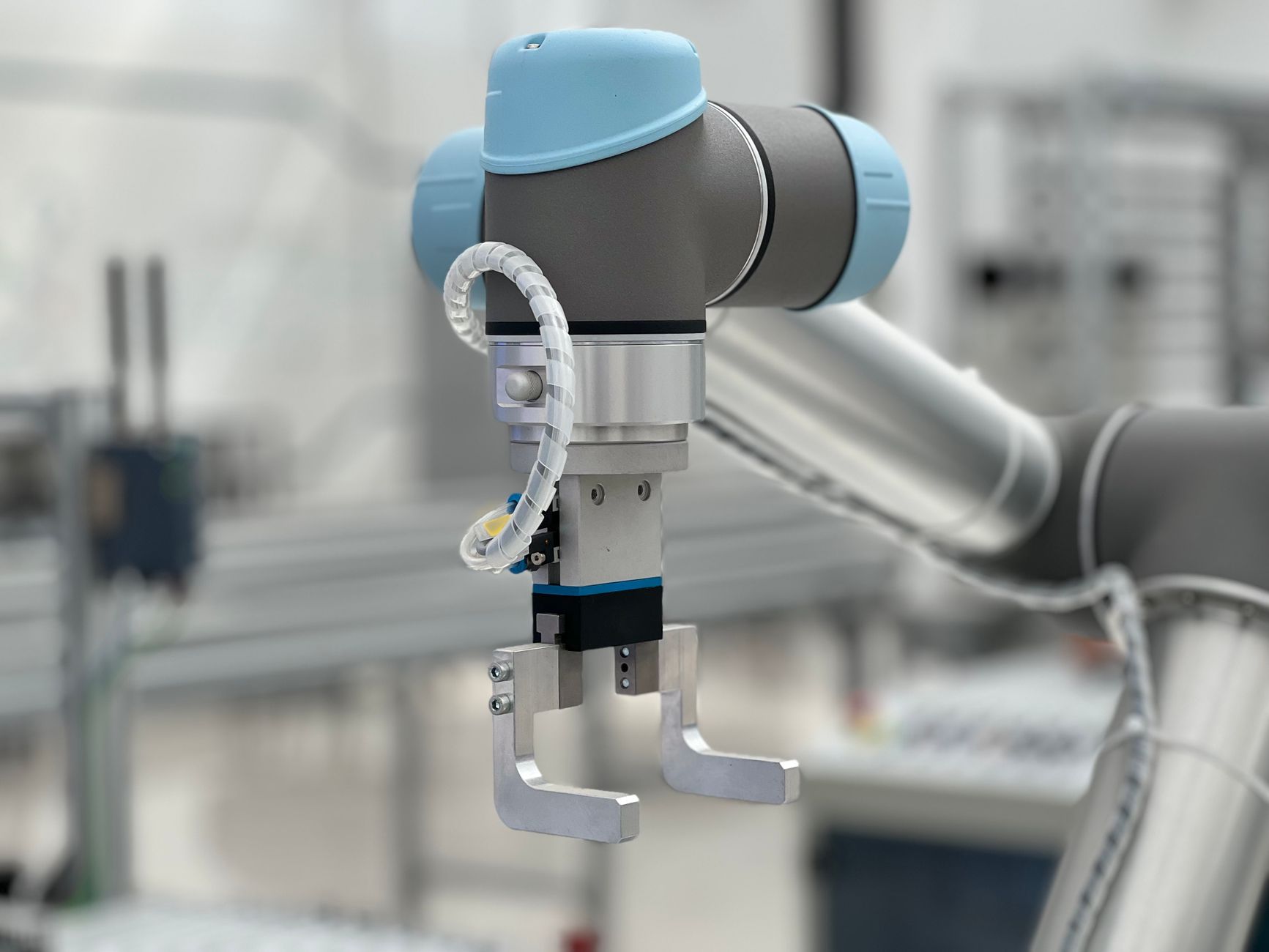
Guoao Technology's G-Tools makes the point in miniature: at the FAIR plus 2026 robotics industry chain conference, it picked up a 0.5mm needle and threaded it through a micropore. According to Chinese tech media, the system reached +/-2μm positioning accuracy and +/-0.05N force control, using a multi-degree-of-freedom motor that combines linear and rotational motion under the same mover structure.
That is not a humanoid story. It is a body chosen for the geometry of the task.
Xiankong Robot Technology shows the same logic at the opposite scale. Chinese tech media says its cable-driven robots target large spaces with heavy loads, including large workpieces, replacing rigid arm structures with parallel constraints from steel wire ropes.
The pattern is practical, not anti-humanoid. Chinese robotics coverage is circling a simpler question: what shape gives the job enough motion with the required precision, while still delivering payoff without paying for limbs the workflow never uses?
Start with task geometry, not a humanoid shape
Start with the work surface. Zibianli's parcel-sorting setup, according to ifanr, put a dual-arm robot in front of a conveyor belt and gave it standard industrial grippers. During a continuous one-hour livestream, it completed 1816 valid sorting actions. The striking part was not a humanoid trick. It was the subtraction: no legs, no fingers, just two arms meeting parcels where the conveyor already brings them.
- at the end of 2024Zibianli released WALL-A embodied foundation model
- 2025Zibianli released a five-finger dexterous hand
- April 2026Zibianli released WALL-B
- In 2026Zibianli and 58 Daojia launched home-cleaning service
That is the practical pattern.
ifanr contrasts this with Figure 03, which uses a full humanoid body and five-finger dexterous hands. Zibianli's design removed the body parts that sorting did not ask for. Public information cited for the solution says cost fell by 70% and sorting accuracy exceeded 98%. Those numbers matter because parcel sorting is a geometry problem before it is an intelligence problem: objects arrive on a belt, the target bins are known, and grippers are enough.
The same logic shows up at the opposite scale. The report describes Xiankong Robot Technology as focused on industrial spaces with heavy loads and large workpieces. Its cable-driven robots replace a rigid arm with parallel constraints from steel wire ropes, controlling rope length and tension to position an end effector across spaces exceeding 1,000 square meters. The company's lineup covers payloads from 50 kg to 5 tons.
A warehouse does not need knees if cables span the room.
In a deployed steel wire rod warehouse case cited by the report, one 3-ton robot covered a 1,200-square-meter storage area, handled stacking and inbound and outbound movement automatically, reached stacking heights of 6-8 layers, and improved space utilization by more than 200% versus forklifts. Guoao Technology makes the same point in miniature: its direct-drive multi-degree-of-freedom motor can move linearly and rotationally under one mover structure, and G-Tools passed a 0.5mm needle through a micropore with +/-2μm positioning and +/-0.05N force control.
Humanoids are shipping, but many are still bought for proof
Humanoid robots are visible because shipments are finally measurable. According to a media report, Counterpoint Research put global humanoid robot shipments above 22,000 units in the first half of 2026, up nearly 300% year on year. Kuawéi Intelligent began selling its humanoid in September last year and has shipped more than 30 units so far, with buyers including scenic-area convenience stores and government-run data collection centers.
Those orders still read more like proof than ordinary workplace replacement. Counterpoint's split is the tell: entertainment performance and data production research together accounted for more than 60% of humanoid shipments. Service guidance was about 19%. Smart manufacturing was about 13%. Warehousing logistics was about 5%. Unitree's prospectus shows the same pattern from another angle. From January to September 2025, research and education made up 73.60% of its humanoid robot revenue. Commercial consumption made up 17.39%. Industry applications made up 9.01%.
The biggest checks can also be for learning, not labor.
A Leju Robotics employee told the outlet its largest order last year was worth about 80 million to 90 million yuan and came from a robot training site buying robots for data collection. That is still a real market, but it is a market for building future capability, not necessarily one where the robot is already the cheapest body for the job.
Narrower robots show a different adoption shape. Heshi Siwei's restroom cleaning robot costs about 200,000 to 250,000 yuan. It reached 100 million yuan in sales by June this year and sold about 400 to 500 units, according to the report. Rokae sold about 15,000 robotic arms last year and 15,000 units in the first half of this year. Fairino has deployed more than 2,000 customized arms since 2024. Jack Technology bought more than 2,000 for sewing robots. Chery's robotics unit has put more than 30 traffic-directing bionic robots on roads, while Yuanshan Zhixing's walking aid is rented at scenic areas for about 90 yuan per 3 hours.
Benchmarks measure intelligence, factories expose bodies
Benchmarks are useful because they make the weakness visible before a robot touches a factory line. According to woshipm, VBench came from institutions including Nanyang Technological University S-Lab and Shanghai Artificial Intelligence Laboratory OpenGVLab, then VBench 2.0 arrived in 2025 with added checks for human fidelity. It also tested physics. Controllability was covered too. Common sense was another check. WorldModelBench, launched in 2025 by researchers from UC Berkeley, UC San Diego, NVIDIA, and MIT, goes closer to embodied AI: it covers 7 domains including robotics and industry, with 350 prompts and 67,000 human annotations.
The hard part is physics.
WorldModelBench gives physical adherence half of the total score, and its results showed the best-performing model completed instructions correctly in only 61% of videos. Another 12% violated mass conservation, while 11% showed objects passing through each other.
That does not mean benchmarks are detached from deployment. RoboTwin 2.0, led by Shanghai Jiao Tong University ScaleLab and the University of Hong Kong MMLab with Shanghai Artificial Intelligence Laboratory participation, tests 50 dual-arm collaborative manipulation tasks in SAPIEN. It supports 5 embodiments: Aloha-AgileX, ARX-X5, Piper, Franka, and UR5. Its object library has 731 instances and 147 categories, and early results showed most methods below 20% success in the Hard setting.
Factories expose a different filter. The outlet reported that Guoao Technology's robots, built around self-developed multi-degree-of-freedom motors, have been sold to Bosch in Germany and entered pre-operation on production lines of several leading manufacturers. Its products have also entered supply chains at a leading domestic chip company. GoerTek is included. Sunny Optical is included too. Li Siyang said Guoao's ZR motor improved die-bonder pick-and-place precision parameters by 3-5 times versus traditional solutions. Reliability parameters rose by 3-5 times as well. Efficiency parameters improved by 3-5 times, while whole-machine manufacturing costs fell.
The contrast matters. A model can score on prediction, but production buys motion control. It also buys payload. Precision matters, as does repeatable integration. Guoao reached mass production in mid-2025, with capacity of 1800-2000 units per month, while integrated solutions remain less than 10% of revenue.
Task-first embodiments in Chinese robotics coverage
| Dimension | Xiankong cable-driven robots | Guoao G-Tools / ZR motors | Zibianli parcel-sorting setup | Fairino / Rokae robotic arms | Tiaoyue hopcopter | Humanoid robots |
|---|---|---|---|---|---|---|
| Body choice | Steel wire ropes replace traditional rigid robotic arm structures; multiple ropes control six-degree-of-freedom positioning. | Self-developed multi-degree-of-freedom motors and dual-degree-of-freedom joints; full direct drive and no mechanical transmission. | Dual-arm robot in front of a conveyor belt with standard industrial grippers; legs and fingers removed. | Mechanical arms for manufacturers; Fairino also launched a general-purpose robotic arm supporting secondary development. | One spring leg plus a quadrotor that generates thrust. | Full humanoid bodies; Figure 03 uses a full humanoid body and five-finger dexterous hands. |
| Main job or target scenario | Large spaces, heavy loads, and large workpieces in steel, shipbuilding, aerospace, and wind power equipment scenarios. | Industrial embodied robots, die bonders, packaging and testing equipment, and high-precision manipulation. | Logistics parcel sorting with cardboard boxes, soft bags, cylindrical express parcels, and foam-packaged fresh-goods parcels. | Factory manufacturing; Jack Technology bought arms to build sewing robots. | First product targets FPV drone enthusiasts and tech toy enthusiasts; rough-terrain use is implied by the hopping-drone form but not specified in sources. | Entertainment performance, data production research, service guidance, smart manufacturing, warehousing logistics, scenic-area convenience stores, and government-run data collection centers. |
| Scale or performance evidence | A single robot can cover a maximum operating area of 1,500 square meters; product lineup covers payloads from 50 kg to 5 tons. | G-Tools picked up a thin needle with a diameter of 0.5mm and passed it through a micropore; positioning accuracy of +/-2μm and force control of +/-0.05N. | Completed 1816 valid sorting actions during a continuous one-hour livestream; short-term throughput exceeded Figure 03's 1248 items per hour benchmark by 45%. | Rokae sold about 15,000 robotic arms last year and had already sold 15,000 units in the first half of this year; Fairino has produced and deployed more than 2,000 customized robotic arms since 2024. | Current prototype can jump up to 2 meters; another prototype can continuously jump to a height of 3.6 meters by adding a motor to the leg. | Global humanoid robot shipments exceeded 22,000 units in the first half of 2026, up nearly 300% year on year. |
| ROI or cost signal | In a deployed warehouse case, one 3-ton robot covered a 1,200-square-meter storage area and improved space utilization by more than 200% compared with traditional forklift solutions. | Li Siyang said ZR motors improved precision, reliability, and efficiency by 3-5 times compared with traditional solutions while whole-machine manufacturing costs decreased. | Public information cited for the solution states that its cost decreased by 70% and sorting accuracy exceeded 98%. | Rokae prices range from 50,000 to 500,000 yuan depending on configuration and use case; Fairino's general-purpose robotic arm was priced at 23,800 yuan. | Pricing not disclosed in sources; Tiaoyue plans to first launch the first-generation hopcopter through overseas crowdfunding. | Kuawéi has shipped more than 30 units; Unitree's prospectus said industry applications accounted for 9.01% of humanoid robot revenue from January to September 2025. |
| Commercialization status | Series A financing completed; typical customers include Juli Sling, Huawei, Nanjing Iron & Steel, and Tengda Group. | A+ funding round completed; products entered Bosch, Xinyichang, Changyuan Semiconductor, Colibri Technologies, Changchuan Technology, and supply chains of a leading domestic chip company, GoerTek, and Sunny Optical. | Livestream demonstration; robot equipped with WALL-B, released in April 2026. | Rokae and Fairino have deployed large volumes; Fairino's largest recent order came from Jack Technology, which bought more than 2,000 robotic arms. | Seed funding completed; first remote-controlled hopcopter product planned for release at the end of the year. | Commercial sales and deployments exist, but shipments remain concentrated in entertainment performance and data production research, which together accounted for more than 60%. |
| What it avoids paying for | Avoids rigid-arm structure for warehouse-scale heavy-load movement. | Avoids mechanical transmission and uses motor-level precision for micron assembly. | Avoids legs and five-finger dexterous hands not needed for parcel sorting. | Avoids full humanoid bodies for factory automation tasks that arms can handle. | Avoids a conventional legged robot body by combining one spring leg with quadrotor thrust. | Pays for a general humanlike form even when sources show many current shipments going to performance, research, and data collection. |
Cheap hardware can win only when the workflow is bounded
Zibianli's sorting demo makes the cheap-body argument concrete because the body was deliberately narrow. According to ifanr, the setup removed legs and fingers that were not needed for parcel sorting, leaving two robotic arms and grippers. During a continuous one-hour livestream, it completed 1816 valid sorting actions. Public information cited for the system put the cost decrease at 70% and sorting accuracy above 98%.
The model mattered because the parcels were not uniform. ifanr described cardboard boxes, soft bags, cylindrical express parcels, plus foam-packaged fresh-goods parcels arriving with random sizes. Their weights also varied. Their orientations were random as well. Zibianli's WALL-B-equipped robot selected handling methods in real time based on parcel properties, and WALL-B, released in April 2026, uses WUM to train vision in one network alongside language. The same network also trains action prediction with physical-change prediction.
That is the optimistic version: better embodied models can make simpler machines economical.
Guoao Technology represents the harder counterargument. Some factory tasks are bounded, but the boundary is microscopic. According to the report, Guoao's multi-degree-of-freedom motor produces linear and rotational motion under the same mover structure through magnetic field changes, using full direct drive and no mechanical transmission. Its G-Tools robot, released in April 2026 as an industrial-grade embodied robot with dual-degree-of-freedom joints, picked up a 0.5mm thin needle at the FAIR plus 2026 robotics industry chain conference and passed it through a micropore.
Here, embodiment is not disposable packaging around intelligence. The report described micron-level positioning accuracy of +/-2μm and force control of +/-0.05N. Guoao built its first self-owned machining factory and assembly factory in Ganzhou in 2024, reached mass production in mid-2025, and now has capacity of 1800-2000 units per month. The debate is therefore not cheap versus advanced hardware. It is whether the workflow's errors can be absorbed by a smarter model, or whether the mechanism itself must be engineered down to the contact point.
Pick the cheapest body that solves the physical task
- You are automating very large industrial spaces with heavy payloads, such as steel wire rod warehouses, shipbuilding, aerospace, or wind power equipment. Do not start with humanoids or conventional arms. A cable-driven robot is the better-fit embodiment when the job is large-space positioning and handling: Xiankong Robot Technology's systems use steel wire ropes to achieve six-degree-of-freedom positioning in spaces exceeding 1,000 square meters, cover payloads from 50 kg to 5 tons, and a single robot can cover a maximum operating area of 1,500 square meters. In one deployed steel wire rod warehouse case, one 3-ton robot covered a 1,200-square-meter storage area and improved space utilization by more than 200% compared with traditional forklift solutions.
- You need micron-level assembly, die bonding, pick-and-place, or other compact industrial work where precision and force control matter more than humanlike form. Use specialized motors, joints, or industrial arms rather than a full humanoid. Guoao Technology's multi-degree-of-freedom motor can achieve linear and rotational motion simultaneously under the same mover structure, uses full direct drive and no mechanical transmission, and its G-Tools demonstrated picking up a thin needle with a diameter of 0.5mm and passing it through a micropore. The reported performance is micron-level positioning accuracy of +/-2μm and force control of +/-0.05N.
- You are sorting parcels on a conveyor belt and the objects vary in size, weight, orientation, and packaging type. Use two arms and industrial grippers, not legs or five-finger hands. Zibianli's livestream setup placed a dual-arm robot in front of a conveyor belt with standard industrial grippers, handled cardboard boxes, soft bags, cylindrical express parcels, and foam-packaged fresh-goods parcels, and completed 1816 valid sorting actions in a continuous one-hour livestream. Public information cited for the solution says its cost decreased by 70% and sorting accuracy exceeded 98%.
- You are buying humanoids mainly because they are visible, impressive, or useful for data collection rather than because the task requires a human body. Treat humanoids as a research, education, entertainment, or data-production purchase unless the application proves otherwise. Counterpoint Research data says entertainment performance and data production research together still accounted for more than 60% of humanoid robot shipments, while smart manufacturing accounted for about 13% and warehousing logistics about 5%. Unitree's prospectus disclosed that from January to September 2025, research and education accounted for 73.60% of its humanoid robot revenue, with industry applications at 9.01%.
- You need mobility over rough or recreational terrain, but not a full walking robot. Consider a minimal hybrid body before paying for legs. Tiaoyue Technology is developing a one-legged drone-like "hopcopter" for FPV drone enthusiasts and tech toy enthusiasts. Its current prototype can jump up to 2 meters, and the company plans to release its first remote-controlled hopcopter product at the end of the year through overseas crowdfunding.
Pilot design should compare robots against simpler fixes
A useful robot pilot should begin with a comparison group. Put the proposed robot beside forklifts. Compare it with conveyors. Test it against AMRs. Include fixture changes or software changes where they could solve the same problem. Then ask which option improves cost, uptime, maintenance load, safety exposure, and customization without adding a body the job does not need.
Xiankong Robot Technology is the clean warehouse example. According to the report, one of its robots can cover a maximum operating area of 1,500 square meters; in a deployed steel wire rod warehouse, one 3-ton robot covered 1,200 square meters, handled stacking and inbound and outbound movement automatically, reached stacking heights of 6-8 layers, and improved space utilization by more than 200% compared with traditional forklift solutions.
That is the right pilot question: not whether a robot looks advanced, but whether the cable-driven body beats the forklift in the same aisle, with the same goods, under the same uptime target.
Price bands make the same point. Rokae Robotics staff told the outlet it sold about 15,000 robotic arms last year and had already sold 15,000 units in the first half of this year, with configurations priced from 50,000 to 500,000 yuan. Fairino Robotics showed a general-purpose arm at 23,800 yuan for large-model companies and software-hardware companies that need secondary development.
Those are not the same purchase. One is an industrial equipment decision; the other can be a customization bench.
Early markets matter too. Benmo Technology's wheeled-legged delivery-box robot was built with JD.com for last-mile express delivery tests, while a military-industry customer bought six units and signed reservation contracts for following years. Different buyers prove different risks.
Tiaoyue Technology's hopcopter shows why some embodiments may need consumer-style validation before B2B proof. Geekpark says the one-spring-leg, quadrotor product is aimed first at FPV drone enthusiasts and tech toy enthusiasts, with an overseas crowdfunding launch planned. Its prototype can jump up to 2 meters, another can reach 3.6 meters with a leg motor, and the company says a 220 gram prototype carrying a 1.5 kilogram battery can keep jumping for more than 1.5 hours.
For buyers, that is promising physics, not yet a warehouse baseline.
In your own workplace, begin with the chores that already have a narrow shape. Zibianli's home route is useful because the examples are plain: folding towels, organizing tabletops, storing miscellaneous items, basic cleaning. In the 2026 service with 58 Daojia, the robot does living-room storage, shoe placement, trash removal, and table wiping while cleaners are present for about three hours.
That is the benchmark: bounded work, human backup, bookable service.
Ask vendors to show the same fit before buying the body. A 20-degree-of-freedom hand released in 2025 matters only if the task needs that hand. WALL-A, released at the end of 2024, matters only if it turns into repeatable work in nursing homes, real homes, or your site. ifanr's author frames Zibianli as a lower-cost route to sufficient physical capability; treat that as a purchasing test, not a slogan.
For readers outside China
- Availability: Most examples described here are China-market deployments or Chinese company announcements. Some sources mention overseas activity: Heshi Siwei's restroom cleaning robot also serves overseas customers, Guoao Technology's industrial robots have been sold to Germany's Bosch, and Tiaoyue Technology plans to launch its first-generation hopcopter through overseas crowdfunding. For most other products, availability outside China is not disclosed in sources.
- Pricing: Pricing is unevenly disclosed. Heshi Siwei's commercial restroom cleaning robot is priced at about 200,000 to 250,000 yuan per unit. Rokae robotic arms range from 50,000 to 500,000 yuan depending on configuration and use case. Fairino Robotics launched a general-purpose robotic arm at WRC priced at 23,800 yuan. Yuanshan Zhixing's smart walking aid is rented by scenic areas to tourists for about 90 yuan per 3 hours. A remote-control robot dog at WRC had a 200 yuan basic version and a 260 yuan version with the Doubao language model. Prices for most humanoids, cable-driven robots, Guoao's G-Tools, Zibianli's parcel-sorting system, and Tiaoyue's hopcopter are not disclosed in sources.
- Closest Western equivalents: Cable-driven industrial robots are closest to large-scale gantry automation or overhead warehouse cranes, but with robotic end-effector positioning rather than a forklift-style workflow.; Guoao's motor and G-Tools examples are closest to high-precision factory automation, semiconductor packaging equipment, and compact industrial manipulators rather than humanoid robotics.; Zibianli's parcel-sorting setup is closest to robotic parcel induction and sorting cells from logistics-automation vendors, but using an embodied model and dual arms with grippers.; Humanoid robots in these sources are closest to research platforms, demo robots, entertainment robots, and data-collection platforms rather than mature general-purpose labor replacements.; Tiaoyue's hopcopter is closest to an FPV drone or robotics hobby product, but with a spring-leg hopping mode added to flight.
- Data residency: The source material does not cover data residency, cloud hosting, telemetry, export controls, or whether robot video, sensor data, or customer operational data stays in China. For deployments involving homes, warehouses, factories, public venues, or government customers, buyers would need to ask vendors directly about data storage location, model hosting, remote access, and retention policies.
Sources
- 36kr 空间具身新品类,落地多个行业应用,这家公司A轮融资数千万丨36氪首发 https://36kr.com/p/3938721849113730
- 36kr 自研微米级工业具身机器人,已进入博世产线,「国奥科技」完成近亿元A+轮融资 | 36氪首发 https://36kr.com/p/3934853676088448
- 36kr 都是谁在买WRC上的机器人啊! https://36kr.com/p/3950374720306563
- woshipm 四张榜单,四种真相:WAIC 之后,世界模型到底该看哪个排名? https://woshipm.com/ai/6434022.html
- ifanr 具身智能迎来「DeepSeek 时刻」:国产机器人用更低成本反超 Figure AI https://ifanr.com/1675007
- geekpark 无人机加了条腿,跳出了一个新硬件品类 https://geekpark.net/news/368257
The evidence: 103 facts from 6 Chinese articles
Each line below was extracted from the article it sits under, in Chinese, before any of this was written. The writing is done from these and never from the source prose - that separation is structural, not a promise. How we work.
36kr都是谁在买WRC上的机器人啊!
- Kuawéi Intelligent's humanoid robot began sales in September last year and has shipped more than 30 units in total so far.
- Buyers of Kuawéi Intelligent's humanoid robot include scenic-area convenience stores and government-run data collection centers.
- Benmo Technology's wheeled-legged robot with a delivery box is a product developed in cooperation with JD.com to test last-mile express delivery.
- A military-industry customer bought six Benmo Technology wheeled-legged robots at one time and signed reservation contracts for the following years.
- Counterpoint Research data says global humanoid robot shipments exceeded 22,000 units in the first half of 2026, up nearly 300% year on year.
- Counterpoint Research data ranks Zhiyuan, Unitree, Galaxea AI, UBTech, and Leju among the top five humanoid robot makers by shipments, and all five are Chinese manufacturers.
- Counterpoint Research data says entertainment performance and data production research together still accounted for more than 60% of humanoid robot shipments, while service guidance accounted for about 19%, smart manufacturing about 13%, and warehousing logistics about 5%.
- Unitree's prospectus disclosed that from January to September 2025, research and education accounted for 73.60% of Unitree's humanoid robot revenue, commercial consumption accounted for 17.39%, and industry applications accounted for 9.01%.
- A Leju Robotics employee said the company's largest order last year was worth about 80 million to 90 million yuan and came from a robot training site that purchased robots for data collection.
- SONGYAN's bionic humanoid robot X-Head1 has entered mass production and sold 100 to 200 units over the past year.
- Heshi Siwei's commercial restroom cleaning robot is priced at about 200,000 to 250,000 yuan per unit and mainly targets government customers, while also serving corporate and overseas customers.
- A Heshi Siwei employee said that by June this year, the company had reached 100 million yuan in sales and sold about 400 to 500 restroom cleaning robots.
- A robotics company under Chery Automobile has deployed more than 30 bionic robots on roads in various locations to direct traffic while wearing traffic-police reflective uniforms.
- Rokae Robotics staff said Rokae sold about 15,000 robotic arms last year and had already sold 15,000 units in the first half of this year, with prices ranging from 50,000 to 500,000 yuan depending on configuration and use case.
- Fairino Robotics staff said Fairino has produced and deployed more than 2,000 customized robotic arms for manufacturers since 2024.
- Fairino Robotics launched a general-purpose robotic arm at WRC priced at 23,800 yuan, mainly for large-model companies and software-hardware companies and supporting secondary development.
- Fairino Robotics' largest recent order came from Jack Technology, which bought more than 2,000 robotic arms to build sewing robots.
- Yuanshan Zhixing's smart walking aid has been deployed at Longmen Grottoes, West Lake, Laojun Mountain, Mount Kailash, and Sanqing Mountain, where scenic areas rent it to tourists for about 90 yuan per 3 hours.
- A remote-control robot dog sold at WRC had a 200 yuan basic version and a 260 yuan version equipped with the Doubao language model for intelligent conversation, and more than 100 units were sold in two days.
36kr自研微米级工业具身机器人,已进入博世产线,「国奥科技」完成近亿元A+轮融资 | 36氪首发
- Guoao Technology recently completed an A+ funding round of nearly 100 million yuan.
- Guoao Technology's A+ funding round was invested by Shenzhen Capital Group, Cornerstone Capital, and Yueke Financial.
- Shenzhen Capital Group was also an existing investor from Guoao Technology's Series A funding round in June last year.
- Guoao Technology plans to use the A+ funding mainly for mass production of industrial embodied robots and the formation of a robotics BU.
- Guoao Technology was founded in 2019.
- Guoao Technology's industrial robots based on its self-developed multi-degree-of-freedom motors have been sold to Germany's Bosch.
- Guoao Technology's industrial robots have entered pre-operation on the production lines of several leading manufacturers.
- Guoao Technology's products have entered the supply chains of a leading domestic chip company, GoerTek, and Sunny Optical.
- Guoao Technology's multi-degree-of-freedom motor can achieve linear and rotational motion simultaneously through magnetic field changes under the same mover structure.
- Guoao Technology's multi-degree-of-freedom motor uses full direct drive and no mechanical transmission.
- Guoao Technology's ZR motor products have entered Xinyichang, a leading domestic die bonder equipment maker.
- Guoao Technology supplies ZR motors in batches to Changyuan Semiconductor, Colibri Technologies, Changchuan Technology, and several other well-known domestic packaging and testing equipment makers.
- Guoao Technology's product matrix is divided into two major segments: core components and integrated solutions.
- Guoao Technology's integrated solutions currently contribute less than 10% of overall revenue.
- At the FAIR plus 2026 robotics industry chain conference, Guoao Technology's G-Tools successfully picked up a thin needle with a diameter of 0.5mm and passed it accurately through a micropore.
- Guoao Technology's G-Tools achieved micron-level positioning accuracy of +/-2μm and high-precision force control of +/-0.05N.
- Guoao Technology built its first self-owned machining factory and assembly factory in Ganzhou in 2024.
- Guoao Technology achieved mass production in mid-2025 and currently has capacity of 1800-2000 units per month.
36kr空间具身新品类,落地多个行业应用,这家公司A轮融资数千万丨36氪首发
- Nanjing Xiankong Robot Technology Co., Ltd. recently completed a Series A financing round of tens of millions of yuan.
- Xiankong Robot Technology's Series A financing round was led by Jiangning Science and Technology Innovation Fund, with follow-on investment from existing shareholder Yunshi Capital.
- Xiankong Robot Technology plans to use its Series A financing for full-stack underlying technology iteration, product line expansion, mass production advancement, and deeper deployment in core scenarios.
- Xiankong Robot Technology was founded in Nanjing in 2023.
- Xiankong Robot Technology focuses on industrial scenarios involving large spaces, heavy loads, and large workpieces.
- Xiankong Robot Technology's cable-driven robots use parallel constraints from steel wire ropes instead of traditional rigid robotic arm structures.
- Xiankong Robot Technology's cable-driven robots control the length and tension of multiple ropes to achieve six-degree-of-freedom positioning of an end effector in spaces exceeding 1,000 square meters.
- Xiankong Robot Technology founder Yang Hai studied under Francois Pierrot, an international robotics authority and the first recipient of the French National Innovation Medal.
- Yang Hai previously led and participated in multiple major robotics research and development projects, including EU Horizon programs, at Tecnalia.
- Yang Hai previously served as Tecnalia's strategic development director for Greater China.
- China's annual wire rod output exceeds 160 million tons.
- Xiankong Robot Technology has formed a product lineup covering payloads from 50 kg to 5 tons.
- A single Xiankong Robot Technology robot can cover a maximum operating area of 1,500 square meters.
- Xiankong Robot Technology's light-load models can reach motion speeds of 4-5 meters per second.
- In a deployed steel wire rod warehouse case, one 3-ton robot covered a 1,200-square-meter storage area and achieved fully automatic stacking and inbound and outbound handling.
- In a deployed steel wire rod warehouse case, Xiankong Robot Technology's robot achieved stacking heights of 6-8 layers and improved space utilization by more than 200% compared with traditional forklift solutions.
- Xiankong Robot Technology's typical customers include Juli Sling, Huawei, Nanjing Iron & Steel, and Tengda Group.
geekpark无人机加了条腿,跳出了一个新硬件品类
- Tiaoyue Technology is developing a robot hardware product that looks like a drone with one leg.
- Tiaoyue Technology calls its new hardware category a "hopcopter" in English and "tiaoyueji" in Chinese.
- Tiaoyue Technology plans to release its first remote-controlled hopcopter product at the end of the year.
- Tiaoyue Technology's first hopcopter product targets FPV drone enthusiasts and tech toy enthusiasts.
- Tiaoyue Technology has completed a seed funding round of several million yuan.
- Tiaoyue Technology's seed funding round was exclusively invested by Inno Angel Fund.
- Tiaoyue Technology is currently conducting a new funding round.
- Wang Fang, CEO of Tiaoyue Technology, was born in 1999 and is studying for a PhD at City University of Hong Kong.
- Wang Fang founded Tiaoyue Technology with his senior lab colleague and his supervisor before completing his PhD.
- Tiaoyue Technology's hopcopter structure consists of one spring leg and a quadrotor that generates thrust.
- Tiaoyue Technology's current hopcopter prototype can jump up to 2 meters.
- Tiaoyue Technology has a prototype that can continuously jump to a height of 3.6 meters by adding a motor to the leg.
- Tiaoyue Technology plans to first launch the first-generation hopcopter through overseas crowdfunding.
ifanr具身智能迎来「DeepSeek 时刻」:国产机器人用更低成本反超 Figure AI
- Zibianli placed a dual-arm robot in front of a conveyor belt and equipped it with standard grippers commonly used in industry for a logistics parcel-sorting livestream.
- Zibianli's robot completed 1816 valid sorting actions during a continuous one-hour livestream.
- Figure 03 previously set a benchmark of 1248 items per hour during a continuous 200-hour run.
- Zibianli's short-term sorting throughput exceeded Figure 03's 1248 items per hour benchmark by 45%.
- Figure 03 uses a full humanoid body and five-finger dexterous hands.
- Zibianli's sorting setup removed legs and fingers that were not needed for sorting and used two robotic arms and grippers instead.
- The parcels in Zibianli's livestream included cardboard boxes, soft bags, cylindrical express parcels, and foam-packaged fresh-goods parcels with random sizes, weights, and orientations.
- Zibianli's robot in the livestream was equipped with the general embodied intelligence large model WALL-B.
- Zibianli released WALL-B in April 2026.
- WALL-B uses WUM, a world unified model architecture, to jointly train vision, language, action, and prediction of physical changes in one network.
- Zibianli released a five-finger dexterous hand with 20 degrees of freedom in one hand in 2025.
- Zibianli initially chose the home as its first commercialization scenario for embodied intelligence.
- Zibianli released its first-generation end-to-end embodied foundation model WALL-A at the end of 2024.
- After the release of WALL-A, Zibianli robots entered nursing homes and real homes to perform tasks including folding towels, organizing tabletops, storing miscellaneous items, and basic cleaning.
- In 2026, Zibianli and 58 Daojia launched an intelligent home-cleaning service that could be booked directly.
- In the intelligent home-cleaning service launched by Zibianli and 58 Daojia, robots and cleaners visit homes together and the robot handles domestic-service tasks including living-room storage, shoe placement, trash removal, and table wiping during a service of about three hours.
woshipm四张榜单,四种真相:WAIC 之后,世界模型到底该看哪个排名?
- WAIC 2026 had more than 300 real robot units displayed across booths of more than 200 embodied intelligence companies.
- Unitree's manned transforming mecha GD01 was displayed near the entrance of Hall H3 at the Shanghai World Expo Exhibition & Convention Center during WAIC 2026.
- VBench was launched by institutions including Nanyang Technological University S-Lab and Shanghai Artificial Intelligence Laboratory OpenGVLab.
- VBench evaluates generated videos across 16 dimensions including subject consistency, background consistency, motion smoothness, and aesthetic quality.
- VBench 2.0 was released in 2025 and expanded evaluation dimensions to include human fidelity, physics, controllability, and common sense.
- The VBench-2.0 leaderboard screenshot from July 2026 showed Veo 3 ranked first with 66.72%.
- WorldModelBench was launched in 2025 by researchers from UC Berkeley, UC San Diego, NVIDIA, and MIT.
- WorldModelBench covers 7 domains including robotics, driving, industry, and human activities, and contains 350 prompts and 67,000 human annotations.
- WorldModelBench scores models on instruction following, physical laws, and common sense, with physical adherence accounting for half of the total score.
- WorldModelBench results showed that even the best-performing model correctly completed instructions in only 61% of videos, while 12% of videos violated mass conservation and 11% showed objects penetrating each other.
- RoboTwin 2.0 was led by Shanghai Jiao Tong University ScaleLab and the University of Hong Kong MMLab, with participation from Shanghai Artificial Intelligence Laboratory.
- RoboTwin 2.0 contains 50 dual-arm collaborative manipulation tasks and runs on the SAPIEN simulator.
- RoboTwin 2.0 supports 5 dual-arm embodiments: Aloha-AgileX, ARX-X5, Piper, Franka, and UR5.
- RoboTwin 2.0 includes an object library with 731 instances and 147 categories, and tests robots in Easy and Hard environments.
- Early RoboTwin 2.0 results showed that most methods still had success rates below 20% under the Hard setting.
- Physics-IQ was jointly launched by Google DeepMind and INSAIT, and its paper was published at WACV 2026.
- Physics-IQ uses 66 real filmed physics experiments across solid mechanics, fluids, optics, thermodynamics, and magnetism, with 3 camera angles and 2 shoots per experiment, totaling 396 videos of 8 seconds each.
- In Physics-IQ, a model sees the first 3 seconds of a video and predicts what will happen in the next 5 seconds, and the prediction is compared with the real filmed continuation.
- In June 2026, the original Physics-IQ team and Anates Labs released Physics-IQ Verified, correcting labeling problems in 57.6% of samples and adopting per-sample weighted scoring.
- On April 21, 2025, Sand.ai's Magi-1 ranked first on Physics-IQ with a score of 56.0%, while Google's VideoPoet had 29.5%.