
Tencent positions WorkBuddy as an office workbench designed to break down complex tasks and execute tool calls on local files. While Microsoft 365 Copilot embeds autonomous agents directly inside Word, Excel, and PowerPoint, woshipm reports that WorkBuddy modifies local documents without uploading files to cloud storage. WPS AI takes an equally insular approach, remaining tethered inside traditional office components like documents, spreadsheets, presentations, and PDFs.
Enterprise automation is shifting away from feature sidebars inside isolated software suites. The coordination layer is moving above the operating system.
According to geekpark, corporate deployments already reflect this structural change. ShineWing Certified Public Accountants layered a unified AI platform over external tools like Tianyancha, Hithink Flush, Yidong, and Glodon to run cross-database comparisons and generate draft reports. The emerging model does not treat standard office software as an intelligent destination. Instead, it reduces desktop programs to headless execution engines governed by central chat hubs.
The desktop overlay operates outside the application window
Western productivity architectures build intelligence inside individual application windows. According to woshipm, Microsoft 365 Copilot embeds autonomous multi-step agent execution directly into Word, Excel, and PowerPoint. WPS AI follows an identical containment model, remaining embedded inside standard office components such as documents, spreadsheets, PDFs, and presentations. Both designs require users to open distinct programs before an assistant can act.
- March 2026Baidu fully launches AI office agent Baidu Dazi
- June 2026Doubao, Qianwen, and DeepSeek lead mobile AI MAUs while Ernie Bot lags
- July 2026China AI office track hits 102M MAUs as WorkBuddy records 6.582M MAU
- Around SeptemberTencent, Alibaba, ByteDance, and Baidu consolidate AI office product lines
- mid-September 2026Baidu Smart Cloud initiates industrial intelligent operating system push
The Chinese desktop overlay rejects that boundary. It sits above the operating system to orchestrate workflows across separate tools.
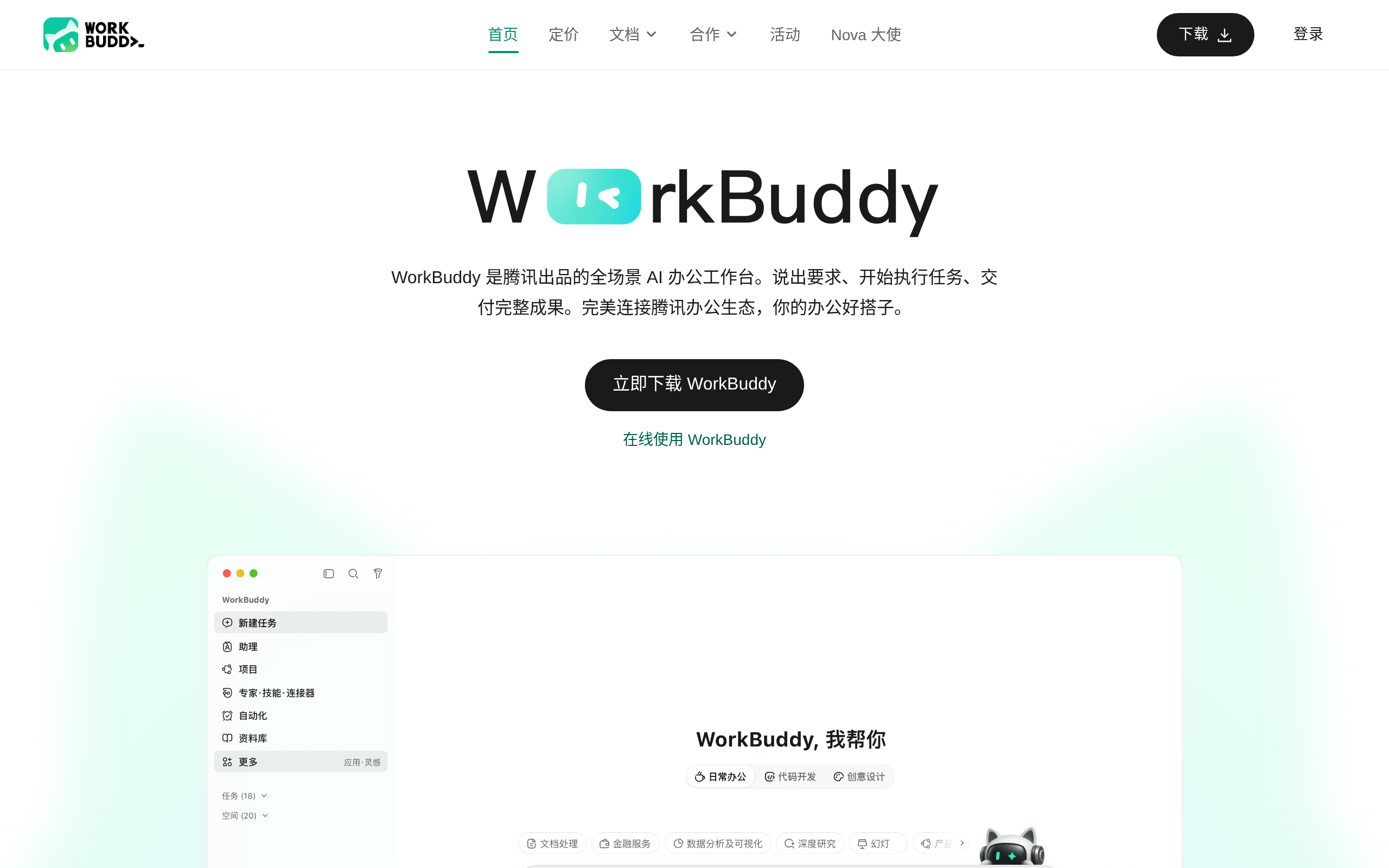
Tencent positions WorkBuddy as an all-scenario AI office workbench rather than an in-app feature. As woshipm reports, the system processes natural language, breaks down tasks, calls tools, and reads and writes local files. Unlike web-first assistants, WorkBuddy can read and modify local documents directly without uploading files to the cloud. Local inspection keeps file handling fast. By managing disk assets on the host machine, the workspace manipulates files across multiple windows without pulling each record into a dedicated editing suite.
Enterprise deployments increasingly rely on this decoupled structure. According to geekpark, ShineWing Certified Public Accountants deployed a unified AI platform over existing core business systems to automate cross-database data comparison and draft production. The setup pulls information across four separate systems: Tianyancha, Hithink Flush, Yidong, and Glodon. That automation depends on advanced reasoning capabilities. Xu Dong, Vice President of Alibaba's Qianwen LLM business, stated to geekpark that Qianwen 3.8 Max crossed production usability thresholds for complex programming alongside function calling, while meeting long-term planning requirements.
Standalone agents stall without an enterprise communication client
Baidu Dazi released 150 version updates over a five-month span starting in March. Speed did not translate into enterprise adoption. In June 2026, the top three AI-native mobile apps by monthly active users in China were Doubao, Qianwen, and DeepSeek, while Baidu's Ernie Bot ranked outside the top ten. An industrial AI researcher cited by woshipm argued that Baidu Smart Cloud's mid-September 2026 initiative to build an industrial intelligent operating system was simply a marketing concept created because Baidu could not win directly in the AI office market.
Standalone tools stall because desktop automation cannot survive outside daily messaging. An agent detached from routine workplace conversation requires deliberate context switching, and employees abandon it.
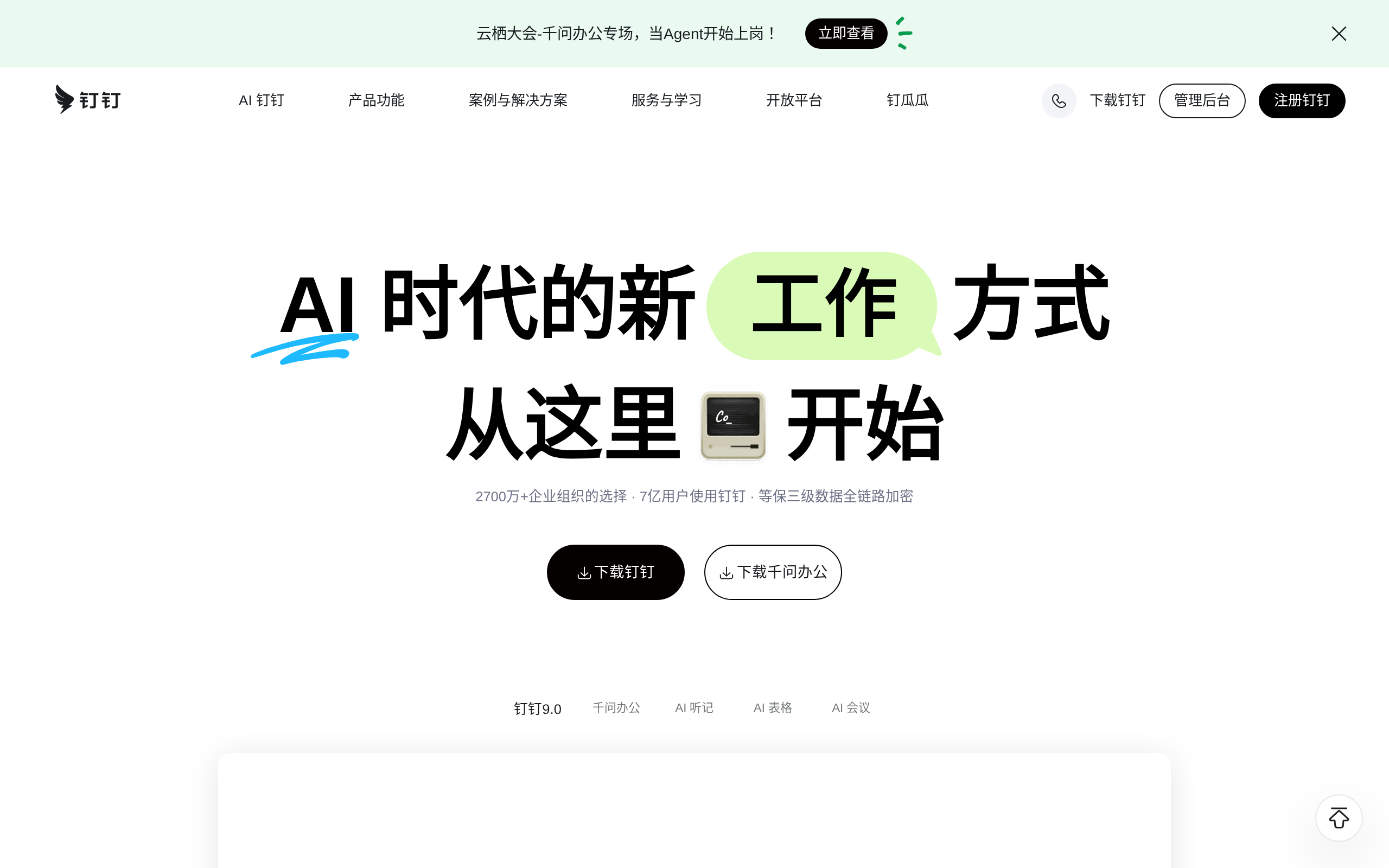
By contrast, desktop automation thrives when tied directly to reigning team clients. Scale matters here. DingTalk possesses over 200 million monthly active users, and WeCom has over 14 million enterprise accounts. TRAE Work integrates into the Feishu ecosystem, allowing users to invoke features without switching software.
Embedding agents inside existing communication channels addresses the economic hurdle of corporate adoption. Chen Yusen heads the Qianwen Office business division, having previously worked at DingTalk. According to geekpark, Chen argues that the only practical metric for an AI-native organization is how much workload is genuinely completed in a closed loop by AI. Work must finish without human intervention. Chen asserts that enterprises only commit to overhauling processes when AI increases efficiency to 3 to 5 times that of human labor.
Centralized Desktop AI Workspaces of Chinese Tech Giants
| Tencent WorkBuddy | Alibaba Qianwen Office | ByteDance Doubao Work / TRAE Work | Baidu Dazi (Dumate) | |
|---|---|---|---|---|
| Enterprise monthly subscription price | 198 yuan per month (SaaS edition) | 198 yuan per month | 990 yuan per month (Doubao Work Partner base plan; TRAE Work offers free tier) | 189 yuan per month (Enterprise edition) |
| Entrenched IM / communication anchor | WeCom (over 14 million enterprise accounts) and WeChat (750 million DAU) | DingTalk (over 200 million MAU) | Feishu (Lark) ecosystem | not disclosed in sources |
| Local file processing without cloud upload | Supported (reads and modifies local documents directly) | not covered | Supported (TRAE Work reads local files directly without uploading data) | not covered |
| Internal product consolidation | Consolidated line around September (predecessors not disclosed) | Merged QoderWork, Wukong, and MuleRun under ATH business group | Integrated Feishu (Lark), TRAE, and Coze teams directly into Doubao Work | Wenku and Netdisk spun into Personal Super Intelligence Group |
| Core architectural positioning & features | All-scenario AI workbench for task breakdown, tool calling, and local file I/O | Desktop, cloud, and team agents; Office/browser automation; up to 1M token context | Work mode (reports) and Code mode (programming); Feishu enterprise context integration | Connects enterprise knowledge, corporate systems, workflows, Search, and Wenku |
| Scale & adoption metrics | 6.582 million MAU (July 2026); 20.97 million PC visits in June | Token MaaS ARR reached 16 billion yuan (>40 billion yuan with AI Cloud) | 1.904 million MAU for TRAE Work (July 2026) | 150 version updates in 5 months; Ernie Bot outside top 10 mobile apps in June 2026 |
Incumbent software suites demote to headless execution engines
The major tech giants are not fighting each other so much as they are targeting the traditional office entry point. According to woshipm's author, Tencent, Alibaba, ByteDance, and Baidu are moving directly against territory long held by Microsoft Office and independent SaaS vendors. Entrenched file formats and enterprise purchasing contracts protect Microsoft Office and WPS from rapid displacement. Standalone tools enjoy no such defense. Instead, woshipm's author contends that discrete SaaS applications risk sinking into background APIs called by automated systems rather than remaining destinations where employees work.
Software demotion alters the structure of enterprise labor. When automated agents operate the tools, workers stop navigating software interfaces and become anchors for corporate liability.
Technical leaders tracked by geekpark describe this structural shift across corporate teams. Huoyu Lianjie CTO Lin Weicong observed that automated collaboration strips execution away from staff, leaving human workers responsible only for judgment and accountability. Gaofan Powang CTO Li Bin similarly argued that employees become responsibility nodes while agents absorb execution nodes. The boundary shifts further under PsyGo Co-CEO Zhang Wenjun's framework. Zhang Wenjun advocates assigning execution and judgment to agents, leaving managers to define the initial vision and provide final sign-offs.
This redistribution mirrors the enterprise adoption path outlined by Zhang Liang at geekpark. Organizations progress from individual tool experimentation to embedding agents in proprietary workflows. Later, companies distill professional expertise directly into cloud assets. In that environment, woshipm's author argues that platform victory depends on orchestrating complex workflows across internal systems. The winning service must capture the user's primary daily entry point, reducing traditional software suites to silent execution machinery.
Enterprise Selection Matrix for Chinese AI Office Workspaces
- Enterprise operations require strict on-device data handling where files cannot be pushed to external servers Deploy Tencent's WorkBuddy or ByteDance's TRAE Work. Both tools can read local files directly without uploading data to the cloud, with WorkBuddy explicitly supporting both local document reading and modification.
- Organizations need high-context technical workflows, long-form planning, and granular team usage governance Choose Alibaba's Qianwen Office. It runs on the Qwen3.8-Max model, accommodates context task processing up to 1 million tokens, includes browser and office automation, and provides native team quota management alongside multi-agent access controls.
- Workflows require frequent switching between software development and administrative report writing Select ByteDance's TRAE Work. It features distinct Work and Code modes that users can toggle between, and offers a free tier for individual trial use.
- Cost-sensitive deployments seeking the lowest entry price for an enterprise-tier AI workspace connected to proprietary knowledge search Opt for Baidu Dazi (Dumate). At 189 yuan per month, its enterprise edition is cheaper than Qianwen Office (198 yuan per month), WorkBuddy SaaS (198 yuan per month), and Doubao Work Partner's base plan (990 yuan per month), while directly integrating Baidu search and Baidu Wenku.
- Procurement for large-scale, customized government or public-sector projects Prioritize Alibaba (Qianwen Office) or Baidu (Dumate/Dazi) over Tencent's WorkBuddy, as source assessments note that WorkBuddy lags behind Alibaba and Baidu in delivery capacity and research experience for large customized government initiatives.
Enforcing permission boundaries and transaction safety across agent workflows
Passing context across internal applications requires strict boundaries on compute and authority. According to woshipm, Qianwen Office handles this by incorporating multi-agent and team quota management services directly into enterprise access control. Underneath sits the Qwen3.8-Max model, which supports context task processing across up to 1 million tokens. Enterprise permission boundaries remain enforceable even during massive multi-tool data ingest.
Cost determines whether these automated loops can run continuously. Cheap inference prevents iterative steps from bankrupting operations.
According to geekpark, Qianwen 3.8 Flash dropped input costs to 0.8 yuan per million tokens, pushing the comprehensive cost per enterprise-grade call below 0.2 yuan. Those economics make deep execution viable. In circuit board design, geekpark reported that Chengdu Paizi Interconnect used cloud-based multi-agent collaboration to secure over 95% accuracy in component library creation and document recognition. Paizi increased grouped processing speed by over 100 times while accelerating data upload speed by 5 times. The setup also cleared a 90% rule-layer merge resolution rate.
Commercial pipelines show similar drops in overhead. Yixiang Technology connected its Feixiang Agent to Alibaba's Qianwen and Wanxiang multimodal models to automate content pipelines for cross-border e-commerce sellers. According to geekpark, that deployment brought promotional image and video production costs down to 5 yuan per set while trimming generation time to 1 minute. Alibaba disclosed that its token-related Model-as-a-Service business achieved an annual recurring revenue of 16 billion yuan, exceeding 40 billion yuan when combined with AI Cloud.
Enterprise teams should evaluate whether software budgets fund redundant sidebars rather than system-level coordination. Stop buying AI add-ons inside separate applications. According to reports, Mengdi Wang directs the Princeton AI Acceleration Innovation Center and is developing LabOS as an intelligent operating system designed for scientific laboratories.
A parallel shift reaches physical hardware. Yujun Shen became Chief Scientist of Ant Group's Lingbo in 2024, leading the open-sourcing of multiple embodied AI models as well as the release of Full-Stack Brain 2.0.
Core engineering groups are concentrating capital directly into these control foundations. Reporting indicates that Wu Di's native 3D AI company allocates 60% to 70% of its revenue back into research and development and derives 80% of its revenue from overseas markets. Workflow design should follow the same discipline. Connect an orchestration agent directly to the team communication client to steer local files and legacy tools headlessly.
For readers outside China
- Availability: Availability outside mainland China is not disclosed in sources. The tools are structurally anchored to domestic communication and workplace ecosystems, including DingTalk, Feishu, and WeCom.
- Pricing: Sourced subscription costs include Baidu Dazi's enterprise edition at 189 yuan per month, Qianwen Office and Tencent's WorkBuddy SaaS edition at 198 yuan per month, and ByteDance's Doubao Work Partner base plan at 990 yuan per month. ByteDance's TRAE Work offers a free tier for individual users covering core features. At the underlying API level, Alibaba's Qianwen 3.8 Flash is priced at 0.8 yuan per million input tokens, bringing individual enterprise calls to under 0.2 yuan.
- Closest Western equivalents: Microsoft 365 Copilot; Microsoft Copilot Chat
- Data residency: Cross-border data residency policies and international compliance frameworks are not disclosed in sources. For localized security, both Tencent's WorkBuddy and ByteDance's TRAE Work provide on-device architecture capable of reading local files without uploading data to the cloud.
Sources
- woshipm WorkBuddy、千问办公、TRAE Work、百度搭子:四大AI办公硬碰硬 https://woshipm.com/ai/6466842.html
- woshipm 豆包大战WorkBuddy,受伤的是WPS? https://woshipm.com/ai/6464265.html
- geekpark 李彦宏的长期主义,进入回报周期 https://geekpark.net/news/371030
- 36kr 外滩大会:AI新人类,登场 https://36kr.com/p/3980309439265793
- woshipm 李彦宏的帅,救不了百度AI的火 https://woshipm.com/it/6469364.html
- geekpark 从数人头到数智能体:一场正在发生的企业生产力换血 https://geekpark.net/news/371011
The evidence: 75 facts from 6 Chinese articles
Each line below was extracted from the article it sits under, in Chinese, before any of this was written. The writing is done from these and never from the source prose - that separation is structural, not a promise. How we work.
36kr外滩大会:AI新人类,登场
- The INCLUSION Conference on the Bund included one main forum, over 40 insight forums, and more than 600 guest speakers discussing the AI economy.
- Nearly 70% of the more than 10,000 participants in the INCLUSION Conference AI Coding hackathon were under 18 years old, with the youngest participant being six years old.
- Chen Boyuan co-authored an ACL 2025 Best Paper, which was one of only four papers worldwide to receive the honor that year.
- In early 2026, undergraduate Chen Boyuan and Ji Jiaming co-founded Physis (逆矩阵科技) to develop general world foundation models.
- Nine-year-old An Ge won first prize at the INCLUSION Conference hackathon by building an interactive digital museum using ChatGPT, Kimi, Claude, and native JavaScript and Canvas without prior coding experience.
- Mengdi Wang received the Donald P. Eckman Award in 2024, an honor granted to only one recipient globally each year.
- Mengdi Wang directs the Princeton AI Acceleration Innovation Center and is developing LabOS, an intelligent operating system designed for scientific laboratories.
- Peking University assistant professor Yang Ling founded the Discovery Intelligence Group and the Gen-Verse open-source community, which has surpassed tens of millions of uses.
- Yujun Shen became Chief Scientist of Ant Group's Lingbo in 2024 and led the open-sourcing of multiple embodied AI models as well as the release of Full-Stack Brain 2.0.
- In February 2026, Huazhe Xu left Galbot to establish Poko Robotics (破壳机器人), raising nearly $100 million in a Pre-A funding round within four months.
- Jensen Huang's CES 2026 keynote presentation incorporated technology developed by Wu Di's native 3D AI company.
- Wu Di's 3D AI company derives 80% of its revenue from overseas markets and allocates 60% to 70% of its revenue back into research and development.
- Donglai Sun founded MuteVox, a wearable silencing mask company, and completed Pre-Seed and Seed financing rounds totaling millions of yuan.
- Shan Yin's AI-generated film 'Building Blocks' won Best AI Film at the 2025 Inspiring Asia festival.
geekpark李彦宏的长期主义,进入回报周期
- On September 21, Baidu founder Robin Li presented the Baidu Highest Award to two technical teams at an internal event, with each team receiving a $1 million prize.
- Baidu's Tianchi team developed the proprietary Baidu Tianchi supernode architecture targeting trillion-parameter Mixture of Experts (MoE) foundation models.
- Around 2010, the cost of an imported chip for Baidu's search server clusters reached up to tens of thousands of dollars per unit.
- Baidu's net profit exceeded 10 billion yuan for the first time in 2012.
- Baidu established the Institute of Deep Learning (IDL) in 2013, with Robin Li serving as its head.
- Baidu's chip development team, the Fairchild team, won the Baidu Highest Award in 2015.
- Baidu spent eight years from initially assembling a chip-related team to officially unveiling its first-generation Kunlun chip in 2018.
- In 2021, Baidu released its second-generation self-developed AI chip, Kunlun 2, which subsequently entered mass production.
- In 2021, Baidu spun off its chip business into the independent company Kunlunxin, reaching a post-money valuation of 13 billion yuan after its first round of financing.
- By 2024, the third-generation Kunlun chip had entered mass production, reaching a cumulative deployment scale of tens of thousands of units across industries including energy, manufacturing, transportation, finance, and internet.
- In 2025, Baidu activated China's first fully self-developed 30,000-card computing cluster.
- In early 2026, Kunlunxin submitted a confidential listing application to the Hong Kong Stock Exchange.
- In August 2026, Robin Li stated during an earnings call that Kunlunxin had completed R&D and commercialization for three generations of AI chips, and disclosed future product roadmaps for the M100 and M300 chips.
- Kunlunxin chips have been deployed in large-model computing power projects for China Merchants Bank, State Grid, and China Iron & Steel Research Institute Group.
- Established in 2010, the Baidu Highest Award has been held for 16 editions, with cumulative prize money totaling nearly 400 million yuan.
geekpark从数人头到数智能体:一场正在发生的企业生产力换血
- Alibaba disclosed that its token-related Model-as-a-Service (MaaS) business achieved an annual recurring revenue (ARR) of 16 billion yuan, and exceeded 40 billion yuan when combined with AI Cloud.
- Chen Yusen heads the Qianwen Office business division, formerly DingTalk.
- ShineWing Certified Public Accountants deployed a unified AI platform over existing core business systems to automate cross-database data comparison and draft production across systems such as Tianyancha, Hithink Flush, Yidong, and Glodon.
- Qianwen 3.8 Flash reduced input costs to 0.8 yuan per million tokens, lowering the comprehensive cost per enterprise-grade call to under 0.2 yuan.
- Yixiang Technology's Feixiang Agent connected to Alibaba's Qianwen and Wanxiang multimodal models to automate promotional content pipelines for cross-border e-commerce sellers.
woshipm李彦宏的帅,救不了百度AI的火
- In July 2026, the AI office efficiency track in China reached 102 million monthly active users, with total usage frequency increasing by 112.4% year-on-year.
- In July 2026, Tencent's WorkBuddy and QClaw recorded 6.582 million and 2.259 million monthly active users respectively, while ByteDance's TRAE Work recorded 1.904 million.
- Baidu fully launched its AI office agent Baidu Dazi (百度搭子) in March 2026.
- Baidu Dazi's enterprise edition launched at a subscription price of 189 yuan per month, compared to 198 yuan per month for Qianwen Office and Tencent's WorkBuddy SaaS edition, and 990 yuan per month for Doubao Work Partner's base plan.
- In June 2026, the top three AI-native mobile apps by monthly active users in China were Doubao, Qianwen, and DeepSeek, while Baidu's Ernie Bot ranked outside the top ten.
- Baidu's AI business generated 12.5 billion yuan in revenue in the second quarter of 2026, accounting for 50% of the company's core operating business revenue.
- In the second quarter of 2026, Baidu generated 7.3 billion yuan from AI cloud infrastructure, 2.5 billion yuan from AI applications, and 2.6 billion yuan from AI-native marketing services.
- Baidu's GPU cloud revenue grew by 283% year-on-year in the second quarter of 2026, marking four consecutive quarters of triple-digit growth.
- Baidu's AI chip subsidiary Kunlunxin submitted listing application documents to the Hong Kong Stock Exchange in January 2026.
- Baidu's autonomous ride-hailing service Apollo Go accumulated over 23 million orders by June 2026 and achieved single-city profitability in select cities.
- Baidu split its technology platform group into the Base Model Unit headed by Wu Tian and the Application Model Unit headed by Jia Lei, both reporting directly to Robin Li.
- Baidu spun Baidu Wenku and Baidu Netdisk out of the Mobile Ecosystem Group to create the Personal Super Intelligence Group, headed by Wang Ying and reporting directly to Robin Li.
- Former Fudan University MOSS model developer Sun Tianxiang joined Baidu in July 2026 to take charge of the Base Model Unit and join the Baidu Technology Strategy Committee.
- Anthropic co-founder Dario Amodei formerly worked at Baidu's Silicon Valley AI Lab.
- ByteDance reorganized its operations by integrating Feishu (Lark), TRAE, and Coze teams directly into Doubao Work.
- Alibaba merged QoderWork, Wukong, and MuleRun into a newly established Qianwen Office business department under its ATH business group.
woshipmWorkBuddy、千问办公、TRAE Work、百度搭子:四大AI办公硬碰硬
- Around September, Tencent, Alibaba, ByteDance, and Baidu completed the consolidation of their AI office product lines.
- WeCom has over 14 million enterprise accounts.
- WeChat has 750 million daily active users.
- WorkBuddy can read and modify local documents directly without uploading files to the cloud.
- DingTalk has over 200 million monthly active users.
- Alibaba formed Qianwen Office (千问办公) by merging three product lines: Wukong, QoderWork, and MuleRun.
- Qianwen Office is designed based on the Qwen3.8-Max large language model and supports context task processing of up to 1 million tokens.
- Qianwen Office provides multi-agent and team quota management services for enterprise access control.
- ByteDance's TRAE Work splits its application into a Work mode for reports and a Code mode for programming, allowing users to switch between them.
- TRAE Work can directly read local files without uploading data to the cloud.
- TRAE Work integrates into the Feishu ecosystem, allowing users to invoke features without switching software.
- TRAE Work provides a free tier for individual users that allows trial use of core features.
- Baidu Dazi (百度搭子) connects Baidu's search engine with Baidu Wenku.
- Baidu Dazi released 150 version updates over a five-month span starting in March.
woshipm豆包大战WorkBuddy,受伤的是WPS?
- Tencent has developed an AI office product called WorkBuddy.
- Alibaba has developed an AI office product called Qianwen Office (千问办公).
- ByteDance has developed an AI office product called Doubao Work (豆包工作).
- Baidu has developed an AI office product called Dumate (百度搭子).
- Tencent positions WorkBuddy as an all-scenario AI office workbench that can process natural language, break down tasks, call tools, and read and write local files.
- Alibaba's Qianwen Office (千问办公) deploys desktop agents, cloud agents, and enterprise collaboration agents while integrating Office software and browser automation capabilities.
- ByteDance's Doubao Work (豆包工作) integrates enterprise context from Feishu (Lark) to transition from content generation to task completion.
- The enterprise version of Baidu's Dumate (百度搭子) is designed to connect enterprise knowledge, corporate systems, and workflows.
- Microsoft 365 Copilot embeds autonomous multi-step agent execution directly into Word, Excel, and PowerPoint.
- Microsoft Copilot Chat functions as a unified entry point capable of generating documents, spreadsheets, presentations, and calling business agents.
- WPS AI remains embedded inside traditional office components, including documents, spreadsheets, PDFs, and presentations.