
TikTok Shop's mall captured 51.4% of attributed US GMV, ahead of short videos at 40.4% and livestreams at 8.2%. According to woshipm, livestreams' share fell from 14% one year earlier, even as creator content can retain purchase attribution when a shopper later buys through the mall tab within 14 days. The first video may create the want; the searchable shelf is increasingly where that want becomes an order.
The pattern reaches beyond TikTok Shop. geekpark puts US TikTok Shop GMV at $15.8 billion in 2025, while 36kr cites research finding that 60% of consumers with clear needs seek information on e-commerce websites. The key question is what system receives the shopper after discovery-and makes the next purchase require less new traffic.
Content creates demand, but the transaction surface captures it
Video still creates much of the first shopping interaction on TikTok Shop. woshipm assigns 40.4% of attributed United States GMV to short videos and 8.2% to livestreams, while geekpark puts short-video contribution at about 60% and livestreaming at 10%. The gap cautions against treating any single split as a complete map of shopper behavior. Both accounts still show video as a major route into commerce.
- April 2020Douyin signs Luo Yonghao for a debut sales livestream
- October 2020Douyin cuts off all third-party product links
- January 2021Douyin Pay launches for in-platform transactions, payments and logistics
- April 2021Douyin proposes interest e-commerce
- May 2022Douyin upgrades the model to all-domain interest e-commerce
The transaction is increasingly recorded elsewhere.
According to woshipm, the mall accounted for 51.4% of attributed United States GMV, ahead of short videos. That can look like evidence that shoppers are moving from feed-led impulse toward a searchable shopping surface, where an existing need can be matched with products after discovery. Broader consumer research cited by 36kr points in the same direction: 60% of respondents with clear needs sought product and service information through e-commerce websites in 2025, compared with 50% using livestream rooms or video platforms.
But attribution blurs the boundary between discovery and checkout. TikTok's creator commission system may credit a mall-tab purchase to a creator when the shopper clicked that creator's product content within the previous 14 days. Mall GMV therefore does not prove that every mall purchase began with independent search; some demand was first created by a video. The useful signal is narrower: the mall is becoming a large transaction surface after that first exposure. Livestreaming's attributed share also fell from 14% to 8.2% over one year, making the post-content path more consequential.
A shelf changes the economics of discovery commerce
Douyin's early commerce model could send demand elsewhere. In 2020, it generated more than 500 billion yuan in GMV: more than 100 billion yuan was completed through Douyin stores, while more than 300 billion yuan was redirected to Taobao and JD.com from short videos and livestreams, according to woshipm. The platform supplied discovery, but external marketplaces could own the subsequent shopping path. Beginning in October 2020, Douyin cut off all third-party product links. Douyin Pay followed in January 2021, allowing transactions and payments inside Douyin, with logistics completed there too.
The consequence was a shelf alongside the feed. Douyin's mall represented 30% of sales in the first half of 2023, woshipm reports.
That shift made repeatable shopping more significant than a single viral route to purchase. Shelf-based shopping scenarios and merchant self-operated livestreaming contributed more than 70% of Douyin e-commerce sales in 2024. GMV rose from 730 billion yuan in 2021 to 2.7 trillion yuan in 2023, about 3.5 trillion yuan in 2024, and more than 4 trillion yuan in 2025.
TikTok Shop shows why the ownership question remains unsettled for merchants. Participating stores increased from 475,000 to 1.35 million, while stores with annual GMV above $1 million rose from 752 to 5,700. Consumer Edge found TikTok Shop reached about 2% of total US online retail spending in July, up from 1.2% one year earlier. Yet 5% of buyers placing more than 20 orders per quarter produced 30% of spending. A platform-controlled shelf, checkout, and fulfillment system can concentrate valuable repeat demand; the merchant must still ask how much of that customer relationship it can retain.
How three commerce systems turn discovery into a repeatable purchase loop
| TikTok Shop in the United States | Whatnot | Douyin Life Service brand-store model | |
|---|---|---|---|
| Primary discovery surfaces | Mall accounted for 51.4% of attributed GMV; short videos accounted for 40.4%; livestreams accounted for 8.2% | Livestream auctions and specialist collecting communities | Short videos, livestreams and influencer content |
| What closes the transaction | Mall-based shopping and in-platform transactions; not covered for fulfillment specifics | Marketplace transactions; Whatnot initially required physical authentication before delivery to buyers | In-store vouchers link users to offline purchases; stores provide experience and fulfillment |
| Trust or differentiation mechanism | Creator-product content can remain attributed to a creator when a mall purchase follows a click within the previous 14 days | Specialist community focus, livestream selling and product authentication | Brand content, store experience and ongoing membership relationships |
| Evidence of repeat or retained demand | Buyers placing more than 20 orders per quarter were 5% of buyers but contributed 30% of spending | Users watch for more than 80 minutes per day on average; 62% of sellers sell exclusively on Whatnot | Staccato added more than 30,000 brand members within three months; 361 Degrees monitors voucher purchases, redemptions and subsequent purchases together |
| Role of livestreaming | Livestreams accounted for 8.2% of attributed US GMV, down from 14% one year earlier | Core operating format; more than 175,000 hours of livestreaming per week | A content and conversion surface that can drive voucher redemption and store visits |
| Operational constraint or conversion gap | Cultivating US creators was estimated to cost about seven times as much as in China; testing a creator for 100 livestreaming hours costs $12,000 to $15,000 | Not covered | Too few redemption stores and dedicated redemption software increased checkout time in the early stage of 361 Degrees' integration |
| Evidence that views alone do not determine sales | Not covered | Not covered | Staccato's top 10 videos by views contributed less than 10% of related transactions |
Whatnot closes the loop through specialist seller trust
Against TikTok Shop's centralized mall direction, Whatnot makes the seller relationship part of the transaction surface. It began as a marketplace for Funko Pop figurines, with products sent to the platform for physical authentication before buyers received them, according to geekpark. That process tied trust to a specialist category rather than to a generic feed.
The seller is part of what the buyer is choosing.
Livestreaming then gave that specialist trust a sales format. After Logan Head spent six weeks building the feature, Grant LaFontaine sold all of Whatnot's Funko Pop inventory in a first livestream auction lasting two and a half hours, generating $5,000 in sales. By 2025, geekpark reports, GMV had reached $8 billion as the assortment expanded into Pokémon cards, sports cards, sneakers, vintage clothing, designer handbags, electronics, jewelry, and fresh food.
Scale does not erase the specialist logic. Whatnot hosts more than 175,000 hours of livestreaming per week, 800 times QVC's weekly duration. ICONIQ partner Yoonkee Sull argues that consumer platforms need a small, highly active community first to establish network effects. On Whatnot, live auctions, seller knowledge, and authentication can make a buyer return to a familiar operator instead of merely seeking another entertaining video.
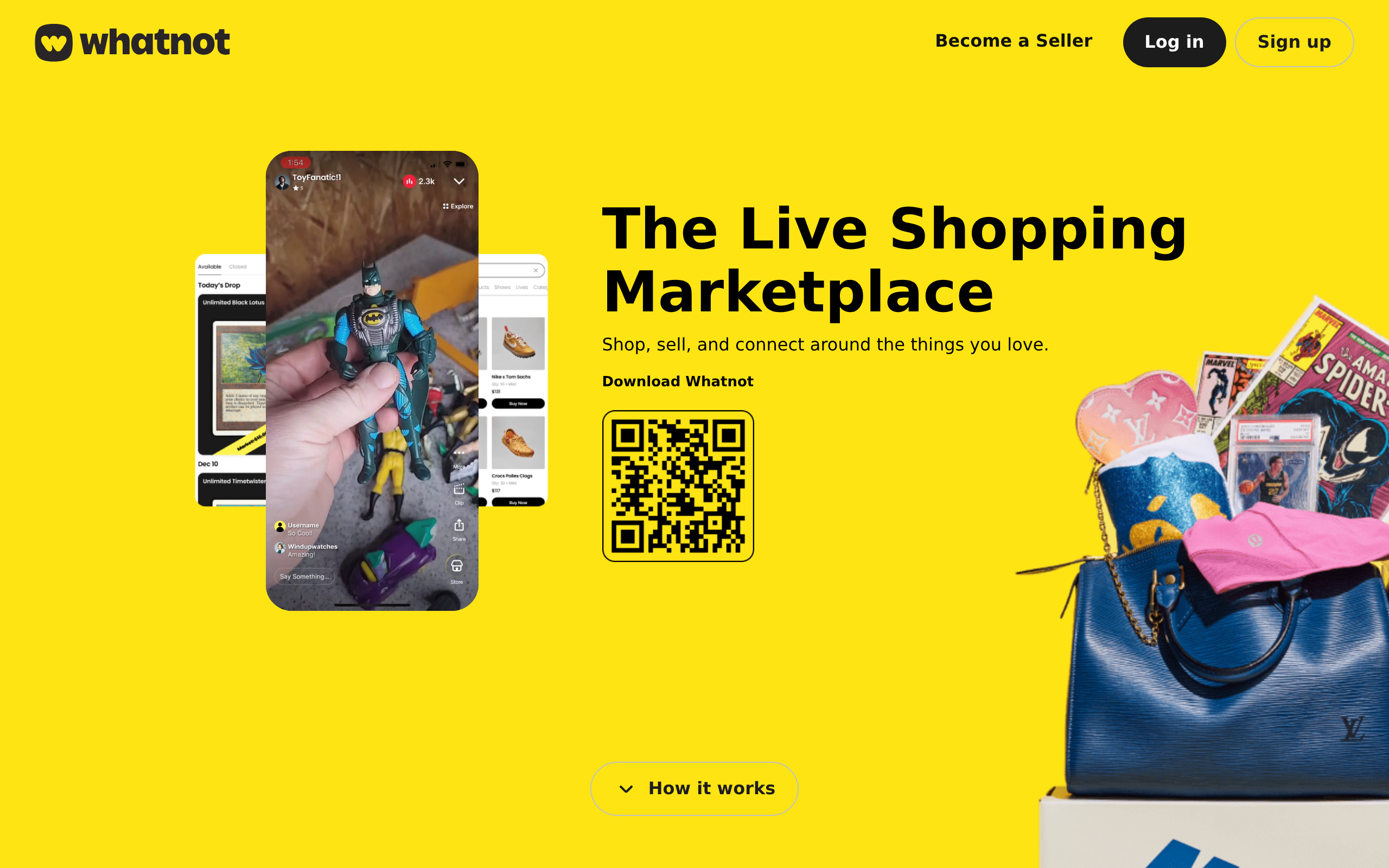
There is a cost to that concentration. geekpark reports that 62% of Whatnot sellers sell exclusively on Whatnot, making the platform a major dependency even when a seller's reputation is central to the sale. The woshipm author argues that traffic generation is becoming infrastructure, while later operations determine a customer's value. Whatnot's lesson is that views create the opening; trusted sellers and repeatable category-specific buying habits are what can close it.
Stores turn a voucher into a retained customer relationship
A marketplace checkout can end the interaction at payment. For apparel and footwear, a store can do more: let customers try products, redeem a voucher locally, and join a brand relationship that supports the next visit.
Staccato joined Douyin Life Service in April, using short videos, livestreams and influencer content around seasonal shoes, styling and collaboration collections. Its vouchers directed users to offline purchases. Within three months, the brand connected 209 stores across 65 cities, according to 36kr. Luo Zheng, Belle Group's Chief User Operations Officer, said content-influenced customers who ordered in stores accounted for 69% of Staccato's GMV.
The conversion mechanism depends on redemption being useful rather than cumbersome. Staccato lifted redemption from influencer livestreams from about 3% to more than 20% with time-limited redemption, in-store benefits and follow-up reminders. It also added more than 30,000 brand members within three months. The voucher therefore becomes a handoff: content creates intent, while the store captures identity and a reason to return.
UR has offered a voucher priced at 500 yuan for 600 yuan of in-store spending credit. 36kr reports that UR, 361 Degrees and Josiny are pursuing a model where content reaches shoppers while stores supply experience and fulfillment, then convert visits into membership relationships.
Operational gaps can break that handoff. In the early stage of 361 Degrees' integration, too few stores accepted voucher redemption, and staff needed dedicated software, lengthening checkout. The company began combining platform operations with its own membership system in the second half of 2024, tracking voucher purchases, redemptions and subsequent purchases together. That is the relevant loop: not the view, but whether redemption reliably produces a customer the brand can recognize next time.
Choose the post-discovery system, not just the traffic source
- Customers arrive with a clear product need and are likely to search rather than browse entertainment content. Invest in a searchable shelf and merchant-operated conversion path. In the United States, TikTok Shop's mall accounted for 51.4% of attributed GMV, versus 40.4% for short videos and 8.2% for livestreams; in 2024, shelf-based scenarios and merchant self-operated livestreaming contributed more than 70% of Douyin e-commerce sales. Do not make creator livestreaming the default closing mechanism for an already-intentional purchase.
- The category depends on expertise, rarity, authentication, collecting, or a highly engaged enthusiast audience. Use live commerce to build specialist trust and repeat participation, rather than treating it as generic performance advertising. Whatnot began with Funko Pop figurines and physical authentication, then expanded into categories including Pokémon cards, sports cards, sneakers, vintage clothing, designer handbags, electronics, jewelry, and fresh food. Its users watch for more than 80 minutes per day on average. This model is less appropriate when the product does not benefit from demonstration, community, or seller credibility.
- A brand has physical stores that can provide product experience and fulfill an online-generated visit. Use content and vouchers to route demand into stores, but connect redemption to membership and subsequent-purchase operations. Staccato connected 209 stores in 65 cities nationwide within three months of joining Douyin Life Service, and added more than 30,000 brand members. 361 Degrees began monitoring voucher purchases, redemptions, and subsequent purchases together in the second half of 2024. Do not launch vouchers before stores can redeem them smoothly: 361 Degrees initially had too few eligible stores and required staff to use dedicated software, increasing checkout time.
- The initial offer is low-priced or high-frequency and can introduce customers to a wider service relationship. Treat the first transaction as entry into a retained customer system, not as the full economic outcome. The source material identifies car washing as a low-ticket, high-frequency automotive aftermarket service that may occur once or even several times a month, and argues that such products can be valuable because they bring users into a broader service system. This approach is weak if the business has no credible next service, membership benefit, or repeat-use path.
- A team is considering spending heavily on creators or optimizing for views alone. Measure the downstream purchase path and repeat behavior before scaling content spend. Staccato's top 10 videos by views contributed less than 10% of related transactions, while its influencer-livestream voucher redemption rose from about 3% to more than 20% after time-limited redemption, in-store benefits, and follow-up reminders. In the United States, testing a creator for 100 livestreaming hours was estimated at $12,000 to $15,000, so creator activity should be justified by a working conversion and retention system rather than reach alone.
Measure the system after the first click
Map the journey after the first click as separate measurements: reach, transaction conversion, voucher redemption, repeat purchase, attachment to further products, and customer ownership. A large audience can be useful while contributing little to checkout. 36kr reports that Staccato's top 10 videos by views produced less than 10% of related transactions.
That gap changes what a dashboard should ask. Track which creators generate paid orders rather than views alone, then compare discount use with redemption and later purchases. Attribute fulfillment failures to the traffic source and store capacity that received the order. The cost of experimentation belongs in the same view: an industry practitioner cited by woshipm estimated US creator cultivation at about seven times China's cost, while testing a creator for 100 livestreaming hours costs $12,000 to $15,000.
Measure attachment across transaction types, too. According to 36kr, merchants operating both products and vouchers represented only 7% of merchants, yet contributed 64% of transaction value and achieved incremental growth three times that of a single operating model. That does not make the model automatic. It signals that the post-discovery path can matter more than the initial format.
Operational capacity is the constraint behind every attractive traffic chart. The woshipm author argues that traffic outruns a business's ability to serve it, problems accelerate with scale. Standardized products, training, and service SOPs can reduce dependence on particular staff members. Procurement scale may lower supply-chain costs, while stronger brands may lower acquisition costs. Technology earns its place only when it amplifies that viable system, rather than extending a temporary traffic advantage.
Audit the system after discovery. Ask why customers return, then test whether supply can be replicated without each new store adding equivalent operating work. If staffing rises eightfold between 100 stores and 1,000 stores, growth has not produced the scale effect woshipm describes.
Use low-price, high-frequency services as an entry point only when they lead into a broader relationship. Car washing can recur once or several times a month; its value may lie in bringing customers toward other automotive services. Track that movement.
AI can compress editor training from several months to several hours and let a few people produce content once handled by dozens. Treat that capacity as an amplifier. The test is whether lower acquisition costs, procurement advantages, and repeat demand make each added store lighter to operate-not merely louder.
For readers outside China
- Availability: TikTok Shop officially launched in the United States in September 2023. Whatnot operates in North America and Europe according to a source claim about its market position. The source material does not say whether Douyin Life Service, Douyin Store, or the Chinese brand joint-operation model is available outside China.
- Pricing: The only consumer offer specified is a UR voucher allowing consumers to pay 500 yuan for 600 yuan of in-store spending credit. A practitioner estimated that testing a US creator for 100 livestreaming hours costs $12,000 to $15,000. Platform fees, merchant software costs, voucher subsidies, and Whatnot pricing are not disclosed in sources.
- Closest Western equivalents: TikTok Shop in the United States for content-led discovery combined with an in-platform shopping destination.; Whatnot for livestream-led specialist marketplaces built around collecting, authentication, sellers, and community.; QVC as a broadcast-shopping reference point, though Whatnot hosts more than 175,000 hours of livestreaming per week, 800 times QVC's weekly livestreaming duration.
- Data residency: The source material does not cover data residency, cross-border data transfers, hosting locations, or privacy compliance for TikTok Shop, Douyin, Douyin Life Service, or Whatnot.
Sources
- geekpark 美国本土直播带货,长出一头 200 亿美元「巨兽」 https://geekpark.net/news/368627
- woshipm 5年1万家店,我总结了5条本地生活经营逻辑 https://woshipm.com/operate/6466346.html
- 36kr 服饰门店打破传统,线上引流到店成新的增长点 https://36kr.com/p/3975856234082563
- woshipm 半年卖了118亿美元,TikTok正在美国再造"抖音电商" https://woshipm.com/operate/6466753.html
The evidence: 58 facts from 4 Chinese articles
Each line below was extracted from the article it sits under, in Chinese, before any of this was written. The writing is done from these and never from the source prose - that separation is structural, not a promise. How we work.
36kr服饰门店打破传统,线上引流到店成新的增长点
- In April, Staccato joined Douyin Life Service and used short videos, livestreams and influencer content to showcase seasonal shoes, outfit styling and collaboration collections, with in-store vouchers linking users to offline purchases.
- Within three months of joining Douyin Life Service, Staccato connected 209 stores in 65 cities nationwide to the service.
- Accenture consumer research found that in 2025, 60% of respondents with clear shopping needs sought product and service information through e-commerce websites.
- Accenture consumer research found that 50% of respondents with clear shopping needs obtained information through livestream rooms or video platforms such as Douyin, Kuaishou and Bilibili in 2025, up from 22% in 2021.
- Accenture consumer research found that the share of respondents choosing to visit shopping malls or stores for an experience fell from 48% to 38%.
- National Bureau of Statistics data showed that in 2025, retail sales of clothing, footwear, hats and textiles by enterprises above the designated size grew 3.2%.
- National Bureau of Statistics data showed that online retail sales of apparel products within physical goods grew 1.9% in 2025.
- Luo Zheng, Chief User Operations Officer of Belle Group, said that GMV from Staccato customers who placed orders in stores after being influenced by content accounted for 69%.
- When Josiny launched its Shanye Series, it combined an online debut with a 'one-day store manager' event at a Wuhan store.
- UR initially tested in-store vouchers in Shanghai, Guangzhou and other regions before gradually expanding coverage.
- UR has offered a voucher allowing consumers to pay 500 yuan for 600 yuan of in-store spending credit.
- Staccato added more than 30,000 brand members within three months of joining Douyin Life Service.
- 361 Degrees began integrating platform operations with its own membership system in the second half of 2024, monitoring voucher purchases, redemptions and subsequent purchases together.
- Staccato data showed that its top 10 videos by views contributed less than 10% of related transactions.
- At the early stage of 361 Degrees' related business integration, too few stores were open for voucher redemption, and staff had to use dedicated software to complete redemptions, increasing checkout time.
- Staccato raised the redemption rate from influencer livestreams from about 3% to more than 20% through measures including time-limited redemption, in-store benefits and follow-up reminders.
- Douyin Life Service disclosed that more than 250 brands participated in its brand joint-operation model over the past year, covering more than 30,000 channel stores, with related transaction value rising more than 500% year on year per month.
- Douyin Life Service data showed that merchants operating both products and vouchers accounted for only 7% of merchants but contributed 64% of transaction value, with incremental growth three times that of a single operating model.
geekpark美国本土直播带货,长出一头 200 亿美元「巨兽」
- Whatnot completed a $545 million Series G financing round at a $20 billion valuation.
- Whatnot users watch for more than 80 minutes per day on average.
- Grant LaFontaine and Logan Head registered Whatnot in Los Angeles in late 2019.
- Before founding Whatnot, Grant LaFontaine was a product manager at Facebook and YouTube, and Logan Head was a senior product manager at sneaker-trading platform GOAT.
- Whatnot initially operated as an online marketplace focused on Funko Pop figurines and required products to be sent to the platform for physical authentication before delivery to buyers.
- Whatnot participated in Y Combinator's winter batch in early 2020.
- After Logan Head spent six weeks developing a livestreaming feature, Grant LaFontaine sold all of Whatnot's Funko Pop inventory in a first livestream auction lasting two and a half hours and generating $5,000 in sales.
- Whatnot's GMV grew 20-fold in 2021.
- By 2025, Whatnot's GMV had reached $8 billion and its product categories included Pokémon cards, sports cards, sneakers, vintage clothing, designer handbags, electronics, jewelry, and fresh food.
- In February 2025, golf-equipment seller Clinton Benninghoff sold more than $100,000 of golf equipment during a six-hour livestream, setting a Whatnot record for the golf category.
- Dakota Peters generated more than $1 million in transaction volume from her Whatnot account in her first year, and her company Achickrips now has weekly GMV exceeding $1 million.
- Short videos contribute about 60% of US TikTok Shop GMV, while livestreaming contributes 10%.
- Whatnot hosts more than 175,000 hours of livestreaming per week, 800 times QVC's weekly livestreaming duration.
- 62% of Whatnot sellers sell exclusively on Whatnot.
- China's livestream e-commerce GMV exceeded 4.5 trillion yuan in 2024, accounting for nearly one-third of online retail sales.
- Whatnot CEO Grant LaFontaine said he would prefer to keep the company private for as long as possible, while preparing for an eventual IPO if circumstances change.
woshipm半年卖了118亿美元,TikTok正在美国再造“抖音电商”
- Momentum Works and Tabcut estimated that TikTok Shop's US gross merchandise value reached about $11.8 billion in the first half of 2026, up 103% year on year.
- TikTok Shop's global gross merchandise value totaled $50.3 billion in the first half of 2026, up 92% year on year.
- The United States overtook Indonesia to become TikTok Shop's largest single market in the first half of 2026.
- eMarketer projected that TikTok Shop's US full-year 2026 GMV would be about $23.4 billion, up 48% year on year and equal to 1.7% of the US e-commerce market.
- TikTok Shop officially launched in the United States in September 2023.
- In the United States, TikTok Shop's mall accounted for 51.4% of attributed GMV, short videos accounted for 40.4%, and livestreams accounted for 8.2%.
- Douyin e-commerce generated more than 500 billion yuan in GMV in 2020, including more than 100 billion yuan completed through Douyin stores and more than 300 billion yuan redirected to Taobao and JD.com through short videos and livestreams.
- Douyin signed Luo Yonghao in April 2020, and his debut livestream generated more than 110 million yuan in sales in more than three hours and received 48 million cumulative views.
- ByteDance established a first-level business unit named for e-commerce and launched Douyin Store two months after April 2020.
- Douyin cut off all third-party product links beginning in October 2020.
- Douyin Pay launched in January 2021, enabling transactions, payments and logistics to be completed within Douyin.
- Douyin proposed the concept of interest e-commerce in April 2021 and upgraded it to all-domain interest e-commerce in May 2022.
- Douyin's mall sales accounted for 30% of sales in the first half of 2023.
- Shelf-based shopping scenarios and merchant self-operated livestreaming contributed more than 70% of Douyin e-commerce sales in 2024.
- Douyin e-commerce GMV rose from 730 billion yuan in 2021 to 2.7 trillion yuan in 2023, about 3.5 trillion yuan in 2024, and more than 4 trillion yuan in 2025.
- The number of stores participating in TikTok Shop increased from 475,000 to 1.35 million, while the number of stores with annual GMV above $1 million rose from 752 to 5,700.
- The number of TikTok Shop stores with annual GMV above $10 million rose from 36 to 506, and two stores each sold more than $100 million in the first half of the year.
- The number of creators participating in TikTok Shop product sales increased from 15.3 million to 20 million.
- TikTok Shop livestreams accounted for 8.2% of attributed US GMV, down from 14% one year earlier.
- TikTok's creator commission system may continue to attribute a purchase made through the mall tab to a creator if the user clicked that creator's product content within the previous 14 days.
- Consumer Edge found that TikTok Shop accounted for about 2% of total US online retail spending in July, up from 1.2% one year earlier.
- Buyers who place more than 20 orders per quarter account for 5% of TikTok Shop buyers but contribute 30% of spending.
- TikTok disclosed in June 2025 that its US site had more than 171,000 local and small businesses, and sales flowing to US small businesses rose 70% year on year over the previous year.
woshipm5年1万家店,我总结了5条本地生活经营逻辑
- The woshipm author has operated four directly owned stores this year.