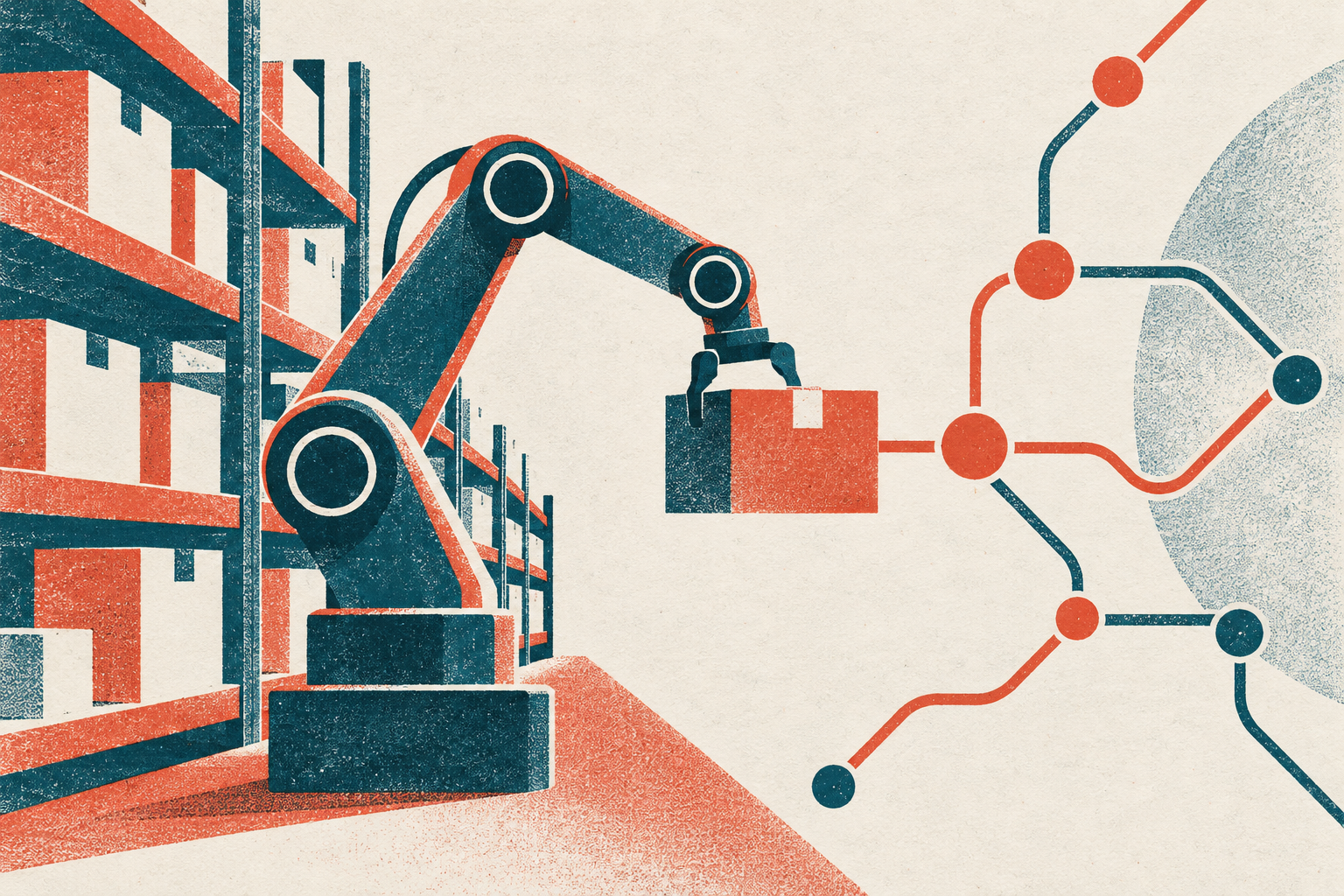
JD AI Shopping, JD.com's standalone conversational app, puts the question plainly: can AI own a customer's goal rather than merely assist inside a screen? According to geekpark, Chen Yu's team built it as a native shopping experience based entirely on conversation, while also placing AI into the established shopping flow through search intent enhancement, recommendations, and a scenario prompt above the cart. A full pilot showed the limit: conversation fits complex product-selection consultations, not every shopping situation.
That distinction is the useful one. woshipm's author argues that the dividing line is not the presence of AI, but completion of a complete, high-value task; Zeng Ming frames an Agent as a system that can pursue a goal without step-by-step human direction. The harder work begins after the model responds: redesigning the workflow, linking decisions to execution, and assigning responsibility when the system cannot finish the job.
A copilot is not an outcome owner
A copilot improves a moment inside an existing product: it helps interpret a query, surfaces relevant information, or offers a prompt. An Agent has a different contract. According to woshipm's account of Zeng Ming's argument, it is defined by its ability to pursue a goal and finish the associated task without requiring step-by-step human direction. The unit of value is therefore not a better screen interaction, but completion of a complex, high-value job.
- September of the previous yearJD Logistics releases Super Brain 2.0 and the Yilang robotic-arm system
- JulyJD Logistics is announced as a Global Digital Economy Lighthouse case
- August 26JD.com and a school launch the JDXplorers-Future Youth AI Explorers Program
That distinction shifts accountability from assistance to an outcome.
JD.com's shopping experiments show why conversation does not automatically replace an established flow. Chen Yu's team launched the standalone JD AI Shopping app to build a shopping experience based entirely on conversation. After a full pilot, geekpark reports, the team concluded that conversational shopping works especially well for complex product-selection consultations, rather than every purchase. A shopper deciding among complicated options may need dialogue; a routine purchase may not.
JD.com instead placed AI within its existing shopping flow. Its search gained intent enhancement, recommendations gained time-, scenario-, and user-based information, and a scenario-prompt entry appeared above the shopping cart. These are useful assistant capabilities because they improve decisions at points where shoppers already act. But woshipm's author argues that the meaningful dividing line comes later: AI must complete a whole high-value task, not merely add intelligence to a product feature. Conversation can be an interface. Outcome ownership is the stronger claim.
The task boundary reaches into the warehouse
A warehouse task does not end when a model recognizes an item. At JD.com, more than 100,000 SKUs create a physical operation in which planning must reach the shelf, the robot, and the exception path. According to geekpark, Lin Che's team built the World Intent Model to separate intent generation from frequent execution. A large model sets the intent; an execution specialist carries out repeated actions. When an unexpected event interrupts the flow, a controller calls the large model back into the loop.
That structure makes the task boundary operational rather than screen-level.
Sensing is part of ownership because the system must know when its plan no longer fits the object in front of it. woshipm describes JD Logistics' Yilang robotic arm as using visual and tactile signals to choose a grasp and check that the item is secure. geekpark reports JD.com's claim that Canglang reached 99.9% grasping accuracy, covered more than 85% of products, and picked 80 items per hour. Those measures connect intelligence to a warehouse result, while the controller provides a route back to higher-level judgment when normal execution fails.
The same boundary appears beyond the warehouse. woshipm says UPS uses ORION operations-research algorithms for last-mile route optimization, while FedEx Network 2.0 weighs weather, traffic, shipment volume, and air and ground capacity together. DHL's Agentic AI is described as detecting operational changes, acting on decisions, and learning from what follows. JD Logistics' Super Brain 2.0 similarly coordinates planning from data across the logistics process. In each case, useful AI has to connect a plan to movement in the network, then revise that plan when conditions change.
From AI-assisted interfaces to operational execution across Chinese industry
| JD AI Shopping | JD Logistics warehouse stack | JD Logistics Super Brain 2.0 | Inovance industrial AI | |
|---|---|---|---|---|
| Primary setting | A standalone conversational shopping experience and AI features in the existing shopping flow | Warehouse operations with more than 100,000 SKUs | Full logistics-process planning | Industrial PLC development and HMI interaction |
| AI's role | Supports product-selection consultations, search intent enhancement, recommendations, and a scenario-prompt entry | Generates intent, routes high-frequency execution to an action expert, and returns to the large model for unexpected events | Integrates full-process data for coordinated planning | Generates PLC code, addresses customers' secondary-development issues, and runs on-device models for everyday HMI interaction |
| Fit or operating boundary | Conversational shopping was found suitable for complex product-selection consultations but not all shopping scenarios | A controller triggers the large model again when an unexpected event occurs | Not covered | Not covered |
| Connection to physical execution | Not covered | The Canglang robot performs grasping and picking; the Yilang robotic arm uses visual and tactile sensing to assess grasp security | Planning is coordinated across the logistics process | Supports industrial development work and interaction on industrial HMI screens |
| Reported performance or deployment evidence | Not covered | Canglang was claimed to reach 99.9% grasping accuracy, more than 85% product coverage, and 80 items per hour | Calculations previously taking two or three days were reduced to two hours, with some tasks iterated toward 30 minutes | Not disclosed in sources |
| Workflow-design implication | AI is embedded in both a native conversational product and existing shopping steps | Execution is explicitly divided among intent generation, an action expert, and exception handling | Uses integrated process data for coordinated planning | Applies AI to concrete engineering and operator-facing workflows |
Autonomy needs an escalation contract
An AI system should receive authority according to the cost of a wrong action, the reliability of its inputs, and the ability to reconstruct what happened. In physical operations, a useful answer is insufficient if it cannot be executed safely or reversed when conditions change. The system needs a defined point at which it stops acting alone and routes the case to a person or a higher-level decision process.
JD's World Intent Model offers a practical split, according to geekpark. A large model generates intent, while an action expert handles high-frequency execution. A controller watches for unexpected events and calls the large model again when the routine no longer fits. That arrangement avoids asking one model to make every decision at every moment. It also makes the controller an accountability boundary: normal actions can proceed, while exceptions receive more scrutiny.
That is the escalation contract.
Performance claims make the boundary concrete rather than philosophical. JD.com says its Canglang robot reaches 99.9% grasping accuracy, covers more than 85% of products, and picks 80 items per hour. Those figures describe a capable operating range, not permission to treat every item or incident as equivalent. A system should identify when it is within that range, record the decision, and expose an override path when it is not.
Human oversight also has to be operational, not ceremonial. JD.com's Nirvana Plan provides technical training for its existing 700,000 couriers and other blue-collar workers through 120 schools nationwide, geekpark reports. That matters because escalation lands with people who need enough context to intervene. woshipm describes DHL's Agentic AI as sensing changes, making and executing decisions, then learning from outcomes; the learning loop still needs explicit limits on when autonomous execution may continue.
Measure the value loop, not the model demo
An ROI test begins after the model demo. JD.com claims its Canglang robot reaches 99.9% grasping accuracy, covers more than 85% of products, and picks 80 items per hour. Those are meaningful operating measures, but they do not by themselves show the cost of connecting the robot to warehouse systems or repairing bad operational data.
A good metric must survive ordinary work.
woshipm reports that JD Logistics cut calculations that had taken two or three days to two hours, with some work moving toward 30 minutes. That gain matters only if redesigned workflows let planners act on the result, exception cases reach accountable people, and the system remains maintained as conditions change. The calculation is one component of the return; integration, training, and responsibility for the resulting outcome belong in the same calculation.
The training bill is visible even when it is not presented as a software cost. According to geekpark, JD.com's Nirvana Plan offers technical training to its existing 700,000 couriers and other blue-collar workers through 120 schools nationwide. That scale suggests deployment is a workforce change as much as a model deployment. A credible ROI review should therefore track the data work required before launch, the operating redesign required afterward, and who owns failures that cross from software into physical execution.
The warning is industrial deployment itself. 36kr attributes to Guo Yingzi research finding industrial AI projects generally fail at rates above 70%, while Wang Guolong argues that scale takes time when the measure is completion of a value loop. woshipm also reports about $300 million in savings from UPS's ORION system. Strong outcomes can exist, but short-term ARR alone cannot establish long-term potential, as Zeng Ming argues.
Choose AI by the outcome it can own, not the screen it can decorate
- A customer is making a complex, consultative purchase decision involving many product attributes. Use a conversational AI experience as the primary interface. JD.com's pilot found conversational shopping well suited to complex product-selection consultations; keep conventional search, recommendations, and shopping flows for other cases rather than forcing every transaction through chat.
- A warehouse task is repetitive and high-frequency, but exceptions are unavoidable. Split planning from execution. JD.com's World Intent Model generates intent with a large model, delegates routine execution to an action expert, and calls the large model again when an unexpected event occurs. This is a stronger operational pattern than asking one model to control every movement continuously.
- A logistics or industrial team wants AI to improve a full operational process rather than automate an isolated step. Start with a measurable business outcome, operating constraints, and domain knowledge, then connect the system to the data and execution layers needed to act on its plan. JD Logistics describes Super Brain 2.0 as integrating full-process data for coordinated planning, while Li Yaman argues against predefining every step before involving AI.
- An organization is considering an industrial AI deployment but cannot yet show how it completes a value loop. Treat it as an implementation and workflow-redesign project, not a model procurement exercise. One conference participant said industrial AI projects generally have a failure rate above 70%, and another said scaled deployment still needs time when judged by whether it completes a value loop.
- A team is evaluating whether a chatbot feature qualifies as an agentic product. Require the system to complete a task around a goal without step-by-step human direction, while defining when humans handle exceptions and accountability. Zeng Ming's distinction between a chatbot and an Agent is goal completion without continuous human instruction; the opportunity, in this view, is complex, high-value tasks rather than isolated simple steps.
Build a smaller feedback loop first
A smaller firm can begin with a bounded task that still contains a complete business outcome. The point is not to automate a single click, but to define what acceptable completion looks like, what constraints apply, and what knowledge the task requires. Li Yaman argues in woshipm that product managers should set those conditions before asking AI to find a solution. That reverses the familiar impulse to split work into predetermined steps and then attach a tool to each one.
Start where the acceptance test can be checked against completed work.
The initial loop should connect the AI's proposed or completed work back to the result it produced. That feedback supplies the task-specific learning Zeng Ming identifies in woshipm, alongside context management, long-term memory, and interaction methods. Human owners should retain responsibility where the task calls for judgment, especially when the result fails its acceptance test or falls outside the stated constraints. Authority can widen only after the team can see the loop close reliably.
A bounded starting point does not mean choosing a trivial step. Zeng Ming argues that AI's larger opportunity is in complete, complex, high-value tasks rather than isolated simple actions. Chen Yu's team reached a related limit after a full pilot, according to geekpark: conversational shopping fit complex product-selection consultations, but it did not fit every shopping situation. The useful boundary is therefore specific, not universal. A firm can assign AI a defined outcome, preserve human judgment at the edges, and redesign collaboration around the task. As woshipm's author argues, that redesign should come before buying tools.
Start with a complete, high-value user task, then re-decompose the work and the collaboration around it before buying another AI tool. Ask where context is lost, who owns the task, and what knowledge must persist between attempts. According to woshipm, an Agent company's technical accumulation must cover context management, long-term memory, interaction methods, and task-specific learning mechanisms. Judge progress by sustained task completion, not short-term ARR, which Zeng Ming argues cannot establish long-term market potential.
Watch for work that can move from role-centered ownership to task-centered ownership. Treat education, health, enterprise growth, and organizational brains as areas to investigate, not proven tracks.
For readers outside China
- Availability: The source material discusses JD.com, JD Logistics, JoyInside, and industrial deployments in China, but does not say whether their AI shopping, warehouse, or logistics systems are available outside China. It also does not describe international access, supported languages, APIs, or enterprise purchasing arrangements.
- Pricing: Pricing is not disclosed in sources.
- Closest Western equivalents: UPS ORION, which uses operations-research algorithms to optimize last-mile delivery routes; FedEx Network 2.0, which evaluates weather, traffic, shipment volume, and air and ground capacity in network planning; DHL's described Agentic AI system, which senses operational changes, makes and executes decisions, and learns from outcomes
- Data residency: Data residency, cross-border data transfer, cloud-hosting location, retention, and compliance arrangements are not disclosed in sources. For overseas organizations, those questions would need to be resolved directly with the relevant provider before connecting operational data or execution systems.
Sources
- 36kr 圆桌:新能源:后时代的深水淘金 | 36氪 2026产业未来大会 https://36kr.com/p/3984491452824578
- geekpark 京东押注物理 AI,冲在前面的是一群 95 后 https://geekpark.net/news/370519
- woshipm 阿里前总参谋长曾鸣万字访谈总结,关于 AI 未来的 42 个判断 https://woshipm.com/ai/6461475.html
- woshipm 京东物流李亚曼:当AI进入物流全链路,产品经理要重新定义自己的价值 https://woshipm.com/ai/6455237.html
- 36kr 圆桌:探路-产业分工的新图谱,看到新未来--国家力量如何转化为产业价值 | 36氪 2026产业未来大会 https://36kr.com/p/3984472921783045
- 36kr 圆桌:先进制造:给世界工厂装一颗AI大脑 | 36氪 2026产业未来大会 https://36kr.com/p/3986931112836096
The evidence: 47 facts from 6 Chinese articles
Each line below was extracted from the article it sits under, in Chinese, before any of this was written. The writing is done from these and never from the source prose - that separation is structural, not a promise. How we work.
36kr圆桌:先进制造:给世界工厂装一颗AI大脑 | 36氪 2026产业未来大会
- 36Kr hosted the 2026 Industry Future Conference in Beijing E-Town from September 9 to 10 under the theme "Above Deep Waters, Resonating into New Life."
- The conference brought together representatives of state-owned capital platforms, industrial investment funds, corporate CVCs, innovative companies, and experts and scholars to discuss the industrialization of future industries including quantum technology.
- The roundtable was moderated by Guo Yingzi, an author at Anyong (暗涌).
- Jiao Teng is a partner at Future Capital.
- Wang Guolong is a partner at Inovance Investment.
- Li Yonghao is a partner at CDH Baifu.
- Zhu Jiachun is a partner at Hengxu Capital.
36kr圆桌:新能源:后时代的深水淘金 | 36氪 2026产业未来大会
- The 2026 Industry Future Conference was held in Beijing Yizhuang from September 9 to 10 under the theme "Above Deep Waters, Resonating into New Life."
- The 2026 Industry Future Conference was organized by 36Kr.
- CMC Capital was founded in 2010 and has offices in Shanghai, Beijing and Hong Kong.
- CMC Capital manages more than 30 billion yuan and operates both foreign-currency and yuan funds.
- CMC Capital has invested in more than 90 companies across early-stage and mid-to-late-stage investments.
- CMC Capital's investment areas include AI applications, new energy, high-end manufacturing and new materials.
- Fortune Capital was founded in Hangzhou in 2000.
- Fortune Capital has invested in more than 200 projects, and 55 portfolio companies have completed IPOs in the A-share, Hong Kong or U.S. markets.
- Fortune Capital began investing in the new-energy sector about 10 years ago.
- Fortune Capital invested in Sigenergy, which listed in Hong Kong in 2026.
- AVIC Securities has issued three public new-energy REITs.
36kr圆桌:探路·产业分工的新图谱,看到新未来——国家力量如何转化为产业价值 | 36氪 2026产业未来大会
- The 2026 Industry Future Conference, organized by 36Kr under the theme "Above Deep Waters, Resonating Rebirth," was held in Beijing E-Town from September 9 to 10, 2026.
- The conference brought together state-owned capital platforms, industrial investment funds, corporate CVCs, innovative companies, and experts and scholars to discuss the industrialization of future industries including quantum technology.
- Chazi Long is general manager of the Quantum Computing R&D Department at China Telecom Quantum Group.
- Yao Lin is chairman and CEO of Huayi Quantum.
- Zhou Li is an associate researcher at the Institute of Software of the Chinese Academy of Sciences, CTO of CAS ArcLight Quantum, and a national-level young talent.
- Zheng Chunjian is deputy general manager of Liangyi Wanxiang.
- China Telecom Quantum Group acquired QuantumCTek, which is its subsidiary.
geekpark京东押注物理 AI,冲在前面的是一群 95 后
- JD.com set the theme of its JDD conference as "JoyAI - Leap into the Physical World."
- Chen Yu's team launched the standalone "JD AI Shopping" app to develop a native shopping experience based entirely on conversation.
- JD.com integrated AI into its existing shopping flow, including intent enhancement in search, time-, scenario-, and user-based information in recommendations, and a "scenario prompt" entry above the shopping cart.
- Lin Che is the head of embodied algorithm development for JD Logistics warehousing.
- JD.com's warehouses contain more than 100,000 SKUs.
- Lin Che's team developed the World Intent Model architecture.
- The World Intent Model uses a large model to generate intent, passes that intent to an "action expert" for high-frequency execution, and uses a controller to trigger the large model again when an unexpected event occurs.
- Xu Xin joined JD.com as a management trainee in 2019.
- Xu Xin later took over JoyInside after working on a consumer-facing AI-native app and being responsible for user growth.
- At the JDD conference, JoyInside built an AI Home model room covering the living room, bedroom, kitchen, and bathroom.
- On August 26, JD.com and the High School Affiliated to Renmin University of China jointly launched the first JDXplorers-Future Youth AI Explorers Program for enrolled middle and high school students aged 12 to 18.
woshipm京东物流李亚曼:当AI进入物流全链路,产品经理要重新定义自己的价值
- Li Yaman has worked in the logistics industry for about 18 years.
- China's per-capita annual express-delivery volume is about 141 parcels, compared with about 82 parcels five years earlier.
- China's logistics costs account for about 13.9% of GDP, compared with about 7.8% in the United States.
- UPS's ORION system uses operations-research algorithms to optimize last-mile delivery routes.
- JD Logistics was one of 13 Global Digital Economy Lighthouse cases announced in July.
- JD Logistics released the Super Brain large model 2.0 and the Yilang embodied intelligent robotic arm system (异狼具身智能机械臂系统) in September of the previous year.
woshipm阿里前总参谋长曾鸣万字访谈总结,关于 AI 未来的 42 个判断
- OpenAI released GPT-6 Astra on September 3.
- OpenAI presented GPT-6 Astra as combining computer operation, browsing, research, programming, and professional document production.
- GPT-6 Astra is being rolled out in phases.
- The woshipm author's company is advancing a large AI product project with a five-person core team comprising two product staff and three R&D staff.
- The interview discussed in the article lasted 154 minutes.