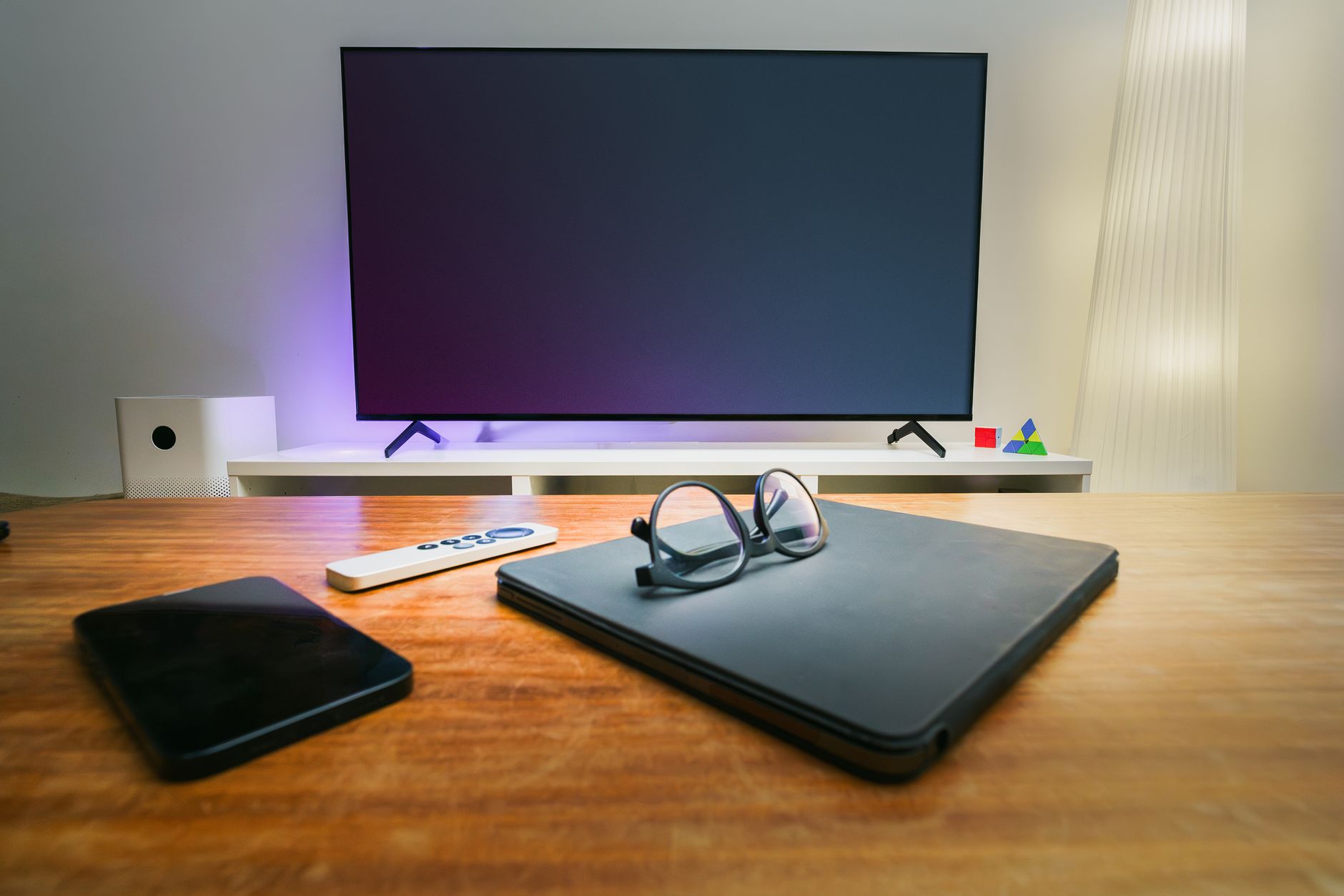
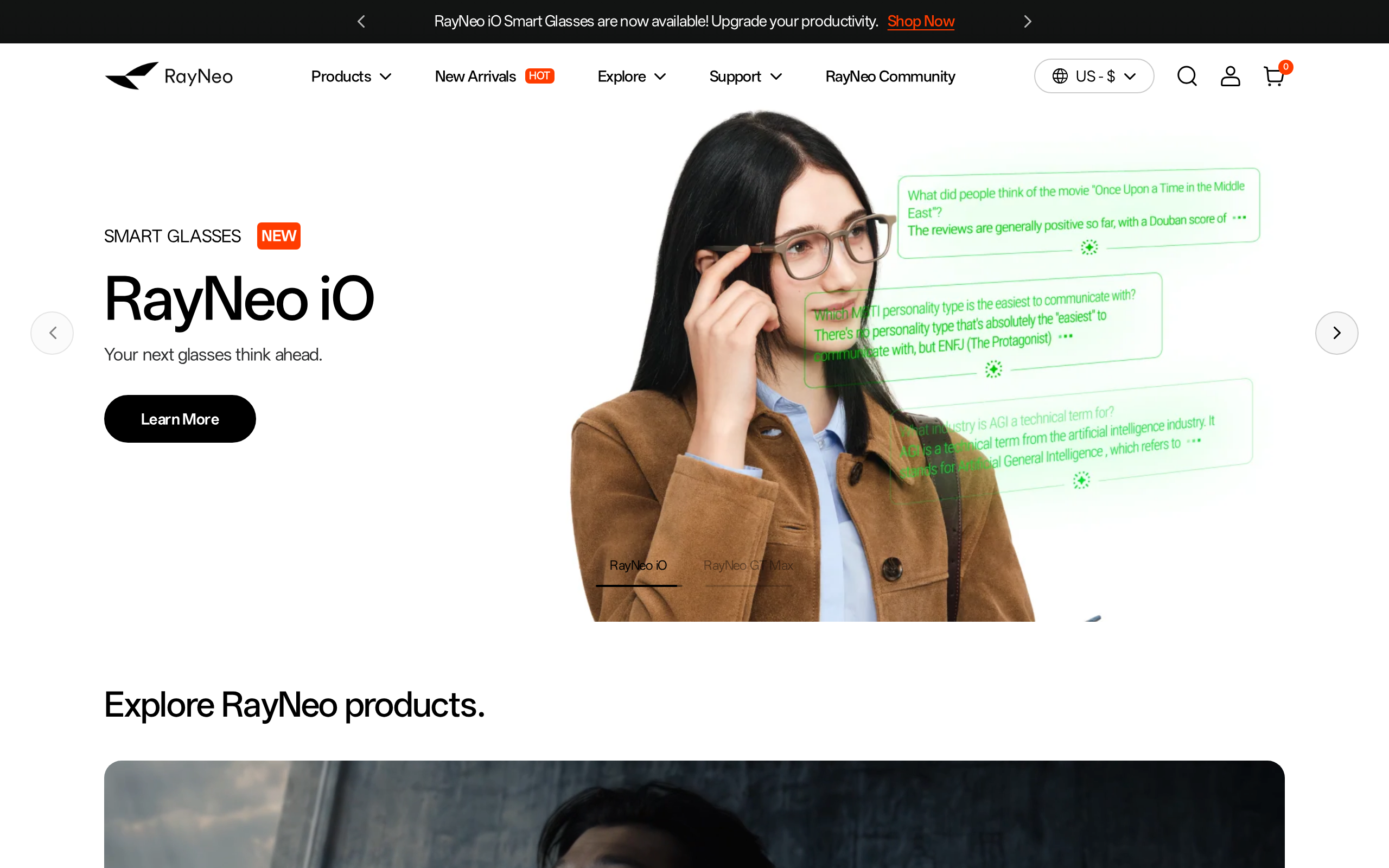
RayNeo iO puts an all-day smart memory function into a 34-gram, crown-frame pair of glasses, continuously organizing daily information and prompting users about to-do items. Its camera-free design, perceptible recording status, and user-controlled data management make privacy part of the product's operating model, not an afterthought. According to 36kr, integrated AR glasses rose from a 9:91 sales ratio against split-device products in the first quarter of 2025 to 47:53 in the second quarter of 2026.
That shift frames a practical divide. RayNeo iO emphasizes lightweight memory and visible permissions, while INMO's GO series places cloud Agents behind voice commands for flights, email, and meeting minutes. The question is which route can complete brief first-person tasks without sending the wearer back to a phone.
Two routes to an always-available AI layer
The split is over where glasses should sense the world and where they should compute. RayNeo iO takes the lighter route: a classic crown-frame body weighing 34 grams, with no camera and no speakers, according to 36kr and woshipm. Its all-day smart memory continuously records and organizes daily information, then can remind the wearer about to-do items. The device signals recording status clearly and offers user-controlled data management.
- 2021INMO launched full-color waveguide smart glasses
- 2023INMO released GO translation and teleprompting glasses
- 2024INMO released AIR3 with Sony Micro-OLED display
RayNeo's model makes memory the visible AI function, while keeping its hardware socially less conspicuous than a camera-equipped device. An OTA update in September is set to add offline translation, convenient SMS replies, and proactive reminders for completed all-day smart-memory tasks. Those additions matter because they turn remembered context into short actions, rather than treating AI output as something to inspect on a display.
INMO defines the other route as a spatial terminal. According to 36kr, its self-developed INMO AIOS includes a mass-produced spatial layer with monocular VIO, 6DoF positioning, spatial anchors, mixed-reality rendering, and gesture interaction. Its GO series puts Agent capabilities into physical hardware, with cloud-based Agents handling voice-command tasks including flight booking, email checks, and meeting-minute drafting.
The market is making room for both architectures. 36kr reports that integrated AR glasses rose from a 9:91 sales ratio against split-device products in the first quarter of 2025 to 47:53 in the second quarter of 2026. RayNeo iO asks glasses to be an unobtrusive memory interface. INMO asks them to perceive space and host a richer control surface. The practical distinction is where sensing belongs: limited hardware designed around privacy signals, or camera-led spatial awareness that supports more direct interaction.
Quark S1 and RayNeo iO: two routes to always-available AI glasses
| Dimension | Quark AI Glasses S1 | RayNeo iO |
|---|---|---|
| Product position | Binocular display glasses with camera capture and Alibaba-service integrations | Camera-free AI glasses centered on all-weather proactive AI and all-day smart memory |
| Release | Officially released on November 27, 2025 | Released in August 2026 |
| Weight and fit | About 52 g for the plano-lens version; nearly 1:1 front-to-back weight distribution | 34 grams; less than 40g with prescription lenses installed; claimed 50:50 front-to-back weight balance |
| Display and optics | Dual optical engines, binocular green Micro-LED displays, and waveguide optics; claimed maximum in-eye brightness of 4000 nits | Blue Lake optical waveguide display technology |
| Camera and media capture | Sony IMX681 sensor; 12-megapixel photos and direct 3K video output; photo and video recording can operate independently | No camera; cannot take photos or record videos |
| Privacy and recording signals | Left-side status indicator light shows different states during photo-taking and video recording | No camera, clearly perceptible recording status, and a user-controlled data-management mechanism |
| AI task model | Public reviews showed a compound command checking weather, finding a nearby restaurant, planning a route, and asking whether to start navigation | Records and organizes daily information, proactively reminds users about to-do items, and offers recording summaries, real-time translation, AI teleprompting, and message notifications |
| Compute and phone dependence | Most functions currently depend on a smartphone; photo and video recording can operate independently | Keeps audio collection, bone-conduction noise-reduction desensitization, and MicroLED display driving on the glasses, while assigning large-model inference and long-context storage to the cloud and app |
| Interaction | Physical screen-off button, brightness adjustment, virtual-image-distance settings, voice screen activation, head-up screen activation, and a dedicated camera button | Smart Crown control dial; head gestures for nodding to confirm and shaking the head to cancel |
| Audio and translation | Translation in nine languages, with translated subtitles and simultaneous audio broadcast | No speakers; real-time translation is offered |
| Service ecosystem | Integrates Amap, Alipay, Taobao, Pailitao, Fliggy, Alibaba Business Travel, QQ Music, and NetEase Cloud Music | Uses DeepSeek V4 Pro and Qwen 3.7 Max for complex large-model inference |
| Price and service | Starts at 3799 yuan; standard package official price is 4299 yuan and was 3999 yuan after subsidies at launch | Official price is 2499 yuan and falls into the 1996 yuan range after its limited-time launch offer and national subsidy; pre-sale hardware includes six months of Pro service |
Proactive memory creates a permissions problem
Proactive memory begins before a reminder appears. RayNeo iO has no camera, according to 36kr, but its memory system still depends on captured signals and needs to make that capture legible to the wearer and nearby people. The device provides a clearly perceptible recording status and a user-controlled data-management mechanism. Those are core permission features: people need to know when collection is active, and the wearer needs a way to govern what remains available to the system.
Visibility matters even without a camera.
woshipm describes RayNeo iO's design as a three-layer memory architecture. Its physical-signal privacy-filter layer uses bone conduction and a four-microphone array, then irreversibly desensitizes captured audio into text on-device, woshipm says. That puts filtering before later semantic and contextual memory processing. The action-suggestion layer then turns retained context into prompts. A reminder is therefore the visible end of a chain that starts with collection, passes through on-device transformation, and depends on controls that let a wearer manage resulting data.
The interruption rule also shapes whether memory feels helpful or intrusive. woshipm says RayNeo iO can infer implicit commitments from conversations, then show a to-do confirmation on its micro-display after 1-2 hours or when a call ends. Confirmation is significant because inferred commitments can be wrong, incomplete, or no longer wanted. A practical memory feature must give the wearer an obvious way to reject a suggestion, correct it, or recognize when an expected prompt did not arrive.
RayNeo iO is expected to add proactive reminders for completed all-day smart-memory tasks through an OTA update in September, alongside offline translation and convenient SMS replies, according to 36kr. That makes permission design part of ordinary use, rather than a setting visited once.
Phone dependence is acceptable only when it is predictable
RayNeo iO divides the job deliberately. According to woshipm, the glasses retain audio collection, bone-conduction noise-reduction desensitization, and MicroLED display driving, while the cloud and app take on large-model inference and long-context storage. That makes the glasses the immediate interface, rather than the place where every computation must occur.
The practical question is where a task breaks.
RayNeo iO's all-weather proactive AI, recording summaries, real-time translation, AI teleprompting, and message notifications depend on that division of labour. A wearer may get an answer in view or hear a result without reaching for a phone at the start. But predictable phone dependence means knowing when the app or cloud is required, and ensuring that handoff does not interrupt the task at the moment it matters.
Quark S1 shows the same constraint from another angle. woshipm says most of its functions currently depend on a smartphone, although photo and video recording can work independently. Its service layer reaches Amap for navigation and nearby locations, Alipay for payments, Taobao and Pailitao for product recognition and price comparison, plus Fliggy and Alibaba Business Travel for itinerary information. Those connections can make glasses useful in context, but they also make completion contingent on the phone-backed service chain.
INMO argues for the opposing destination: glasses as an independent terminal. 36kr describes its GO series as placing Agent capabilities in hardware, with cloud-based Agents able to book flights, check emails, and draft meeting minutes through voice commands. Cloud use remains part of that model. The distinction is operational: users should not have to discover mid-task that the glasses are only a display for a phone process.
Quark S1 makes task completion the real benchmark
Quark S1 shifts the test from showing an answer to closing a task. Public reviews cited by woshipm showed it handling a compound request: checking weather, finding a nearby restaurant, planning a route, then asking whether navigation should begin. That final question matters. It keeps the user in control before a consequential action starts.
Its integrations supply the handoffs that a display alone cannot provide. Quark S1 connects to Amap for routes and nearby places, Alipay for payments, and Taobao with Pailitao for recognition and price comparison. Fliggy and Alibaba Business Travel add itinerary information.
The glasses also translate across nine languages, placing subtitles on the lenses while broadcasting translated audio after capture. Photo and video recording can work independently, according to woshipm, but most other functions depend on a smartphone. RayNeo iO offers recording summaries, translation, teleprompting, and message notifications; 36kr says an OTA update in September will add offline translation, SMS replies, and proactive reminders tied to all-day smart-memory tasks.
A useful benchmark is therefore a short first-person task with a clear completion point. Can the glasses request confirmation, show what happened, and recover when a service cannot finish? The woshipm author argues Quark S1 still must move from usable functions to dependable micro-task completion before daily mass-market use.
Choose glasses by the task they can finish without making you reach for a phone
- You need discreet, all-day prompts, meeting summaries, translation, and reminders, but do not need to capture photos or video. Choose RayNeo iO. It weighs 34 grams, offers recording summaries, real-time translation, AI teleprompting, message notifications, and all-day smart memory. Its camera-free, speaker-free design is explicitly oriented away from photo, video, and music use; RayNeo says it provides a clearly perceptible recording status and a user-controlled data-management mechanism.
- You need first-person capture as well as navigation, nearby-location search, product recognition, or lens-displayed translation. Choose Quark S1 rather than RayNeo iO. Quark S1 has a Sony IMX681 sensor, supports 12-megapixel photos and direct 3K video output, and integrates Amap, Alipay, Taobao, Pailitao, Fliggy, and Alibaba Business Travel. It also supports translation in nine languages. Do not choose it expecting independence from a handset: most Quark S1 functions currently depend on a smartphone.
- Comfort, prescription compatibility, and low social friction matter more than a camera or standalone media features. Favor RayNeo iO. It weighs less than 40g with prescription lenses installed and supports prescription lenses for myopia of up to 1,200 degrees. Its lack of camera can be a practical advantage in settings where visible recording capability would create discomfort or concern.
- You want a display-forward device that can carry out a short, multi-step request while you are moving around. Consider Quark S1, but test the exact service path you depend on. Public reviews showed it handling a compound request covering weather, a nearby restaurant, route planning, and navigation. Its supported travel notifications initially mainly covered Fliggy, Alibaba Business Travel, and Gaotie Guanjia; Didi and Hanglv Zongheng had not yet been integrated.
- You expect an AI agent to complete high-stakes or open-ended work without supervision. Do not treat any of these products as a proven replacement for a phone or computer. INMO describes cloud-based Agents that can book flights, check emails, and draft meeting minutes through voice commands, while the Quark S1 assessment concludes that AI glasses still need to progress from usable functions to reliably completing micro-tasks before they become mass-market daily-use products.
Run a personal task audit before buying
Start with a week of phone use, then mark the moments a single glance could plausibly replace: checking a prompt, reading a short alert, or confirming a reminder. The useful test is repetition. If an interaction still needs typing, long reading, or private attention, glasses may simply add a screen before the phone.
Comfort is part of task completion.
Try the frame as an ordinary pair of glasses for the periods when prompts are most likely to matter. According to woshipm, the plano-lens Quark S1 weighs about 52 g, and a reviewer reported no obvious nose-bridge marks or ear soreness after two consecutive hours. That is encouraging, not a universal result. In a 200-person survey cited by woshipm, 77% needed glasses daily, while 53% said they would wear Quark S1 long-term as ordinary glasses. Prescription fit can decide the purchase: 36kr says RayNeo iO supports myopia corrections up to 1,200 degrees.
Also audit social control. Can the display disappear instantly in a meeting, on public transport, or during a conversation? Quark S1 offers a physical screen-off button, brightness adjustment, virtual-image-distance settings, voice screen activation, and head-up activation, according to woshipm. Treat those controls as things to test in real routines, alongside notification filtering and the consequences of losing connectivity. A useful device should let you ignore it without friction.
Price needs a longer horizon than the delivered hardware figure. RayNeo iO starts at 1,996 yuan, according to 36kr. woshipm reports that RayNeo pre-sale hardware includes six months of Pro service, after which Pro costs $9.99 per month and Core costs $5.99 per month. Before buying, write down which tasks require the paid tier and which still force a return to the phone. The better fit is the pair that completes your frequent, brief tasks while remaining comfortable enough to wear when nothing needs doing.
For health-oriented AI wearables, audit the loop before adding another device: which signals are collected, where they are linked, and what action follows. Huawei devices can detect more than 70 health indicators, and their data can already link to Ant A Fu, according to ifanr. That makes data handoff, consent, and the usefulness of the resulting prompt more consequential than a long sensor list.
Watch whether the service changes a specific decision. Mint Health's database contains 5 million foods, while more than 43 million Huawei users in China monitor emotional status through wearables. The relevant test is simple: can a glance produce a timely, appropriate next step without turning monitoring into another screen habit?
For readers outside China
- Availability: The source material describes Quark S1 availability through 604 offline stores in 82 cities at launch. RayNeo says consumers will be able to try and buy RayNeo iO at its offline outlets nationwide starting in September. RayNeo will officially launch overseas versions of iO and the GT series at the upcoming IFA show, and the overseas iO will integrate Gemini, ChatGPT, and Claude. INMO x Magic AI launched exclusively in North America in July. Broader country-by-country availability is not disclosed in sources.
- Pricing: Quark S1 starts at 3799 yuan; its standard package has an official price of 4299 yuan and was priced at 3999 yuan after subsidies at launch. RayNeo iO has an introductory delivered price starting at 1,996 yuan; another source lists an official price of 2499 yuan and says it falls into the 1996 yuan range after its limited-time launch offer and national subsidy. RayNeo pre-sale hardware includes six months of Pro service. Pro costs $9.99 per month and Core costs $5.99 per month.
- Closest Western equivalents: The source material does not identify a direct Western equivalent for Quark S1, RayNeo iO, or INMO's products.; For overseas RayNeo iO, the named AI-service integrations are Gemini, ChatGPT, and Claude; these are services, not hardware equivalents.; RayNeo's new Pocket TV includes Google TV, YouTube, and Prime Video, but the source material presents it as paired with the RayNeo GT series rather than as an equivalent to the glasses discussed here.
- Data residency: Data residency, server locations, retention periods, and cross-border transfer policies are not disclosed in sources. RayNeo iO is described as keeping audio collection, bone-conduction noise-reduction desensitization, and MicroLED display driving on the glasses, while assigning large-model inference and long-context storage to the cloud and app. It is also described as irreversibly desensitizing captured audio into text on-device, but the source material does not specify what data reaches the cloud or app.
Sources
- woshipm 放弃拍照与听歌:一款销量第一的 AI 眼镜背后的产品设计哲学与商业取舍 https://woshipm.com/ai/6460726.html
- 36kr 科氪|34 克、全天候 AI,1996 元起,雷鸟 iO 热卖加速智能眼镜全民普及 https://36kr.com/p/3957837582286217
- ifanr 在外滩大会上,我看到健康 AI+ 硬件的新可能 https://ifanr.com/1679765
- 36kr 头部智能眼镜品牌完成近10亿C轮融资,已正式启动上市筹备工作|硬氪首发 https://36kr.com/p/3974730056757511
- 36kr 科氪|2026 年上半年雷鸟创新包揽第一,雷鸟 iO 首销即爆款开启新增长曲线 https://36kr.com/p/3967816023929097
- woshipm 夸克 S1 卖到缺货之后,AI 眼镜还要证明什么 https://woshipm.com/ai/6443397.html
The evidence: 86 facts from 6 Chinese articles
Each line below was extracted from the article it sits under, in Chinese, before any of this was written. The writing is done from these and never from the source prose - that separation is structural, not a promise. How we work.
36kr头部智能眼镜品牌完成近10亿C轮融资,已正式启动上市筹备工作|硬氪首发
- INMO Technology recently completed its C3 financing round, led by the Sichuan Revitalization Science and Technology Innovation Fund.
- Jing'an Capital, Shanghai North Hi-Tech, Guangzhou Industrial Investment, Sichuan Pilot Test, Meishan Pilot Test, and Dongpo State Investment participated in INMO Technology's C3 financing round.
- After completing its C1 and C2 financing rounds earlier this year, INMO Technology's cumulative Series C financing totaled nearly 1 billion yuan.
- INMO Technology has formally begun preparations for an initial public offering.
- Global AI smart-glasses shipments increased by more than 200% year on year in 2025, IDC data showed.
- China's smart-glasses sales across all channels reached 909,000 units in the first half of 2026, up 85.5% year on year.
- China's smart-glasses sales revenue reached 1.88 billion yuan in the first half of 2026, up 98.7% year on year.
- The sales share of AI smart glasses with displays rose to 60% in the first quarter of 2026.
- The sales ratio of integrated AR glasses to split-device products changed from 9:91 in the first quarter of 2025 to 47:53 in the second quarter of 2026.
- INMO Technology was founded at the end of 2020.
- INMO launched full-color waveguide smart glasses in 2021.
- INMO's AIR3, released in 2024, debuted Sony's 0.44-inch Micro-OLED display globally and delivered 1920x1080 resolution with brightness three times that of the previous generation.
- INMO released its GO series in 2023, focusing on AI capabilities including translation and teleprompting for business scenarios.
- INMO and WHL formed a strategic partnership to launch the INMO x Magic AI series, which Jackson Wang helped design and has worn long term.
36kr科氪|2026 年上半年雷鸟创新包揽第一,雷鸟 iO 首销即爆款开启新增长曲线
- IDC and Counterpoint data show that RayNeo ranked first globally in AR glasses shipments in the first half of 2026, with a 24.8% market share.
- RayNeo has ranked first in global AR glasses shipments for five consecutive quarters.
- RayNeo has ranked first in AR glasses sales in China for five consecutive years.
- RayNeo ranked first in AR glasses sales in China in the first half of 2026.
- RayNeo ranked first in smart glasses sales in China for the first time in the first half of 2026.
- CINNO data show that RayNeo held a 25% share of China's AI/AR glasses market in the first half of 2026.
- RayNeo V4 is an AI photography glasses product aimed at creators.
- RayNeo will officially launch overseas versions of iO and the GT series at the upcoming IFA show.
- The overseas RayNeo iO will integrate Gemini, ChatGPT, and Claude.
- The new Pocket TV paired with the RayNeo GT series supports Dolby picture quality and includes Google TV, YouTube, and Prime Video.
36kr科氪|34 克、全天候 AI,1996 元起,雷鸟 iO 热卖加速智能眼镜全民普及
- On August 27, RayNeo announced the initial sales results for RayNeo iO.
- RayNeo iO uses a classic crown-frame design and has a body weight of 34 grams.
- RayNeo iO uses Blue Lake optical waveguide display technology.
- RayNeo iO supports prescription lenses for myopia of up to 1,200 degrees.
- RayNeo iO features all-weather proactive AI.
- RayNeo iO's all-day smart memory function can continuously record and organize daily information and proactively remind users about to-do items.
- RayNeo iO offers recording summaries, real-time translation, AI teleprompting, and message notifications.
- RayNeo iO has no camera, provides a clearly perceptible recording status, and includes a user-controlled data-management mechanism.
- RayNeo iO will add offline translation, convenient SMS replies, and proactive reminders for completed all-day smart-memory tasks through an OTA update in September.
- RayNeo iO has an introductory delivered price starting at 1,996 yuan.
- Consumers will be able to try and buy RayNeo iO at RayNeo's offline outlets nationwide starting in September.
ifanr在外滩大会上,我看到健康 AI+ 硬件的新可能
- Ant A Fu's exhibition area at the Bund Summit was built around three themes: future hospitals, future family management, and future rural clinics.
- More than 10 smart hardware products, including body-fat scales, wristbands, and blood-pressure monitors, were displayed at Ant A Fu's exhibition area.
- Ant A Fu is connected to health hardware from 18 brands, including Apple, Huawei, and vivo.
- Blood glucose meters, ventilators, and blood-pressure monitors can be linked to Ant A Fu.
- Body metrics from different connected devices can be synchronized to the Ant A Fu App with one click.
- Ant A Fu App's latest user count has reached 150 million.
- Ant A Fu handles nearly 20 million health consultations per day.
- At the end of June, Ant A Fu launched its 'Lose 100 Million Jin' campaign through co-branded body-fat scales and a weight-loss challenge.
- 2.75 million internet users checked in on Ant A Fu for 75 days during the weight-loss campaign.
- Participants in Ant A Fu's weight-loss campaign had collectively lost more than 5 million jin.
- More than 50,000 participants in Ant A Fu's weight-loss campaign lost more than 10 jin.
- More than 80,000 participants in Ant A Fu's weight-loss campaign moved from overweight or obese BMI status to the normal range.
- In the two months after the campaign began, sales of Ant A Fu co-branded body-fat scales increased by more than 3 million units.
- Huawei smart wearable devices can detect more than 70 health indicators.
- Among Huawei's users in China, more than 43 million use wearable devices to monitor emotional status, and more than 15 million use watches to monitor pulse-wave arrhythmia.
- Huawei wearable-device data currently supports linking to Ant A Fu.
- Mint Health has opened a nutrition database containing 5 million foods.
- National Tax Service data showed that sales revenue from smart health-monitoring devices rose 41.6% year on year in the first quarter of 2025, while health consultation service sales revenue rose 11.7% year on year in 2025.
woshipm夸克 S1 卖到缺货之后,AI 眼镜还要证明什么
- Quark officially released the AI Glasses S1 on November 27, 2025.
- The Quark S1 series starts at 3799 yuan.
- The Quark S1 standard package has an official price of 4299 yuan and was priced at 3999 yuan after subsidies at launch.
- The article's 200-person user survey included only users who had not returned their Quark S1 glasses.
- Men accounted for 91% of respondents in the 200-person Quark S1 user survey, and technology early adopters accounted for 96%.
- Quark S1 uses dual optical engines and binocular displays, has temples as narrow as about 7.5 mm and a frame as thin as about 3.3 mm, and uses nearly 1:1 front-to-back weight distribution.
- IT Home measured the plano-lens version of Quark S1 at about 52 g.
- IT Home reported that, after two consecutive hours of wearing the plano-lens Quark S1, its reviewer experienced no obvious nose-bridge marks or ear soreness.
- In the 200-person survey, 77% of respondents needed to wear glasses daily and 53% said they would wear Quark S1 long-term as ordinary glasses.
- At launch, Quark S1 was available through 604 offline stores in 82 cities.
- Quark S1 uses binocular green Micro-LED displays and waveguide optics, with a claimed maximum in-eye brightness of 4000 nits and support for virtual-image-distance adjustment.
- Rokid Glasses also uses binocular Micro-LED displays, weighs about 49 g, and has an official maximum brightness of 1500 nits.
- Quark S1 provides a physical screen-off button, brightness adjustment, virtual-image-distance settings, voice screen activation, and head-up screen activation.
- Public reviews showed Quark S1 handling a compound command to check the weather, find a nearby restaurant, plan a route, and ask whether to start navigation.
- Most Quark S1 functions currently depend on a smartphone, while photo and video recording can operate independently.
- Quark S1 integrates Alibaba services including Amap for navigation and nearby locations, Alipay for payments, Taobao and Pailitao for product recognition and price comparison, and Fliggy and Alibaba Business Travel for itinerary information.
- QQ Music and NetEase Cloud Music are among the external services within Quark S1's integration scope.
- IT Home's launch experience reported that travel-service notifications initially mainly supported Fliggy, Alibaba Business Travel, and Gaotie Guanjia, while Didi and Hanglv Zongheng had not yet been integrated.
- Quark S1 supports translation in nine languages, displaying translated subtitles on its lenses and simultaneously broadcasting them after capturing audio.
- Quark S1 uses a Sony IMX681 sensor, supports 12-megapixel photos and direct 3K video output, and can use algorithms to output higher-specification video.
- Quark S1's dedicated camera button supports tap-to-focus, click-to-take-a-photo, and long-press-to-record-video controls.
- In the 200-person survey, 94% of respondents approved of Quark S1's daytime image clarity, while 55% approved of its nighttime image clarity.
- Quark S1 has a status indicator light on its left side that shows different states during photo-taking and video recording.
woshipm放弃拍照与听歌:一款销量第一的 AI 眼镜背后的产品设计哲学与商业取舍
- RayNeo iO was released in August 2026.
- RayNeo iO has no camera and no speakers.
- RayNeo iO cannot be used to take photos, record videos, or play music.
- RayNeo iO weighs 34g, and weighs less than 40g with prescription lenses installed.
- RayNeo iO uses a three-layer memory architecture consisting of a physical-signal privacy-filter layer, a semantic-and-contextual-memory layer, and an action-suggestion layer.
- RayNeo iO uses a BES2800 single-main-controller chip manufactured on a 6nm process.
- RayNeo iO has a Smart Crown control dial on top of the right temple and supports head-gesture recognition for nodding to confirm and shaking the head to cancel.
- RayNeo iO has an official price of 2499 yuan and falls into the 1996 yuan range after its limited-time launch offer and national subsidy.
- RayNeo pre-sale hardware includes six months of Pro service.
- RayNeo offers a Pro subscription for $9.99 per month and a Core subscription for $5.99 per month.