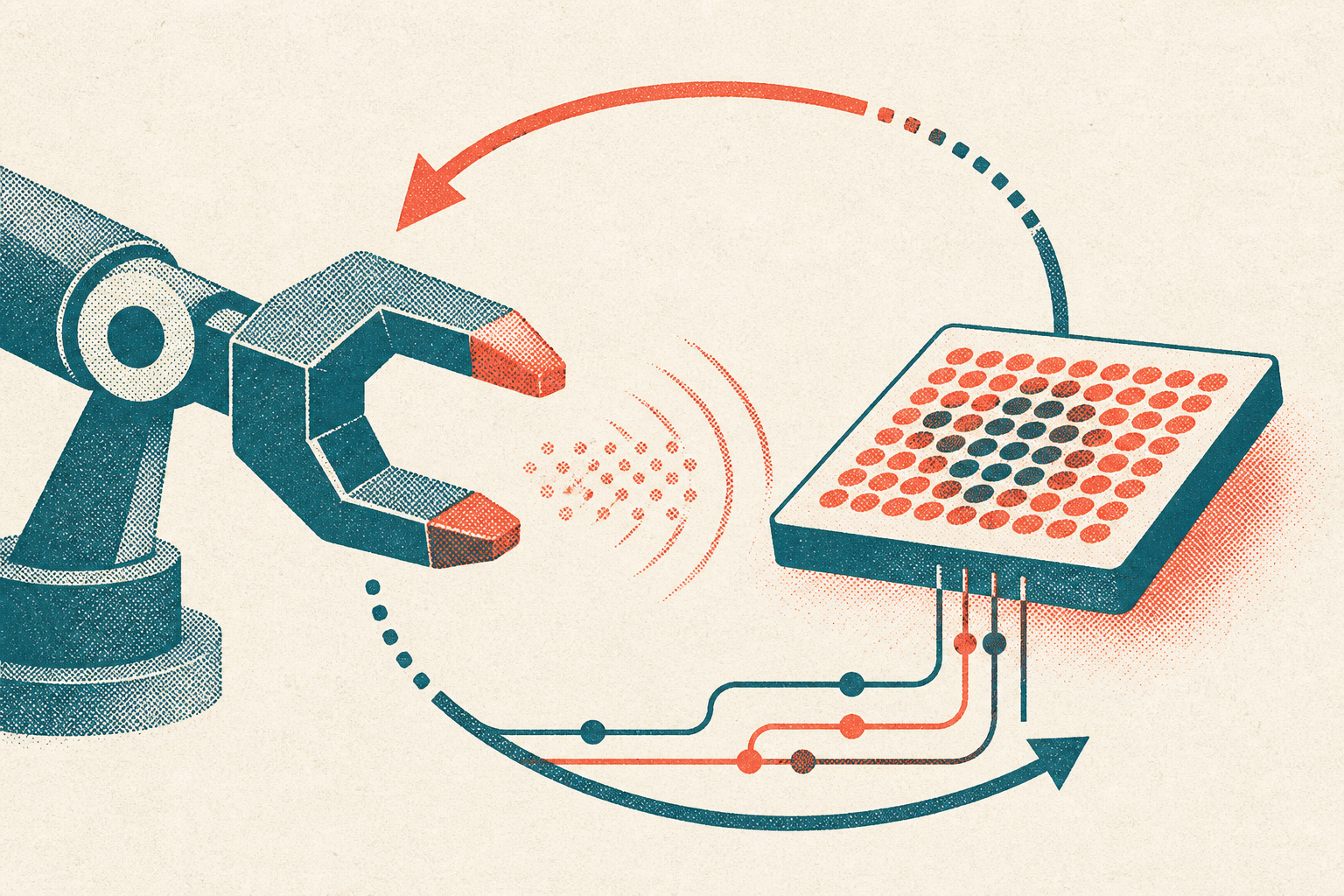
Pasini's full-modal data collection system shows where robot training is moving: tactile data is being lined up with vision. It is also being aligned with joint states and motion trajectories, so the result can feed model training instead of stopping at a demo.
36kr describes LatentVerse as building an embodied-native foundation model and training UTAM, the Unified Tactile Action Model, as its first model. UTAM is framed around simultaneous visual feedback signals. Language feedback is part of the frame too. So is tactile feedback. Its four expert modules cover vision-language understanding and world modeling. Separate modules handle action and touch.
The scale pressure is already visible.
woshipm reported Zhiyuan Robotics describing a dataset with more than 1 million trajectories. It spans 217 tasks. It includes 5 deployment scenarios collected through 100 dual-arm humanoid robots. Put beside Pasini's tactile alignment and UTAM's multi-signal design, the pattern is clear: embodied AI coverage is shifting from the moving robot to the repeatable data loop that teaches the next one.
The demo bottleneck moved into the data loop
The useful question is no longer whether a robot can make a convincing motion clip. The harder question is what the clip leaves behind: synchronized perception data, records of action, contact traces, plus outcome data that can be reused for training.
- In early 2024Hu Yucheng proposed PAD, a multimodal diffusion VLA model
- In November 2024Hu Yucheng proposed VPP, a video action model
- AprilHu Yucheng left ByteDance Seed
- JuneYingsu completed financing for model training and data engine work
- In April 2026Zhiyuan deployed AGIBOT G2 on a Longcheer tablet production line
That is where Chinese embodied-AI coverage is shifting, from demo capability to the machinery that turns work into data.
LatentVerse is a clean example of the model-side version of this shift. According to 36kr, the company describes itself as building an embodied-native foundation model, with UTAM, the Unified Tactile Action Model, as its first model. UTAM is designed to output visual feedback signals at the same time as language feedback signals. It also outputs tactile feedback signals. Its architecture separates the problem across a vision-language expert, a world-model expert, an action expert, plus a tactile expert.
The point is not elegance. It is capture.
Pasini's contribution sits closer to the data pipe. 36kr describes its full-modal collection system as aligning tactile data with vision. It also aligns joint states with motion trajectories to form training data. That wording matters because contact is treated as a first-class signal, not as a side effect of movement. A grasp becomes usable when the system knows what the robot saw. A press or a slip becomes usable when the system knows how its joints moved, plus what trajectory produced the touch event.
Deployment logs show why that loop matters. Woshipm reports that Zhiyuan Robotics described a dataset with more than 1 million trajectories; 217 tasks; 5 deployment scenarios; collected with 100 dual-arm humanoid robots. In April 2026, Zhiyuan put AGIBOT G2 on a Longcheer Technology tablet production line. The disclosed line figures were up to 310 units per hour; about 19-20 seconds per operation; a success rate above 99%; 36 hours of integration time; about 3,000 units per shift; 24/7 autonomous operation.
Those numbers turn embodiment into a flywheel. Collect data, then train models. Deploy them, log results, then train again.
What a physical-data schema has to align
A reusable robot-training record has to bind the robot's visual record to task meaning. It also has to capture body action and the evidence supplied by contact. LatentVerse's UTAM shows one version of that schema: according to 36kr, it outputs visual signals and language signals while also capturing tactile feedback, then routes them through four expert modules: a vision-language expert, a world-model expert, an action expert, and a tactile expert.
The split matters because not all data teaches the same part of the system. LatentVerse uses teleoperation data only for the action expert, while human-hand sources, including ego-centric data and open-source video, train the understanding expert and the world-model expert. That turns internet-scale observation into supervision for perception and prediction, while keeping robot action data focused on control.
Pasini's schema starts from the other end: contact. Its full-modal data collection system aligns tactile data with vision and joint states. It also aligns them with motion trajectories, producing training data rather than isolated sensor logs. The task label and outcome then become interpretable because the record can connect motion to touch and touch to success or failure.
That is why tactile channel count is not just a hardware spec. Pasini's current products can provide up to 717 tactile signal channels, and 36kr says its self-developed tactile chip consumption approached 1 million units in the past year. More touch points mean richer labels for grasping and pressing. They also make slipping easier to distinguish from release.
LatentVerse is also moving data collection closer to ordinary hands. It is developing its own data-collection glove, and Hu Yucheng says wearable collection could cut single-hour costs from the thousand-yuan level to under 100 yuan by letting non-professionals contribute. Pasini has laid out tactile sensors as one technical direction. It also names embodied data collection and tactile integrated terminal execution. Both point to the same requirement: the model record must survive the trip from video to body, then from body to deployment results.
The 2D versus 3D fight is really about scalable supervision
The fight between 2D and 3D is less a theology of representation than a question of supervision cost. NVIDIA used Cosmos to build an alliance around world models, according to geekpark, while woshipm reports that Max Li frames simulation as a way to make robot training and evaluation more repeatable and reusable. That makes simulation attractive when the task needs controlled variation and a stable benchmark.
Yingsu Technology starts from the opposite pressure point: the internet already contains huge amounts of video, but robots cannot directly treat pixels as contact-rich task data. geekpark says Yingsu plans to reach monocular-video-to-360-degree dynamic-scene conversion this year and then begin batch conversion. Zhang Guofeng's argument is that physical laws live in 3D space, not on pixels, so training data should become multimodal data in a 3D coordinate system.
That is the cost argument.
Yingsu says converting existing internet data into 3D or 4D has no extra collection cost, and claims its method can lower overall costs by at least one to two orders of magnitude compared with traditional on-site collection plus reconstruction. Its June financing is planned mainly for model training and data engine construction, which shows where the company thinks the bottleneck sits: not in a single capture rig, but in a conversion pipeline.
The practical rule is to compare data forms against the task. If occlusion is central, Yingsu's internal embodied-AI experiments found that jointly modeling 3D geometric representations and actions clearly improved success rates. If long-term consistency or physical interaction dominates, Max Li still sees advantages for 3D environments. If the task benefits from scale before contact, his team's move toward pixel-to-text combinations helps explain why video models remain compelling. Action data becomes part of that shift rather than a separate capture doctrine. Teleoperation trajectories and first-person data still matter, but Zhang calls them stage-specific because they are costly, slow, limited in diversity, and hard to scale.
Tactile sensing splits frontier models from factory delivery
Tactile data sits in two different places in the embodied-AI stack. At the model frontier, it is still being formalized. According to 36kr, LatentVerse is training UTAM, the Unified Tactile Action Model, as its first model, evolved from its earlier UAM, the Unified Action Model. UTAM is designed to output visual feedback signals at the same time as language feedback signals. It also outputs tactile feedback signals, with four expert modules: a vision-language expert, a world-model expert, an action expert, and a tactile expert.
That is the research-side bet: touch becomes part of action prediction, not an accessory sensor stream.
The timing shows how unfinished that layer remains. LatentVerse plans to release its first embodied foundation model with 16B parameters after one quarter, and to accumulate hundreds of thousands of hours of training data within one year to one and a half years. In other words, the tactile action model is being positioned as a future foundation capability whose value depends on data scale. It also depends on alignment, with deployment feedback repeated over time.
Pasini represents the other side of the split: tactile sensing as a deliverable control loop. 36kr says Pasini completed a new financing round of 1 billion yuan, bringing cumulative financing to nearly 4 billion yuan. Its current products use the HAPTA heterogeneous multi-core array architecture, provide up to 717 tactile signal channels, carry IP68 protection, and have a measurement lifetime of more than 10 million times.
Those are factory metrics, not demo metrics.
The bridge between the two sides is Pasini's full-modal data collection system, which aligns tactile data with vision, joint states, and motion trajectories to form training data. In the past year, Pasini's self-developed tactile chip consumption approached 1 million units, and its full-modal data has been adopted by multiple leading embodied intelligence foundation model companies and large Internet technology companies. It is also building localized operations and delivery systems in North America, Japan and South Korea, and Europe.
Evaluation is moving in the same direction. Woshipm recorded Zhiyuan Robotics describing more than 1 million trajectories, 217 tasks, and 5 deployment scenarios collected with 100 dual-arm humanoid robots. It also disclosed AGIBOT G2 performance in production terms: up to 310 units per hour, about 19-20 seconds per operation, continuous-operation success above 99%, 36 hours of production-line integration time, about 3,000 units per shift, and support for 24/7 autonomous operation.
Embodied-AI data stack: how sources describe each layer
| Dimension | Yingsu Technology | NVIDIA Cosmos / Max Li | LatentVerse / UTAM | Pasini | Zhiyuan Robotics |
|---|---|---|---|---|---|
| Core position in the workflow | Converts existing 2D images and videos into structured 3D/4D data; plans monocular-video-to-360-degree dynamic-scene conversion this year. | Uses simulation for more repeatable and reusable robot training and evaluation; first generation of Cosmos mainly focused on video models and video tokenizers. | Builds an embodied-native foundation model; training UTAM, short for Unified Tactile Action Model. | Provides tactile sensors, embodied data collection, and tactile integrated terminal execution. | Turns real robot operation into datasets and deployment results; described a dataset from 100 dual-arm humanoid robots. |
| Data inputs emphasized | Massive existing 2D images and videos on the internet; high-quality data should be multimodal data in a 3D coordinate system. | Scalable data forms such as pixel, text, and action combinations; simulation environments. | Three layers: teleoperation data trains only the action expert, while human-hand data such as ego-centric data and open-source video data train the understanding expert and world-model expert. | Full-modal data collection aligns tactile data with vision, joint states, and motion trajectories. | More than 1 million trajectories, 217 tasks, and 5 deployment scenarios. |
| Model or system output | 360-degree dynamic-scene conversion; internal experiments jointly modeling 3D geometric representations and actions. | Video models; generative models; simulation-based training and evaluation systems. | UTAM outputs visual, language, and tactile feedback signals at the same time. | Data for model training; tactile integrated terminal execution. | AGIBOT G2 production-line performance data from a real consumer electronics precision manufacturing environment. |
| Contact or tactile layer | Not covered. | 3D environments still have advantages in scenarios such as physical interaction. | Includes a tactile expert; LatentVerse is developing its own data-collection glove. | Current products can provide up to 717 tactile signal channels and have IP68 protection. | Not covered. |
| Scaling argument | Says internet data converted into 3D or 4D data has no extra collection cost; says teleoperation and first-person data are important but high cost, slow speed, limited diversity, and difficult to scale. | Argues directions that cannot scale data and experiments are difficult to advance; says Sora validated large-scale pixel-based generative models as a more scalable path. | Plans to reduce single-hour collection costs from the thousand-yuan level to under 100 yuan through wearable devices that let non-professionals collect data. | Self-developed tactile chip consumption approached 1 million units in the past year; full-modal data adopted by multiple leading embodied intelligence foundation model companies and large Internet technology companies. | Collected with 100 dual-arm humanoid robots; deployment supports 24/7 autonomous operation. |
| Cost, funding, or commercialization evidence | Completed a new financing round in June; plans to use it mainly for model training and data engine construction; claims costs are lower by at least one to two orders of magnitude than traditional on-site collection plus reconstruction. | Pricing not disclosed in sources. | Completed a seed funding round of several hundred million yuan; plans first embodied foundation model with 16B parameters after one quarter. | Completed a new financing round of 1 billion yuan; cumulative financing nearly 4 billion yuan. | AGIBOT G2 reached up to 310 units per hour, about 19-20 seconds per operation, a continuous-operation success rate above 99%, 36 hours of production-line integration time, and about 3,000 units per shift. |
| Deployment or delivery footprint | Not covered. | Not covered. | Not covered. | Building localized operations and delivery systems in North America, Japan and South Korea, and Europe. | In April 2026, deployed AGIBOT G2 on a Longcheer Technology tablet production line. |
When to use each layer of the embodied-AI data stack
- You need scalable spatial training data before you have enough robot fleets or teleoperation operators. Start with internet video and 3D/4D reconstruction. Yingsu Technology argues that the next key step is converting massive existing 2D images and videos on the internet into structured 3D/4D data, and says this route has no extra collection cost. It also plans monocular-video-to-360-degree dynamic-scene conversion this year and batch conversion.
- Your robot policy fails under occlusion or needs to reason about space rather than pixels. Prioritize 3D coordinate-system data and joint modeling of geometry and action. Yingsu Technology says its internal embodied-AI experiments preliminarily found that jointly modeling 3D geometric representations and actions clearly improved success rates on tasks involving complex occlusion, and Zhang Guofeng argues that high-quality spatial-intelligence training data should be multimodal data in a 3D coordinate system.
- You need contact-rich manipulation, grasping, or terminal execution rather than only visual navigation. Add tactile sensing and aligned full-modal logs. Pasini has laid out tactile sensors, embodied data collection, and tactile integrated terminal execution; its full-modal data collection system aligns tactile data with vision, joint states, and motion trajectories for model training. LatentVerse is also training UTAM, which outputs visual, language, and tactile feedback signals at the same time.
- You need action data but cannot afford specialist teleoperation at large scale. Use teleoperation selectively for action experts and look for cheaper human-hand or wearable collection. LatentVerse's current strategy uses teleoperation data only to train the action expert, while ego-centric and open-source video data train the understanding expert and world-model expert. Hu Yucheng says its wearable-device plan will reduce single-hour collection costs from the thousand-yuan level to under 100 yuan by letting non-professionals participate.
- You are evaluating robot capability for deployment, not just a demo or benchmark. Require repeatable simulation plus real task logs. NVIDIA emphasizes simulation for more repeatable and reusable training and evaluation systems, while Max Li says benchmarks are important but cannot fully reflect real usage. For a deployment reference point, Zhiyuan Robotics described more than 1 million trajectories, 217 tasks, and 5 deployment scenarios, and reported AGIBOT G2 production-line metrics including up to 310 units per hour and a continuous-operation success rate above 99%.
Hardware capital rewards closed loops but punishes weak cash flow
Capital is rewarding robotics companies that can show a loop from hardware delivery to task data and back into training. According to woshipm, Chinese robotics companies had raised $5.6 billion across 176 deals by mid-May 2026, matching the full-year 2021 level and exceeding the $4.3 billion raised in all of 2025. In the first quarter of 2026, robotics-related companies contributed $3.3 billion across 126 deals to Asian startup financing.
That money is not evenly patient.
The strongest fundraising stories attach models to manufacturable bodies. They also attach them to near-term deployment channels. TARS Robotics raised a $513 million seed round about one year after its founding, at a valuation of about $1.9 billion. X Square completed a $140 million Series A extension in January 2026, then a $293 million Series B round 3 months later. Spirit AI and Galaxea AI each paired February 2026 rounds with April 2026 follow-on capital. The signal is clear enough: investors want teams close to the physical data source, not only the model layer.
Manufacturing depth makes that bet plausible in China. Woshipm cites International Federation of Robotics data showing about 2 million operating industrial robots in China's manufacturing sector, about 4.5 times Japan's count. In 2025, 54% of newly installed industrial robots worldwide were deployed in China. Domestic suppliers also moved from 30% of China's industrial robot installations in 2020 to 57% in 2024. A robot company can therefore sell into dense factories. It can learn from failures while sourcing more of the stack locally.
The harder question is what to build. China's Ministry of Industry and Information Technology split humanoid core technologies into a "brain" and a "cerebellum" in its 2023 guidelines. It also identified "limbs," and capital has followed that anatomy. Linkerbot, a Beijing robotic hand company, recently completed a Series B+ round at a $3 billion valuation and plans to target $6 billion next. It claims more than 80% of the global high-degree-of-freedom robotic hand market, monthly capacity close to 5,000 units, and a plan for 10,000 units.
For practitioners, the takeaway is blunt. Build hardware when the component itself captures scarce contact data or controls deployment. Buy hardware when the value is in task execution and agent interfaces. Returned logs matter too. Woshipm's author argues that software-plus-hardware is becoming a standard AI startup configuration because pure software has low barriers to entry. That does not make every team a factory. It makes the cash-flow test harsher.
Treat every robotics pilot as a data contract. Before buying a system, ask what it records when the gripper slips, when an operator corrects a path, when a task takes too long, and when scene geometry changes. Zhang Zhengyou's warning, cited by woshipm, is the useful test: the system must represent position. It must also represent space. If it cannot represent operability, it is still closer to a brain in a vat than a worker.
Watch the cost unit shift from model usage to work done.
WAIC 2025 put the Token economy on the agenda, but Xu Bing's sharper point was machine working hours. IDC's projection from 28.6 million daily active agents in 2025 to 79.4 million in 2026 matters only if those agents turn execution traces into improvement. Wu Yunsheng said enterprises are already calculating Token costs; Li Feifei said customers pay for implementation results. Apply that standard to physical AI vendors too: pay attention to closed loops, not demos.
For readers outside China
- Availability: Most of the companies and systems discussed are China-centered or described through Chinese industry reporting. Yingsu Technology is described as a Shanghai company, and Pasini moved its headquarters to Beijing. The source material does not say whether Yingsu Technology or LatentVerse products are available outside China. Pasini is the exception: it is building localized operations and delivery systems in North America, Japan and South Korea, and Europe.
- Pricing: Commercial product pricing is mostly not disclosed in sources. The clearest cost figures are for data collection rather than finished products: Yingsu Technology says its method lowers overall costs by at least one to two orders of magnitude compared with traditional on-site collection plus reconstruction, and Hu Yucheng says LatentVerse's wearable-device plan will reduce single-hour collection costs from the thousand-yuan level to under 100 yuan. WAIC 2025 ticket resale prices are reported separately: single-day tickets with an original price of 168 yuan were resold for 1500 yuan, and three-day passes rose to 3000 yuan.
- Closest Western equivalents: NVIDIA Cosmos, for world-model and simulation-centered robot data infrastructure; World Labs Marble, for spatial or world-model generation; Sora-style large-scale pixel-based generative models, as a reference point for scalable video modeling; SLAM and 3D reconstruction pipelines, for the older robotics and mapping lineage that these companies are trying to scale with learning-based methods
- Data residency: The source material does not disclose where training data is stored, whether cross-border data transfer is supported, or what compliance regime applies to internet video, teleoperation logs, tactile data, or factory deployment logs. Medical robotics is specifically called out as having data access and sharing problems because hospital data is usually managed independently and has strong private attributes, but the sources do not provide operational data-residency policies for the companies covered.
Sources
- 36kr 获高瓴等基金数亿元投资,LatentVerse:不想被叫世界模型公司,要做具身原生大脑|智能涌现首发 https://36kr.com/p/3934484753398918
- geekpark 对话影溯章国锋:互联网数据才是空间智能最需要的「太阳能」 https://geekpark.net/news/368667
- woshipm 专访 NVIDIA Cosmos Max Li:为什么Action必须成为预训练的一部分?Physical AI的底层逻辑正在重写 https://woshipm.com/ai/6436066.html
- 36kr 近40亿元融资背后:资本为何看好帕西尼 https://36kr.com/p/3933515490884744
- woshipm 从"会动"到"能干活":中国具身智能融资热潮的底层逻辑 https://woshipm.com/ai/6435394.html
- woshipm 爆火的WAIC 2026,AI产品的三个根本转变 https://woshipm.com/ai/6432470.html
The evidence: 84 facts from 6 Chinese articles
Each line below was extracted from the article it sits under, in Chinese, before any of this was written. The writing is done from these and never from the source prose - that separation is structural, not a promise. How we work.
36kr获高瓴等基金数亿元投资,LatentVerse:不想被叫世界模型公司,要做具身原生大脑|智能涌现首发
- LatentVerse was founded by Hu Yucheng and members from institutions including Tsinghua University, Nanyang Technological University, Peking University, Qwen, ByteDance, and Xiaomi.
- Hu Yucheng is the founder of LatentVerse and a doctoral student at Tsinghua University's Institute for Interdisciplinary Information Sciences.
- Hu Yucheng was born in 2001.
- Hu Yucheng left ByteDance Seed in April.
- LatentVerse positions itself as a company building an embodied-native foundation model.
- LatentVerse has completed a seed funding round of several hundred million yuan.
- LatentVerse's first-round investors include Hillhouse Venture Capital, Crystal Stream Capital, Zhiyuan, Xingdong Jiyuan, and Inno Angel Fund.
- In early 2024, Hu Yucheng proposed PAD, a multimodal diffusion VLA model.
- In November 2024, Hu Yucheng proposed VPP, a video action model that achieved closed-loop reasoning.
- After joining ByteDance Seed, Hu Yucheng led the development of the BagelVLA series of embodied foundation models.
- LatentVerse is training UTAM, short for Unified Tactile Action Model, as its first model.
- UTAM evolved from UAM, short for Unified Action Model, which the LatentVerse team had previously proposed.
- UTAM outputs visual, language, and tactile feedback signals at the same time.
- UTAM contains four expert modules: a vision-language expert, a world-model expert, an action expert, and a tactile expert.
- LatentVerse's current data strategy has three layers: teleoperation data trains only the action expert, while human-hand data such as ego-centric data and open-source video data train the understanding expert and world-model expert.
- LatentVerse is developing its own data-collection glove.
- LatentVerse plans to release its first embodied foundation model with 16B parameters after one quarter.
- LatentVerse plans to accumulate hundreds of thousands of hours of training data within one year to one and a half years.
36kr近40亿元融资背后:资本为何看好帕西尼
- Pasini completed a new financing round of 1 billion yuan.
- Pasini's cumulative financing is nearly 4 billion yuan.
- Pasini moved its headquarters to Beijing.
- Pasini completed a joint-stock restructuring.
- Pasini's latest financing round was jointly led by a global consumer electronics and semiconductor industry giant, BOC International Investment, Kunpeng Fund, and Hexin Fangce.
- CDH Baifu, Chengdu Jiaozi Artificial Intelligence Fund, Jingming Capital, and Jinrong Guosheng jointly invested in Pasini's latest financing round.
- Existing shareholders including Zhilai Capital continued to increase their investment in Pasini's latest financing round.
- Pasini has laid out three technical directions: tactile sensors, embodied data collection, and tactile integrated terminal execution.
- Pasini's current products are based on the HAPTA heterogeneous multi-core array architecture.
- Pasini's current products can provide up to 717 tactile signal channels.
- Pasini's current products have IP68 protection.
- Pasini's current products have a measurement lifetime of more than 10 million times.
- Pasini's full-modal data collection system aligns tactile data with vision, joint states, and motion trajectories to form data for model training.
- In the past year, Pasini's self-developed tactile chip consumption approached 1 million units.
- Pasini's full-modal data has been adopted by multiple leading embodied intelligence foundation model companies and large Internet technology companies.
- Pasini has participated in the formulation of relevant national and international standards.
- Pasini's investors cover industrial directions including automobiles, logistics, consumer electronics, artificial intelligence, and precision manufacturing.
- Pasini's core patents have covered major global markets.
- Pasini is building localized operations and delivery systems in North America, Japan and South Korea, and Europe.
geekpark对话影溯章国锋:互联网数据才是空间智能最需要的「太阳能」
- Yann LeCun left Meta to work directly on world models.
- Fei-Fei Li's World Labs released Marble.
- NVIDIA used Cosmos to build an alliance around world models.
- Yingsu Technology is a Shanghai company that has been established for one year.
- Yingsu Technology plans to achieve monocular-video-to-360-degree dynamic-scene conversion this year and begin batch conversion.
- Yingsu Technology completed a new financing round in June.
- Yingsu Technology plans to use its June financing mainly for model training and data engine construction.
- Zhang Guofeng is the founder and chairman of Yingsu Technology and a Qiushi Distinguished Professor at Zhejiang University.
woshipm专访 NVIDIA Cosmos Max Li:为什么Action必须成为预训练的一部分?Physical AI的底层逻辑正在重写
- Max Li is a member of the NVIDIA Cosmos team.
- Max Li's PhD research initially focused on robotics, specifically surgical robotics.
- Max Li shifted his research focus from robotics itself toward visual perception and environmental understanding.
- Max Li says his earlier research mainly studied 3D reconstruction.
- Max Li says his team explored 3D object generation and 3D scene generation before moving away from data collection methods that were hard to scale.
- Max Li says his team became more focused on scalable data forms such as pixel, text, and action combinations.
- Max Li says his team uses extensive vibe testing in product development rather than relying only on benchmarks.
- Max Li has participated in Cosmos-related work since the first generation of Cosmos.
- Max Li says the first generation of Cosmos mainly focused on video models and explored video tokenizers including discrete and continuous designs.
woshipm从“会动”到“能干活”:中国具身智能融资热潮的底层逻辑
- As of mid-May 2026, Chinese robotics companies had raised $5.6 billion across 176 deals, based on Crunchbase statistics.
- The $5.6 billion raised by Chinese robotics companies as of mid-May 2026 had matched the full-year 2021 level and exceeded the $4.3 billion raised by Chinese robotics companies in all of 2025.
- In the first quarter of 2026, Asian startups raised a total of $27.4 billion, and Chinese companies received $16.5 billion of that total.
- In the first quarter of 2026, robotics-related companies contributed $3.3 billion across 126 deals to Asian startup financing.
- TARS Robotics is a Shanghai humanoid robotics company that raised a $513 million seed round about one year after its founding, with a valuation of about $1.9 billion.
- X Square completed a $140 million Series A extension round in January 2026 and completed a $293 million Series B round 3 months later.
- Spirit AI completed a $290 million Series A round in February 2026 and added another $145 million in April 2026.
- Galaxea AI raised a $145 million Series B round in February 2026 and added $290 million in April 2026.
- Engine AI completed a $200 million Series B round at a valuation of about $1.5 billion.
- China's manufacturing sector had about 2 million operating industrial robots, about 4.5 times the number in Japan, based on International Federation of Robotics data.
- In 2025, 54% of newly installed industrial robots worldwide were deployed in China, based on International Federation of Robotics data.
- The share of Chinese domestic suppliers in China's industrial robot installations rose from 30% in 2020 to 57% in 2024.
- Galaxea AI completed a 1 billion yuan Series B round in February 2026 and later completed a 2 billion yuan Series B+ round, raising about 3 billion yuan in 2 months at a valuation above 20 billion yuan.
- China's Ministry of Industry and Information Technology divided humanoid robot core technologies into a "brain," a "cerebellum," and "limbs" in the 2023 Guidelines for the Innovative Development of Humanoid Robots.
- Linkerbot is a Beijing high-degree-of-freedom robotic hand company that recently completed a Series B+ round at a $3 billion valuation and plans to target a $6 billion valuation in its next round.
- Unitree Robotics had obtained Shanghai STAR Market IPO approval and planned to raise 4.2 billion yuan, based on public reports cited by the source.
- Zhiyuan Robotics described a dataset containing more than 1 million trajectories, 217 tasks, and 5 deployment scenarios collected with 100 dual-arm humanoid robots.
- In April 2026, Zhiyuan Robotics deployed its AGIBOT G2 robot on a Longcheer Technology tablet production line in a real consumer electronics precision manufacturing environment.
- Zhiyuan Robotics disclosed that the AGIBOT G2 robot reached up to 310 units per hour, about 19-20 seconds per operation, a continuous-operation success rate above 99%, 36 hours of production-line integration time, about 3,000 units per shift, and support for 24/7 autonomous operation.
woshipm爆火的WAIC 2026,AI产品的三个根本转变
- WAIC 2025 was held in Shanghai in July across four venues in three areas: Expo, Zhangjiang, and West Bund.
- WAIC 2025 had an exhibition area that exceeded 100,000 square meters for the first time.
- WAIC 2025 featured 1100 companies, more than 3000 exhibits, and more than 300 global product debuts.
- WAIC 2025 single-day tickets with an original price of 168 yuan were resold by scalpers for 1500 yuan, and three-day passes rose to 3000 yuan.
- Honor released Agentic OS, described as the industry's first partner-style multimodal agent operating system, at WAIC 2025.
- StepFun released STEPX Neo, described as the world's first agent phone, at WAIC 2025.
- The number of embodied intelligence companies at WAIC increased from more than 80 last year to more than 200 this year.
- WAIC 2025 featured 208 embodied intelligence terminals and more than 300 physical machines performing dynamic demonstrations at the same time.
- WAIC 2025 listed embodied intelligence as a core track alongside intelligent computing for the first time.
- WAIC 2025 made the Token economy a core topic for the first time.
- IDC data projected that the number of global daily active agents would rise from 28.6 million in 2025 to 79.4 million in 2026.