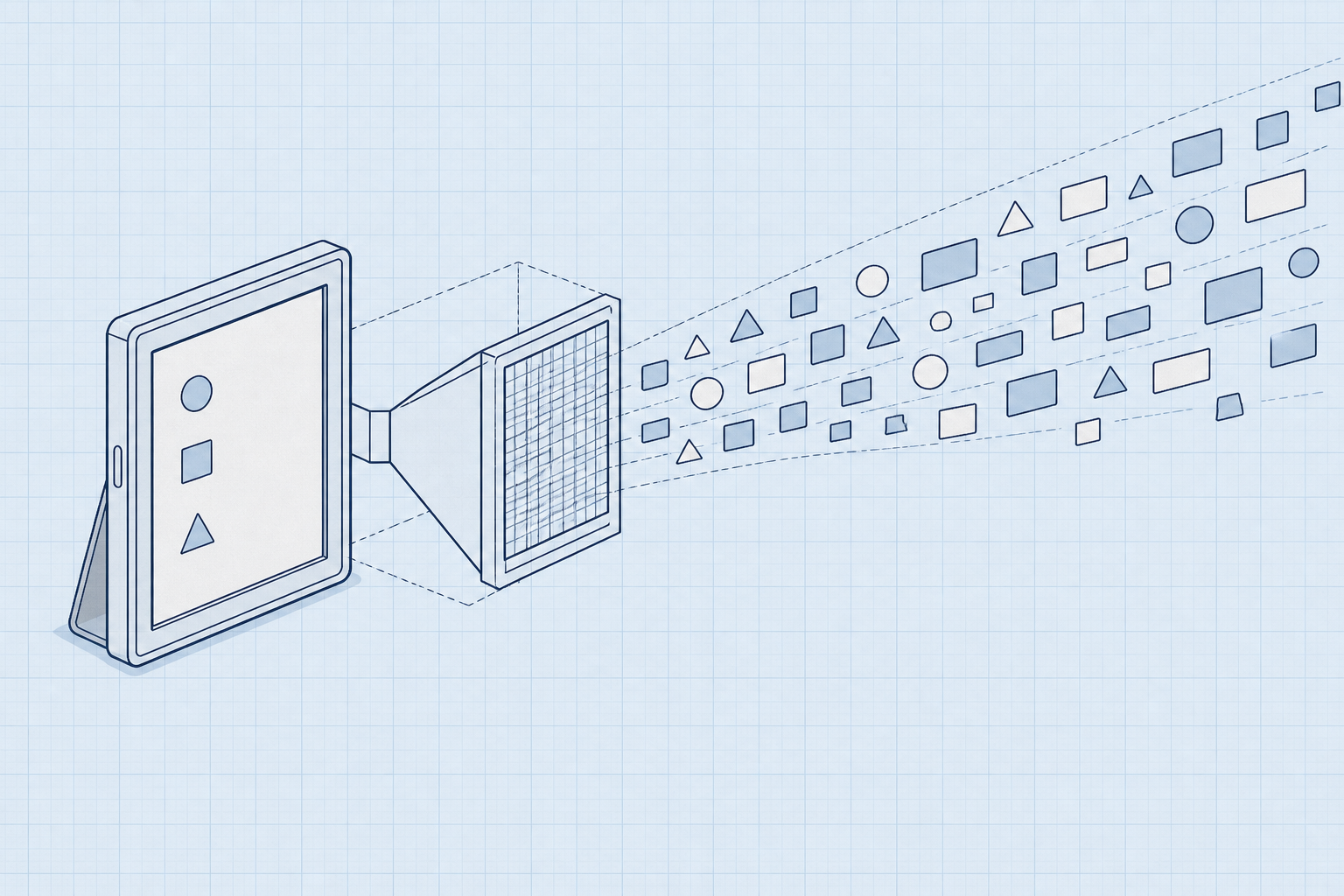
Yuexingtong X3 is a 3.7-inch e-ink device that turns the AI screen question away from making more content. It points instead toward deciding what is worth showing. ifanr describes hardware built for peripheral attention: 58g in weight and 5.1mm thick, with a magnetic coil on the back that can attach to the back of an iPhone.
The more interesting part is not the tiny display itself.
It is the role the display implies.
AirPage lets a Mac pair with Yuexingtong X3 by scanning a QR code on the screen after the device connects to Wi-Fi. It can then push rendered images from the Mac to the e-ink screen over a network, according to ifanr. ink-Macintosh adds freely arranged functional widgets and can update the screen every 5 minutes. That makes the device less like a miniature computer than a narrow checkpoint.
The pattern matters because the most useful AI interface may be backstage. It ranks before the user looks down. It compresses what needs attention. It routes the result to a narrow screen.
The useful AI screen may be the one that shows less
Yuexingtong X3 treats AI as a display constraint, not a conversation box. According to ifanr, the device has a 3.7-inch e-ink screen, weighs 58g, and is 5.1mm thick. A magnetic coil on the back lets it attach to an iPhone, which makes the screen feel less like another gadget and more like a small status layer riding with the phone.
- 2023Yuexingtong is founded as a consumer electronics startup
- After the 2025 Spring FestivalHu Yufei shares the light magnetic device concept
- In April this yearYuexingtong discloses five financing rounds
- recentlyYuexingtong completes nearly 50 million yuan Series A closing
The constraint is the point.
AirPage shows how the product direction works. After X3 connects to Wi-Fi, a Mac pairs with it by scanning a QR code on the screen, according to ifanr. The Mac can then push rendered images to the e-ink display over the network. With ink-Macintosh, users can freely arrange functional widgets on X3, and those widgets can refresh every 5 minutes.
That cadence changes what AI is for. The ifanr author used an Agent to cap an AI morning briefing at 3 news items, with each item compressed to no more than two sentences. The same setup added a Weibo real-time trending-search module that shows the top 3 to 5 trending searches and popularity values, depending on window size. AI is not performing as a creative engine here. It is deciding how little should appear.
E-ink helps enforce that choice. The ifanr author argues that black-and-white, low-refresh e-paper is a poor fit for watching videos or browsing Douyin, and that a palm-sized black-and-white device can preserve focus in daily life. Mark Weiser, Xerox PARC's chief scientist, proposed Calm Technology in 1995; X3 makes that idea feel like hardware strategy.
Geekpark reports that Yuexingtong, founded in 2023, recently completed nearly 50 million yuan in additional Series A financing. Its plan includes locking in e-paper screens and production capacity, developing new hardware, improving software interaction, exploring AI capabilities, and expanding content copyrights and overseas markets. The company's core products include small e-paper devices such as X3 and X4. The bet is that less screen can become a better AI surface.
Video AI is moving from making scenes to choosing scenes
iQIYI's video AI stack shows a useful split: one side makes more material, while the other decides which material deserves the next glance. Skip Watch is the clearest example. According to woshipm, the feature lets a user swipe during horizontal playback and jump to the next plot node identified by the system. iQIYI says the system analyzes images and content, finds highlights that move the story forward, then offers those clips as choices.
That changes the job of AI from scene generator to scene selector.
The trade-off is visible. The woshipm author argues that Skip Watch can reduce viewing time, but does not necessarily preserve the complete viewing experience. That is the central tension for video platforms: a system that removes friction can also remove texture. Plot advancement is easier to detect than mood. It is also easier to detect than rhythm. The small pause that makes a later scene work is harder still.
Taodou points in the opposite direction. Public information in 2025 showed that it could be invoked from the iQIYI homepage and the video half-play page, while Taodou World had launched about 1000 IP characters and accumulated more than 100 million rounds of interactions. That is generative entertainment, but the woshipm author's caution matters: those interactions show willingness to try the feature, not stable habits.
The author also argues Taodou has more room for imagination than Skip Watch, but still needs high-frequency use cases that are hard to replace.
Behind the screen, the same filtering logic becomes more operational. iQIYI's script evaluation system can analyze about 500,000 Chinese characters in about 30 minutes and flag issues in theme, character development, as well as plot design, according to woshipm. QClip can record monitoring signals on set in real time. It can distribute those signals to the cloud. It can also upload them, then match footage with electronic script supervisor records through AI.
Public materials show QClip has been used in dozens of projects, with more than 2.8 million uploaded footage items and more than 43,000 hours in total duration.
Nadou Pro wraps that direction into a broader production environment. It is meant to integrate screenwriting, directing, art design, editing tasks, plus other tasks for films. It also covers series. The scope extends to animation as well as AI-native content, and public information in early 2026 showed availability for iQIYI internal teams and core partners.
Still, woshipm's author argues the clearer gains sit in pre-shooting analysis and proposal communication. On-set footage collaboration is another clearer gain. The gains do not yet mean immediate cuts to actor costs. They do not yet mean immediate cuts to copyright costs, location costs, or core creative costs. A script read in 30 minutes is not a project approved in 30 minutes.
The same AI that generates slop is being hired as the bouncer
The contradiction is now inside the same platform strategy. woshipm notes that iQIYI listed an AIGC content ecosystem as an important strategic direction, and describes tools that push AI deeper into production. One is a script evaluation system that can process about 500,000 Chinese characters in about 30 minutes. Another is an Image Workshop that turns scripts into modifiable concept proposals. Nadou Pro tries to gather screenwriting plus directing inside a professional creation environment. It also covers art design. It covers editing as well as other tasks.
That is the supply-side dream: AI makes more things easier to start.
Banfo Xianren's critique, as summarized by woshipm, is that this dream has run into the distribution system. Nearly 3 years after AI content generation appeared, he argues, the first half of the competition was about which companies could use AI better to generate content. The second half is about which companies can use AI to defend against AI-generated content. Platforms trained AI to create volume. Then they paid again to identify it. They also paid to limit its reach or remove it.
The damage is not only that some posts are synthetic. Banfo Xianren argues that users care less about whether a piece was made by AI or by humans than about being repeatedly shown unpleasant, repetitive content. His harsher point is about trust: mass AI-generated content did not help platforms retain users, and it made users stop trusting recommendation algorithms. Once that happens, the feed itself becomes suspect.
This is where Yuexingtong's path matters. According to geekpark, its financing is meant to lock in e-paper screens plus production capacity. It is meant to develop new hardware. It is also meant to improve software interaction, explore AI capabilities, expand content copyrights plus overseas markets. On a small e-paper device, AI cannot be treated only as a media factory. It has to become a gatekeeper.
Banfo Xianren argues that some platforms are already broadly banning AI-generated content, while others push it to the bottom of traffic pools. That makes the bouncer role explicit across platform distribution systems. Ranking becomes core AI work. Hiding becomes core AI work. Removing becomes core AI work.
Backstage AI across e-ink devices, video platforms, and content feeds
| Dimension | Yuexingtong X3 / ink-Macintosh workflow | iQIYI AI video workflow | Platform AI-content distribution defense |
|---|---|---|---|
| Where AI sits | On a small e-ink status board, with an Agent writing modules that pull, compress, and display selected information before it reaches the screen. | Inside viewing and production systems: Skip Watch identifies plot nodes; script evaluation, Image Workshop, QClip, and Nadou Pro support production workflows. | Inside recommendation and moderation layers, where platforms use AI to identify, limit distribution of, and remove AI-generated content. |
| Main job | Summarizing, routing, and compressing information: an AI morning briefing is limited to at most 3 news items, each no more than two sentences. | Selecting and organizing media: Skip Watch jumps to the next plot node; QClip matches footage with electronic script supervisor records through AI. | Defending distribution quality: Banfo Xianren argues platforms are using AI to fight AI-generated content produced by AI systems they previously encouraged. |
| User-facing surface | A 3.7-inch e-ink screen weighing 58g and 5.1mm thick, only slightly larger than a bank card, attachable to the back of an iPhone by magnetic coil. | Horizontal video playback, the iQIYI homepage, the video half-play page, and professional film and television creation environments. | Recommendation algorithms, follow lists, traffic pools, and moderation systems. |
| What gets filtered or compressed | News briefings, Weibo real-time trending searches, Home Assistant environmental data, and GitHub Actions workflow status. | Plot highlights, script issues, visual concepts, on-set footage, monitoring signals, and electronic script supervisor records. | Unpleasant, repetitive, mass AI-generated content that Banfo Xianren argues pushes users away. |
| Evidence of scale or performance | ink-Macintosh can automatically update content every 5 minutes; the Weibo module shows the top 3 to 5 real-time trending searches and popularity values based on window size. | Script evaluation can analyze about 500,000 Chinese characters in about 30 minutes; QClip has been used in dozens of projects, with more than 2.8 million uploaded footage pieces and more than 43,000 hours total duration. | Banfo Xianren argues removals cannot keep up with new posts, and that some platforms have begun broadly banning AI-generated content while others push it to the bottom of traffic pools. |
| Claimed benefit | A restrained physical carrier preserves focus; the author argues e-ink is unsuitable for high-frequency entertainment such as watching videos or browsing Douyin. | Clearer cost changes appear in pre-shooting content analysis, proposal communication, and on-set footage collaboration. | The platform that first completes an upgrade to better AI-content distribution can take users from competing platforms that have not yet upgraded. |
| Caveat raised by sources | Pricing not disclosed in sources. | Skip Watch reduces viewing time but does not necessarily preserve the complete viewing experience; completing script analysis in 30 minutes does not mean completing project approval in 30 minutes. | Using AI to fight AI is essentially renovating the information cocoon rather than freeing users from it. |
A quiet dashboard still needs user control
The best case for Yuexingtong X3 as an AI terminal starts with restraint, not autonomy. ifanr's author used an Agent to cap a morning briefing at at most 3 news items, with each item compressed to no more than two sentences. That is a good fit for e-ink because the screen itself resists high-frequency media. The same author argues that black-and-white, low-refresh e-paper is poorly suited to watching videos or browsing Douyin.
The risk is that a quiet screen can still become a pushy one.
Yuexingtong's own product culture points toward a different rule set: according to geekpark, users turn pages with physical buttons. They import books through a phone App or Xingtong Cloud (星曈云). Images can be brought in the same way, along with other content. The devices use a closed system rather than an open Android app ecosystem. Hu Yufei describes the co-creation method as "sixty to forty": the founder fixes 60% of the product, and users fill in the remaining 40%.
That split matters for AI.
The fixed part should protect the reading surface from constant interruption. The user-filled part should decide which helpers are allowed to appear. It should also decide when they can refresh and what they may read. CrossMux keeps the core reading function while adding WeChat Reading plus mini-games. ink-Macintosh brings early Macintosh-style black-and-white desktop widgets to X3. Those projects show the right shape: additions around the reading core, not a replacement for it.
Permissions should be narrow by default. ifanr's author connected Mijia smart home devices to Home Assistant before using the e-ink screen as a desktop status board, then used an Agent to display indoor temperature through a local interface. The same local interface showed humidity. It also showed key statuses. Another component polled GitHub Actions through an API and showed elapsed time with completion progress. It also showed execution steps. These are bounded tasks with visible outputs.
Users should also be able to override the assistant at the surface level. Hide a widget. Pin a book. Disable a schedule. The Gemini module in ink-Macintosh only appears after entering a Gemini API Key, with a visible button labeled "Let Gemini do it!" That is the better pattern: AI waits behind a button until invited.
When AI belongs backstage
- A video platform wants to help viewers move through long-form content faster without pretending the whole work has been preserved. Use AI as a navigation layer, not as a replacement for viewing. iQIYI's Skip Watch lets users swipe during horizontal playback to jump to the next plot node identified by the system, and iQIYI says it analyzes video images and content to identify highlights that advance the plot. But the source also warns that this reduces viewing time without necessarily preserving the complete viewing experience.
- A production team needs faster pre-shooting analysis, proposal communication, or on-set footage coordination. Use AI for analysis and routing before claiming it changes the economics of the entire production. iQIYI says its script evaluation system can analyze about 500,000 Chinese characters of script in about 30 minutes, while QClip can match footage with electronic script supervisor records through AI. The source argues that these tools currently show clearer cost changes in pre-shooting content analysis, proposal communication, and on-set footage collaboration, rather than immediately reducing actor, copyright, location, or core creative costs.
- A platform is being flooded by repetitive AI-generated material. Put AI into ranking, limiting, and removal rather than simply generating more content. Banfo Xianren argues that platforms first used AI to generate massive amounts of content, then spent more money training another AI to identify, limit distribution of, and remove that content. The same source argues that mass AI-generated content pushed users away and made users stop trusting recommendation algorithms.
- A user wants a low-distraction personal dashboard rather than another entertainment screen. Use the e-ink device as a compressed status surface. On Yuexingtong X3, the ifanr author used an Agent to limit an AI morning briefing to at most 3 news items, with each item compressed to no more than two sentences, and added a Weibo module showing the top 3 to 5 real-time trending searches and popularity values based on the window size. This fits the source's view that black-and-white, low-refresh e-ink is unsuitable for high-frequency entertainment such as watching videos or browsing Douyin.
- A home or developer workflow needs ambient monitoring, not constant app-checking. Route machine-readable status to a small always-on display. The ifanr author connected Mijia smart home devices to Home Assistant, then used an Agent to pull Home Assistant environmental data through a local interface and show indoor temperature, humidity, and key statuses. The same setup was extended to a GitHub Actions monitoring component that polls workflow status through an API and displays elapsed time, completion progress, and execution steps on the e-ink screen.
Measure removal, not just engagement
The practical test for an AI filter is removal. On Yuexingtong X3, according to ifanr, the author set an Agent to cap a morning briefing at at most 3 news items, with each item compressed to no more than two sentences. That is a measurable cut before the screen lights up. The harder question is whether the missing items were merely noise, or whether the filter hid context the user would have needed to act.
A good filter should shorten work without pretending the work disappeared.
The same logic applies to live signals. ifanr's author added a Weibo real-time trending-search module that shows the top 3 to 5 real-time trends and popularity values based on the window size. That design admits constraint. The screen cannot show everything, so the product must decide what earns space and what remains outside the frame.
Interaction counts are a weak substitute for habit. Public information in 2025 showed that Taodou World had launched about 1000 IP characters and accumulated more than 100 million rounds of interactions, but woshipm's author argues that those rounds prove willingness to try, not stable usage. Novelty can look like product-market fit until users stop returning.
Operational metrics matter more. For iQIYI's AI tools, woshipm's author points to clearer cost changes in pre-shooting content analysis, proposal communication, and on-set footage collaboration, not immediate cuts to actor or copyright costs. The same author argues that script analysis finished in 30 minutes does not mean project approval is finished in 30 minutes, and that QClip should be judged by reshoot rate, not only upload and retrieval.
Banfo Xianren's warning is the darker benchmark: studios can publish one hundred items a day and hope one or two hit, while audiences grow sick of AI faces in only a few months. If users retreat from recommendation algorithms back to follow lists, the filter failed. It increased supply, then made trust scarce.
Treat the next AI feature as a gate, not a mouth.
If a feed keeps showing repetitive material, the user will blame the product before they care whether the source was human or AI. The same is true inside an inbox. It is true on a dashboard too, as Banfo Xianren argues in woshipm.
That makes the open thread practical: build controls that can demote low-value items before they become the user's problem. Some items may need to be delayed instead. Others may need to be hidden. Watch for the moment when old recommendation logic stops being enough. Banfo Xianren's warning is that platforms are already using AI to fight the AI content they helped normalize, while removals fail to keep pace with new posts.
The product question is simple: what should not appear yet? Follow lists are one signal that attention filtering is becoming the feature users notice. Traffic-pool demotion points the same way. So does quieter routing.
For readers outside China
- Availability: Yuexingtong is a Chinese consumer electronics startup founded in 2023, with core products including small-size e-paper devices such as X3 and X4. The company plans to expand content copyrights and overseas markets, but the source material does not say where the devices are currently sold outside China. Nadou Pro was available to iQIYI's internal teams and core partners according to public information in early 2026; broader public availability is not disclosed in sources.
- Pricing: Consumer pricing for Yuexingtong X3, X4, X4 Pro, CrossMux, AirPage, ink-Macintosh, iQIYI Skip Watch, Taodou, QClip, and Nadou Pro is not disclosed in sources. Financing figures are disclosed: Yuexingtong recently completed nearly 50 million yuan in additional Series A financing, and in April this year disclosed five financing rounds from angel round to Series A, raising more than 100 million yuan in total.
- Closest Western equivalents: Kindle or other small e-reader hardware, but Yuexingtong X3 is positioned as an ultra-portable 3.7-inch e-paper device that can attach to the back of a phone through magnetic accessories.; A tiny always-on status dashboard, closer in spirit to a low-refresh e-ink widget board than to an iPad or Android tablet.; Netflix-style chapter skipping or recap/navigation features, though iQIYI's Skip Watch specifically jumps to AI-identified plot nodes during horizontal playback.; Production-management and dailies tools used in film and television workflows, with QClip described as recording, distributing, and uploading monitoring signals to the cloud in real time on set.
- Data residency: Several workflows involve networked or cloud components. Yuexingtong users can import books, images, and other content through a phone App or Xingtong Cloud. AirPage can push rendered images from a Mac to an e-ink screen over a network after pairing by QR code. QClip is described as uploading monitoring signals to the cloud in real time on set. The ifanr author's Home Assistant component pulls environmental data through a local interface. Specific server locations, retention rules, and data-residency guarantees are not disclosed in sources.
Sources
- woshipm 爱奇艺接入 AI 后,是否真的降低了影视制作成本 https://woshipm.com/ai/6443760.html
- woshipm 平台们正在用AI对抗AI https://woshipm.com/ai/6453229.html
- ifanr 巴掌大的墨水屏,为什么是现在最火的 AI 终端|AI 器物志 https://ifanr.com/1675741
- geekpark AI 硬件都在做加法,阅星曈靠一块「减法屏」拿下近 5000 万融资 https://geekpark.net/news/368690
The evidence: 45 facts from 3 Chinese articles
Each line below was extracted from the article it sits under, in Chinese, before any of this was written. The writing is done from these and never from the source prose - that separation is structural, not a promise. How we work.
geekparkAI 硬件都在做加法,阅星曈靠一块「减法屏」拿下近 5000 万融资
- Yuexingtong recently completed nearly 50 million yuan in additional Series A financing.
- Yuexingtong's recent additional Series A financing was backed by existing shareholders Shunwei Capital, Matrix Partners China, Boyu Capital, and Xiaohongshu.
- In April this year, Yuexingtong disclosed that it had completed five financing rounds from angel round to Series A, raising more than 100 million yuan in total.
- Yuexingtong said the nearly 50 million yuan financing was a recently completed Series A closing within rolling financing.
- Yuexingtong plans to use the financing mainly to lock in e-paper screens and production capacity in advance, develop new hardware, improve software interaction, explore AI capabilities, and expand content copyrights and overseas markets.
- Yuexingtong is a consumer electronics startup founded in 2023 that entered the market through ultra-portable e-paper devices.
- Yuexingtong's current core products include small-size e-paper devices such as X3 and X4.
- Yuexingtong's X3 has a 3.7-inch screen and weighs about 58 grams.
- Yuexingtong's X4 has a 4.3-inch screen.
- Yuexingtong's devices can attach to the back of a phone through magnetic accessories.
- Yuexingtong users turn pages using physical buttons and import books, images, and other content through a phone App or Xingtong Cloud (星曈云).
- Yuexingtong's monthly sales have reached hundreds of thousands of units.
- Yuexingtong founder Hu Yufei previously worked in operations or management roles at Uber China, Bluegogo, Ele.me, OYO Hotels, and Neolix.
- OYO's official information once said that the EMO business group founded by Hu Yufei expanded into 275 cities and signed 1600 hotels within half a year.
- After the 2025 Spring Festival, Hu Yufei publicly shared his product concept on Xiaohongshu, saying the device must be light, support magnetic attachment, and could sacrifice some battery capacity but could not have too-short battery life.
- Yuexingtong's devices use a closed system and do not rely on an open Android app ecosystem.
- Yuexingtong's first-generation product did not have a touchscreen or front light.
- Yuexingtong's X4 Pro has launched, adding touchscreen and front light while staying close to the thickness of the first-generation X4.
- Yuexingtong's X4 Pro has a 1100mAh battery that can support about one week of fragmented reading.
ifanr巴掌大的墨水屏,为什么是现在最火的 AI 终端|AI 器物志
- Yuexingtong X3 has a 3.7-inch screen, weighs 58g, and is 5.1mm thick.
- Yuexingtong X3 is only slightly larger than a bank card.
- Yuexingtong X3 has a magnetic coil on the back that can attach to the back of an iPhone.
- CrossMux is a third-party firmware for Yuexingtong X3 that keeps the core reading function and adds extended functions such as WeChat Reading and mini-games.
- CrossMux includes a function called AirPage.
- AirPage lets a Mac pair with Yuexingtong X3 by scanning a QR code on the screen after the device connects to Wi-Fi.
- AirPage can push rendered images from a Mac to an e-ink screen over a network.
- ink-Macintosh is an open-source project that brings the black-and-white desktop of early classic Macintosh computers to Yuexingtong X3.
- ink-Macintosh supports freely arranging functional widgets on Yuexingtong X3.
- ink-Macintosh can automatically update content on the e-ink screen every 5 minutes.
- ink-Macintosh can place a Codex pixel desktop pet directly on the screen.
- The ifanr author used an Agent to limit an AI morning briefing on Yuexingtong X3 to at most 3 news items, with each item compressed to no more than two sentences.
- The ifanr author added a Weibo real-time trending-search module that automatically shows the top 3 to 5 real-time trending searches and popularity values based on the window size.
- The ifanr author had connected all Mijia smart home devices at home to Home Assistant before using the e-ink screen as a desktop status board.
- The ifanr author used an Agent to write a home component that pulls Home Assistant environmental data through a local interface and displays indoor temperature, humidity, and key statuses in a retro Mac-style window.
- The ifanr author used an Agent to write a GitHub Actions monitoring component that polls the latest workflow status through an API and displays elapsed time, completion progress, and execution steps on the e-ink screen.
- The ifanr author added a Gemini scheduling module to the ink-Macintosh client, and after entering a Gemini API Key a button labeled "Let Gemini do it!" appeared in the upper right corner.
- Mark Weiser, chief scientist at Xerox PARC, proposed the philosophy of Calm Technology in 1995.
woshipm爱奇艺接入 AI 后,是否真的降低了影视制作成本
- iQIYI's Skip Watch feature lets users swipe the screen during horizontal playback to jump directly to the next plot node identified by the system.
- Public information in 2025 showed that Taodou could be invoked from the iQIYI homepage and the video half-play page.
- Public information in 2025 showed that Taodou World had launched about 1000 IP characters and accumulated more than 100 million rounds of interactions.
- Public materials show that QClip has been used in dozens of projects, with more than 2.8 million pieces of uploaded footage and a total duration of more than 43,000 hours.
- Public information in early 2026 showed that Nadou Pro had been made available to iQIYI's internal teams and core partners.
- iQIYI listed building an AIGC content ecosystem as an important strategic direction.
- Public information shows that the number of iQIYI virtual production projects grew 50% year on year over the past year.
- iQIYI's digital asset library has accumulated tens of thousands of assets from virtual production, visual effects, 3D reconstruction, and animation production.