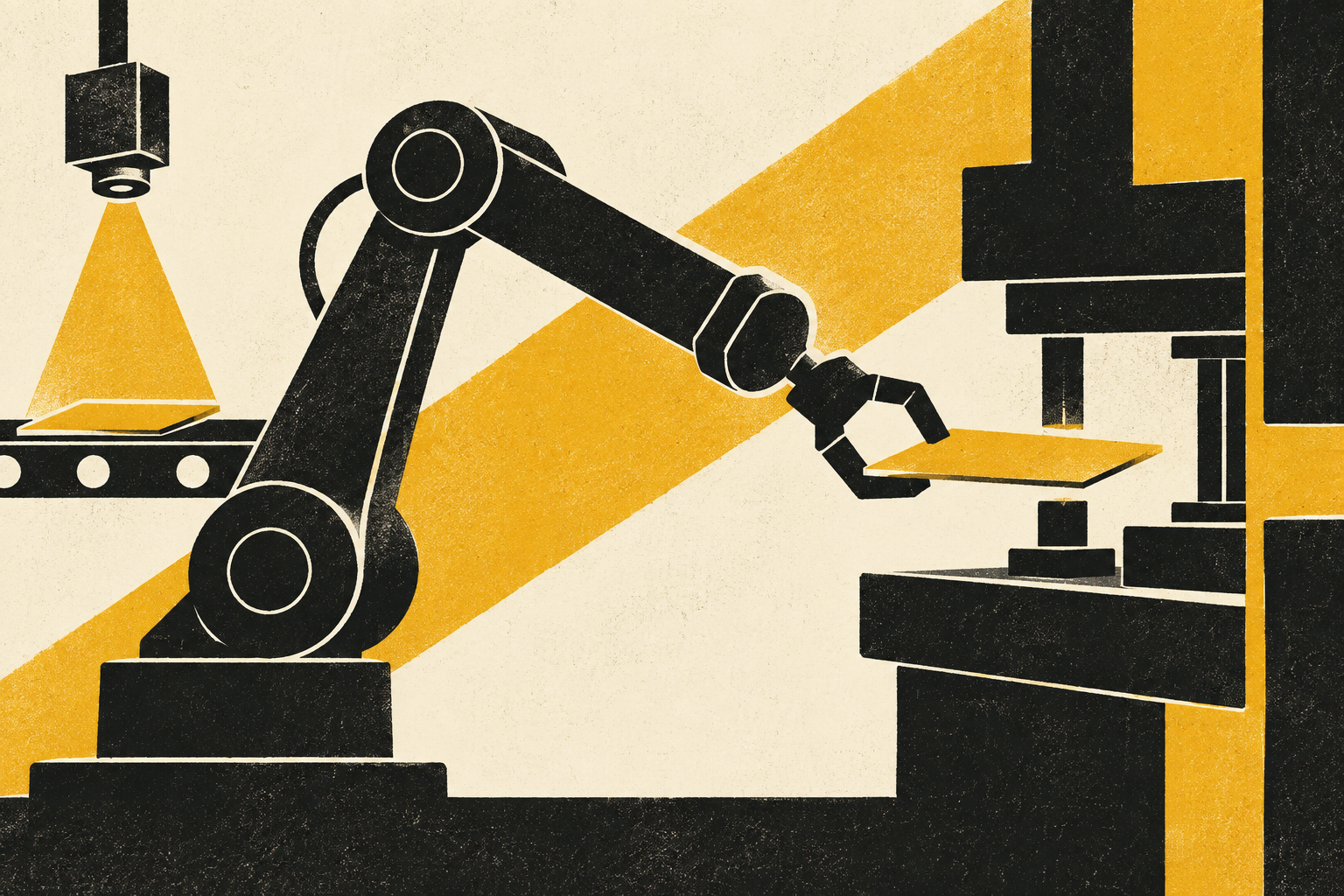
Mech-Mind's Mech-Eye supports robot deployment. Mech-Vision and Mech-Viz extend that deployment into a chain from seeing a workpiece to locating it, then planning an arm's grasp or route around obstacles. According to geekpark, that stack moved into daily chemicals and automotive parts from 2017 to 2019. It also moved into robot manufacturing for sorting, palletizing, depalletizing, and workpiece loading. The point is a bounded job that can be made repeatable.
Before its listing, Mech-Mind recorded more than 29,000 cumulative deployments, with products in nearly 50 countries and regions, according to geekpark. A source attributes to Ren Geng the claim that demonstration artefacts alone have no value. That contrast frames the real question: who makes robot intelligence usable after a demonstration ends?
A robot deployment starts with a bounded job
A buyer's first decision is not which humanoid body to buy. It is which closed-loop job must be completed: sorting a defined stream of goods. The job may instead involve palletizing finished items, depalletizing inbound stock, or loading workpieces into a machine.
- 2016Mech-Mind was founded
- 2017Mech-Mind launched Mech-Eye, Mech-Vision, and Mech-Viz
- 2019Mech-Mind completed its first overseas deployment
- 2023Mech-Mind released Mech-GPT for multimodal task workflows
- September 1, 2026Mech-Mind was listed on the Hong Kong Stock Exchange
Those jobs have clear starts and ends, which makes failure visible and improvement measurable.
Mech-Mind's deployments show the value of that framing. From 2017 to 2019, it entered daily chemicals and automotive parts. It also entered robot manufacturing with sorting applications, palletizing applications, depalletizing applications, and workpiece-loading applications, according to geekpark. Its stack separates the work into practical stages: Mech-Eye captures 3D point clouds and images; Mech-Vision finds positions and poses. Mech-Viz plans arm grasps. It also plans movement and obstacle avoidance. A buyer can therefore ask where the task breaks: perception, picking, or motion.
Scale does not remove that discipline. Before its listing, Mech-Mind had more than 29,000 cumulative deployments, covering more than 50 typical scenarios across dozens of industries and processing more than 100,000 types of goods, geekpark reports. Those figures describe many repeated jobs, not one universal robot problem.
Kunlunxing Robotics offers a useful filter before selecting hardware. Ren Geng told a technology outlet that a deployment scenario should form a complete closed loop and demonstrate value. It should also be relatively simple, create a data flywheel, and support human-machine interaction. That test puts the work ahead of the body: define the object flow. Then define the required handoff and the operator's role before evaluating an automation stack. Ren also argues that POCs alone do not establish value. Videos and leaderboard results alone do not establish it either. The operational loop does.
Measure production readiness beyond a pilot
A production buyer has to ask what happens after a robot completes a polished pilot. Task success is only the opening measure. Uptime and the rate of human intervention show whether the system can stay on the line. Safety must be assessed in the actual work area, while cycle time determines whether automation fits the production rhythm.
Downtime changes the economics quickly. So do integration cost and the expected payback period.
According to woshipm, NIST identifies a significant remaining gap between embodied intelligence demonstrated in laboratories and systems that can be deployed in manufacturing. The gap is physical as well as computational. Nature Machine Intelligence notes, via woshipm, that real-world interaction data is harder to collect than image or video data. Friction and material variation can disrupt policies developed in simulation, as can lighting or sensor errors.
That is why an operating record carries more weight than a video. BMW disclosed that Figure 02 worked for about 1,250 hours at its Spartanburg plant in the United States. It handled more than 90,000 sheet-metal parts and participated in producing more than 30,000 BMW X3 vehicles, according to woshipm. Those figures do not settle every question about reliability or cost, but they shift scrutiny toward sustained work under factory conditions.
woshipm also cites IEEE Spectrum's view that endurance and reliability obstruct humanoid scaling. Safety and clear demand do as well. A deployment-ready provider must therefore make each measure visible to the customer and integrator. As Ren Geng argued, POCs and videos alone do not create value. Leaderboard results alone do not create value either. The production gate is whether the system can keep performing its assigned work with a tolerable intervention burden and a credible economic case.
Choose the interface after defining the work
A robot's body should follow the work, rather than dictate it. A fixed arm may be the right interface when the job is grasping and placing within a defined cell; a mobile manipulator becomes relevant when the worksite itself must be reached. A humanoid form is another option, not an automatic default.
Mech-Mind's product structure illustrates why. According to geekpark, its first-generation Mech-Eye appeared in 2017. Mech-Vision and Mech-Viz products also appeared that year.
Mech-Eye collects 3D point clouds and images. Mech-Vision determines where objects are and how they are oriented. Mech-Viz then plans an arm's grasp. It also accounts for movement and obstacle avoidance. That division makes the intelligence legible as a set of capabilities that can be matched to a fixed arm, or adapted where a different robot form is justified. The interface can change while perception and motion planning remain identifiable engineering components.
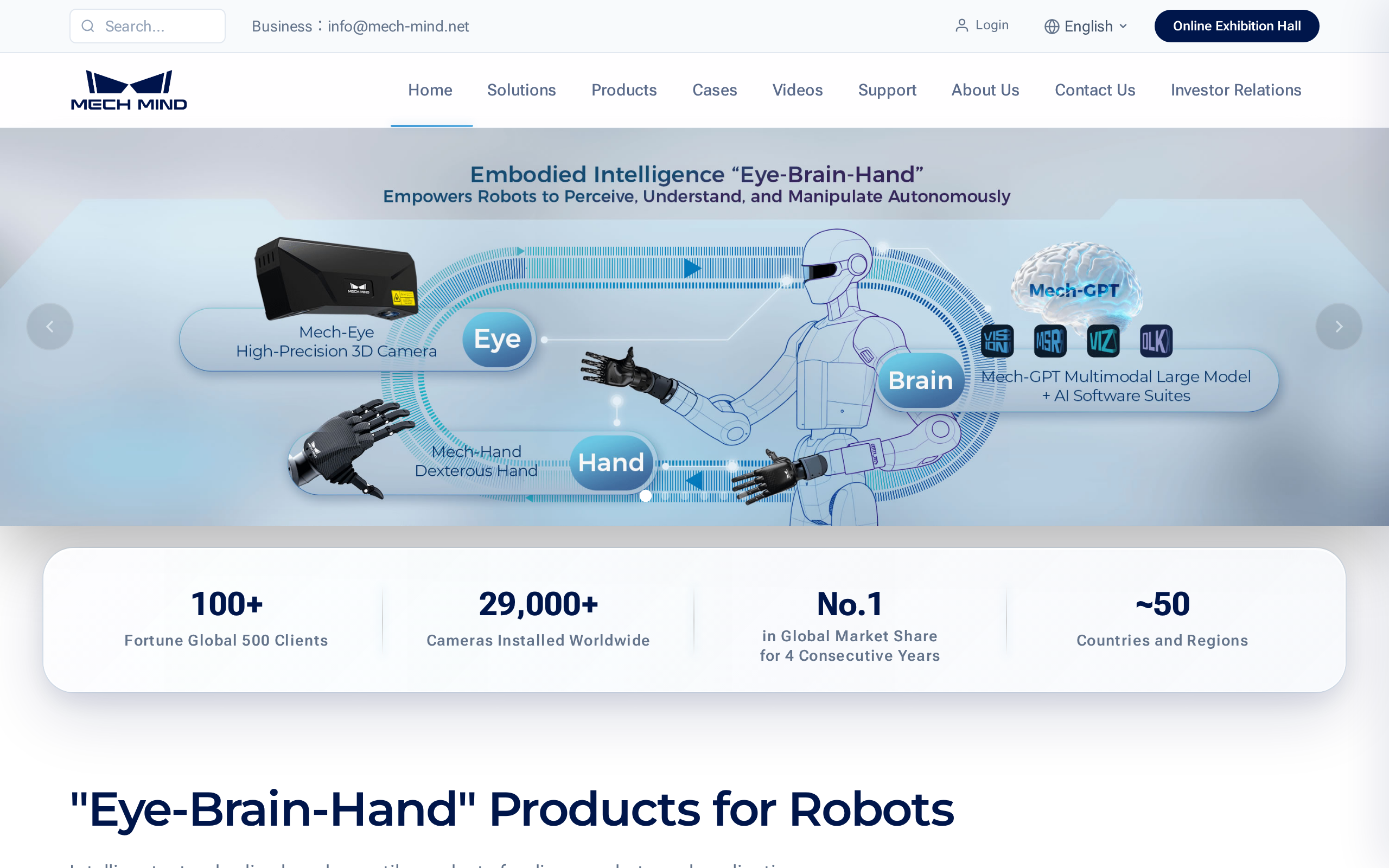
Mech-GPT, released in 2023, extends that logic by combining natural language with images within one task workflow, geekpark reports. It also incorporates 3D spatial information. The point is not that language makes every robot humanoid. It is that a task workflow can connect several forms of input to a physical action system.
Kunlunxing Robotics frames its own path more broadly. Ren Geng said the company would build humanoid robots first, then apply its technology to other product forms, according to a report. He also said Kunlunxing intends to develop humanoid embodied-intelligence products. It also intends to develop human-like and non-humanoid versions. Its humanoid strategy targets Tesla Optimus through an integrated hardware-and-software approach. That ambition makes the interface question central: reusable technology matters most when it can move beyond a single body.
Integration and maintenance decide who owns the result
Deployment ownership is earned after the model leaves the lab. Mech-Mind's record points to the accumulated work of adapting systems across sites: more than 29,000 deployments, more than 100,000 types of goods, and more than 50 typical scenarios in dozens of industries, according to geekpark. Each installation can produce process knowledge that a later integrator or operator can reuse.
The commercial pattern matters too. Customers active in the previous year contributed 61% of annual revenue in 2023, 78% in 2025, and 86% in the first quarter of 2026, geekpark reports. That does not prove any individual deployment is easy to maintain. It does suggest that repeat use matters to the business rather than being an afterthought. Extensions and customer-side continuity are also central to it.
Site data remains the hard input. Hyundai Motor's Robot Metaplant Application Center simulates production environments, trains robots, collects data, and sends tested solutions into factories, according to woshipm.
That process explains why a general capability is not a factory-ready result. woshipm notes that physical-interaction data is harder to obtain than image or video data, while friction can change how simulation policies behave in reality. Materials can also affect those policies. Lighting and sensor errors can do so as well. Integrators must therefore adapt the process and hand over a system operators can sustain. The evidence does not settle who bears responsibility when a robot causes damage or interrupts a line. It also does not settle responsibility when a robot creates a worker-safety risk. Those duties belong in contracts and operating models.
Choosing an Embodied-AI Deployment Path
- A manufacturer needs automation for a defined handling task such as sorting, palletizing, depalletizing, or workpiece loading. Favor a modular industrial-automation stack over a humanoid-first program. Mech-Mind's Mech-Eye acquires 3D point clouds and images, Mech-Vision identifies object positions and poses, and Mech-Viz plans robotic-arm grasping, movement, and obstacle avoidance; the company entered these task categories from 2017 to 2019.
- A buyer needs evidence that a system can be maintained across many sites and changing product mixes. Prioritize suppliers with repeat deployments, returning customers, and demonstrated scenario coverage. Before listing, Mech-Mind reported more than 29,000 cumulative deployments, more than 100,000 types of goods processed, and customer revenue retention rising from 61% of annual revenue in 2023 to 78% in 2025 and 86% in the first quarter of 2026.
- A company is considering a humanoid robot because a laboratory demonstration looks compelling. Treat demonstrations as insufficient and require production-line measures of endurance, reliability, safety, and demand. IEEE Spectrum identified these as major obstacles for humanoid robots, while NIST described a significant gap between laboratory embodied intelligence and deployable manufacturing systems. BMW's disclosed Figure 02 trial provides the kind of operational evidence to seek: about 1,250 hours at its Spartanburg plant, more than 90,000 sheet-metal parts handled, and participation in production of more than 30,000 BMW X3 vehicles.
- An automotive company believes its factories, supply chain, and AI team automatically make it ready to commercialize robots. Use those assets to create training and validation loops, not as proof of market readiness. Hyundai built the Robot Metaplant Application Center to simulate production environments, train robots, collect data, and send tested solutions into factories. XPeng's IRON robot has not yet entered large-scale commercial delivery.
- A robotics startup must select its first deployment scenarios. Choose bounded scenarios with complete closed loops, visible value, relative simplicity, data flywheels, and human-machine interaction. Those are the five principles Kunlunxing Robotics says it uses; its leadership also argues that POCs, videos, or leaderboard results alone have no value.
Automakers supply useful assets, not a complete answer
Automakers bring assets that robot companies cannot quickly reproduce: factories, supply chains, and experience turning complex machines into mass-produced products. XPeng also plans to apply its VLA model across cars and Robotaxis, according to woshipm. It plans to use the model for robots and flying cars as well. That creates a plausible route for shared engineering rather than a separate robot effort built from nothing.
Capital is pricing that possibility early. On August 24, XPeng said its robot business raised more than $900 million in its first financing round, at a post-money valuation above $6.3 billion. The woshipm author interprets that valuation as an advance payment for the chance that automotive AI teams and production capabilities can move robots from laboratory work into commercial products.
But those assets do not settle the deployment question. XPeng's IRON has not yet entered large-scale commercial delivery, woshipm reports. A vehicle maker's factory capacity can help once a robot design is ready to build; it does not by itself prove that customers can install the machine and operate it. Nor does it prove that customers can maintain it or buy it repeatedly.
That gap explains the distinction Ren Geng draws in a report between a small exploratory group and a business with independent weight. Ren says an automaker assigning only 100 or 200 people has not materially changed its commitment, while 5,000 or 10,000 would signal an all-in effort. He also says Xiaomi's embodied-intelligence unit has fewer than 200 people, and argues that at least 3,000 people are needed before a major enterprise has genuinely entered the field.
Ren's framing is deliberately cautious: he calls embodied intelligence a future strategic necessity, yet characterizes current entry as tactical speculation. He says automakers should wait until the market is mature and growing explosively, with annual revenue of at least hundreds of billions for automakers, and until their competitive battle has ended. The practical test remains harsher than funding or headcount: can a separately financed robot unit convert automotive advantages into repeatable commercial delivery?
Three routes to embodied-AI deployment
| Mech-Mind's industrial automation system | Automaker-backed humanoid efforts | Kunlunxing Robotics' stated strategy | |
|---|---|---|---|
| Primary deployment model | 3D perception, object-pose identification, and robotic-arm planning for industrial tasks | Factory testing, robot training, production-environment simulation, and automotive engineering reuse | Integrated full-stack hardware-and-software humanoid strategy |
| Task and scenario focus | Sorting, palletizing, depalletizing, and workpiece loading across daily chemicals, automotive parts, and robot manufacturing | Humanoids tested or trained in factory environments; not covered as a common task framework | Scenario selection emphasizes complete closed loops, value demonstration, relative simplicity, data flywheels, and human-machine interaction |
| Evidence of deployed operations | More than 29,000 cumulative deployments before listing; products covered more than 50 typical scenarios | BMW said Figure 02 operated for about 1,250 hours and handled more than 90,000 sheet-metal parts; XPeng IRON has not yet entered large-scale commercial delivery | Large-scale mass production is the stated objective; deployment results not covered |
| Integration and operator tooling | Mech-Eye captures 3D point clouds and images; Mech-Vision identifies positions and poses; Mech-Viz plans grasping, movement, and obstacle avoidance | Hyundai's Robot Metaplant Application Center simulates environments, trains robots, collects data, and sends tested solutions into factories | Not covered beyond the integrated full-stack approach |
| Customer and market footprint | More than 900 overseas customers; overseas revenue accounted for more than half of revenue | Automotive industry recorded 126,100 industrial robot installations globally in 2024 | Not covered |
| Commercial reliability signal | Revenue from customers active in the previous year reached 86% in the first quarter of 2026 | Industry analysis identified endurance, reliability, safety, and clear demand as major obstacles for humanoid robots | POCs, videos, or leaderboard results alone are described as having no value |
| Role of automotive experience | Automotive parts were among the industries entered from 2017 to 2019 | Automakers provide factories, supply chains, AI teams, and mass-production capabilities; Mercedes-Benz, BMW, Hyundai Motor, Toyota, and XPeng are cited | Lang Xianpeng previously delivered advanced assisted-driving systems for 1.5 million vehicles |
Before treating an automaker's robot program as a supply-chain signal, ask what commitment sits behind it. According to the report, Ren Geng's test is far above a team of 100 or 200 people; he places a major-enterprise entry at at least 3,000 people and calls 5,000 or 10,000 an all-in commitment. Use that distinction when judging whether a partner's factory access or capital is likely to translate into a durable deployment program.
Treat mass-production claims as a separate diligence question.
Ask suppliers to distinguish an ambition from demonstrated output. Kunlunxing Robotics aims for a global top-three mass-production position within 24 months, the report says, while Ren says Tesla has not achieved mass production in embodied-intelligence robots. Unitree has mass-production capability in his account, but he characterizes its focus as embodiment rather than embodied intelligence. That gap should shape evaluation: require evidence that the specific system needed for the task can be produced at the required scale. It must also be installed and sustained-not merely shown in a capable body.
For readers outside China
- Availability: Mech-Mind completed its first overseas deployment in 2019. Before listing, its products had entered nearly 50 countries and regions, and it served more than 900 customers in overseas markets. The source material does not identify those markets or describe direct purchasing, support, or integration arrangements outside China. XPeng's IRON robot has not yet entered large-scale commercial delivery. Availability outside China for Kunlunxing Robotics is not disclosed in sources.
- Pricing: Product pricing for Mech-Mind, XPeng IRON, and Kunlunxing Robotics is not disclosed in sources. The reported corporate figures are not product prices: XPeng's robot business raised more than $900 million at a post-money valuation of more than $6.3 billion, while Mech-Mind had a market capitalization of about 12.4 billion Hong Kong dollars at the close of its first trading day.
- Closest Western equivalents: Figure, which worked with BMW on real production-line testing; BMW disclosed Figure 02 operating for about 1,250 hours at its Spartanburg plant.; Apptronik, whose Apollo humanoid robot was brought into factories for training after Mercedes-Benz invested in the company.; Boston Dynamics, 80% of which Hyundai Motor acquired in 2021.
- Data residency: The source material does not cover data residency, customer-data ownership, cloud processing, cross-border data transfer, or security terms. Mech-Mind released Mech-GPT in 2023 to combine natural language, images, and 3D spatial information in a single task workflow, but where those data are processed or stored is not disclosed in sources.
Sources
- 36kr 对话昆仑行创始人任庚:车企做具身,未来入场是"战略必然",现在切入是"战术投机" https://36kr.com/p/3953725993991560
- geekpark 梅卡曼德上市,具身智能又跑出一家百亿公司 https://geekpark.net/news/369850
- woshipm 一家机器人公司还没开始交付,为什么就值63亿美元? https://woshipm.com/embodied/6459461.html
The evidence: 37 facts from 3 Chinese articles
Each line below was extracted from the article it sits under, in Chinese, before any of this was written. The writing is done from these and never from the source prose - that separation is structural, not a promise. How we work.
36kr对话昆仑行创始人任庚:车企做具身,未来入场是“战略必然”,现在切入是“战术投机”
- Kunlunxing Robotics was co-founded by Ren Geng, a former Huawei national CEO and Alibaba Group vice president, and Lang Xianpeng, the former head of Li Auto's assisted-driving business.
- Within less than 90 days of registration, Kunlunxing Robotics completed three financing rounds totaling tens of billions of yuan.
- Hillhouse Capital and Gaorong Capital participated in all three financing rounds for Kunlunxing Robotics.
- Kunlunxing Robotics had reached unicorn valuation before completing its registration process.
- Kunlunxing Robotics' humanoid robot strategy targets Tesla Optimus and uses an integrated full-stack hardware-and-software approach.
- Lang Xianpeng has experience delivering advanced assisted-driving systems for 1.5 million vehicles.
- Ren Geng said Lang Xianpeng leads Kunlunxing Robotics' AI business, while Ren Geng is responsible overall for strategic direction, organizational development, commercial operations, and corporate financing.
geekpark梅卡曼德上市,具身智能又跑出一家百亿公司
- Mech-Mind was listed on the Hong Kong Stock Exchange on September 1, 2026.
- Mech-Mind had a market capitalization of about 12.4 billion Hong Kong dollars at the close of its first trading day.
- Mech-Mind introduced nine cornerstone investors in its listing, including Baillie Gifford, which collectively subscribed for $186 million.
- Mech-Mind was founded in 2016.
- Mech-Mind launched the first-generation Mech-Eye, Mech-Vision, and Mech-Viz products in 2017.
- Mech-Eye acquires 3D point clouds and images, Mech-Vision identifies object positions and poses, and Mech-Viz plans robotic-arm grasping, movement, and obstacle avoidance.
- From 2017 to 2019, Mech-Mind entered industries including daily chemicals, automotive parts, and robot manufacturing for sorting, palletizing, depalletizing, and workpiece loading.
- Mech-Mind completed its first overseas deployment in 2019.
- Before its listing, Mech-Mind products had entered nearly 50 countries and regions, covered more than 50 typical scenarios across dozens of industries, processed more than 100,000 types of goods, served more than 100 Fortune Global 500 companies, and recorded more than 29,000 cumulative deployments.
- Mech-Mind serves more than 900 customers in overseas markets, and overseas revenue accounts for more than half of its revenue.
- Mech-Mind's overseas revenue rose from 58.6 million yuan in 2023 to 195.5 million yuan in 2025, representing a compound annual growth rate of 82.7%.
- Mech-Mind's overseas revenue share rose from 32.4% in 2023 to 50.3% in 2025.
- Revenue contributed by customers that were active in the previous year rose from 61% of Mech-Mind's annual revenue in 2023 to 78% in 2025, reaching 86% in the first quarter of 2026.
- Mech-Mind released Mech-GPT in 2023 to combine natural language, images, and 3D spatial information in a single task workflow.
- At the 2026 World Artificial Intelligence Conference, Mech-Mind demonstrated an embodied-intelligence foundation model, a bionic hierarchical robot brain, a world action model, two humanoid robots performing coordinated loading and basket-handling tasks, and the new-generation Mech-Hand multi-finger dexterous hand.
- Mech-Mind's revenue increased from 180.8 million yuan in 2023 to 388.8 million yuan in 2025, with a compound annual growth rate of 46.6%.
- Mech-Mind's gross margin increased from 39.1% in 2023 to 64.6% in 2025 and reached 64.8% in the first quarter of 2026.
woshipm一家机器人公司还没开始交付,为什么就值63亿美元?
- On August 24, XPeng announced that its robot business had raised more than $900 million in its first financing round, at a post-money valuation of more than $6.3 billion.
- XPeng's robot business financing transaction remains subject to subsequent closing arrangements.
- XPeng's IRON robot has not yet entered large-scale commercial delivery.
- The International Federation of Robotics recorded 126,100 industrial robot installations in the global automotive industry in 2024, representing about 24% of new global installations.
- Toyota released its third-generation humanoid robot, T-HR3, in 2017.
- F-Prime, citing PitchBook data, reported that funding for humanoid robots and robot foundation models in the Americas, Europe and Israel increased from $300 million in 2023 to $6.1 billion in 2025.
- Figure raised more than $1 billion in Series C financing in 2025, reaching a post-money valuation of $39 billion.
- Apptronik's financing in 2026 raised its valuation to about $5 billion.
- Hyundai Motor acquired an 80% stake in Boston Dynamics in 2021.
- Mercedes-Benz invested in Apptronik and brought its Apollo humanoid robot into factories for training.
- BMW has collaborated with Figure and Hexagon Robotics to test robots on real production lines.
- BMW disclosed that Figure 02 operated for about 1,250 hours at its Spartanburg plant in the United States, handled more than 90,000 sheet-metal parts, and participated in the production of more than 30,000 BMW X3 vehicles.
- Hyundai Motor built the Robot Metaplant Application Center to simulate production environments, train robots, collect data and send tested solutions into factories.