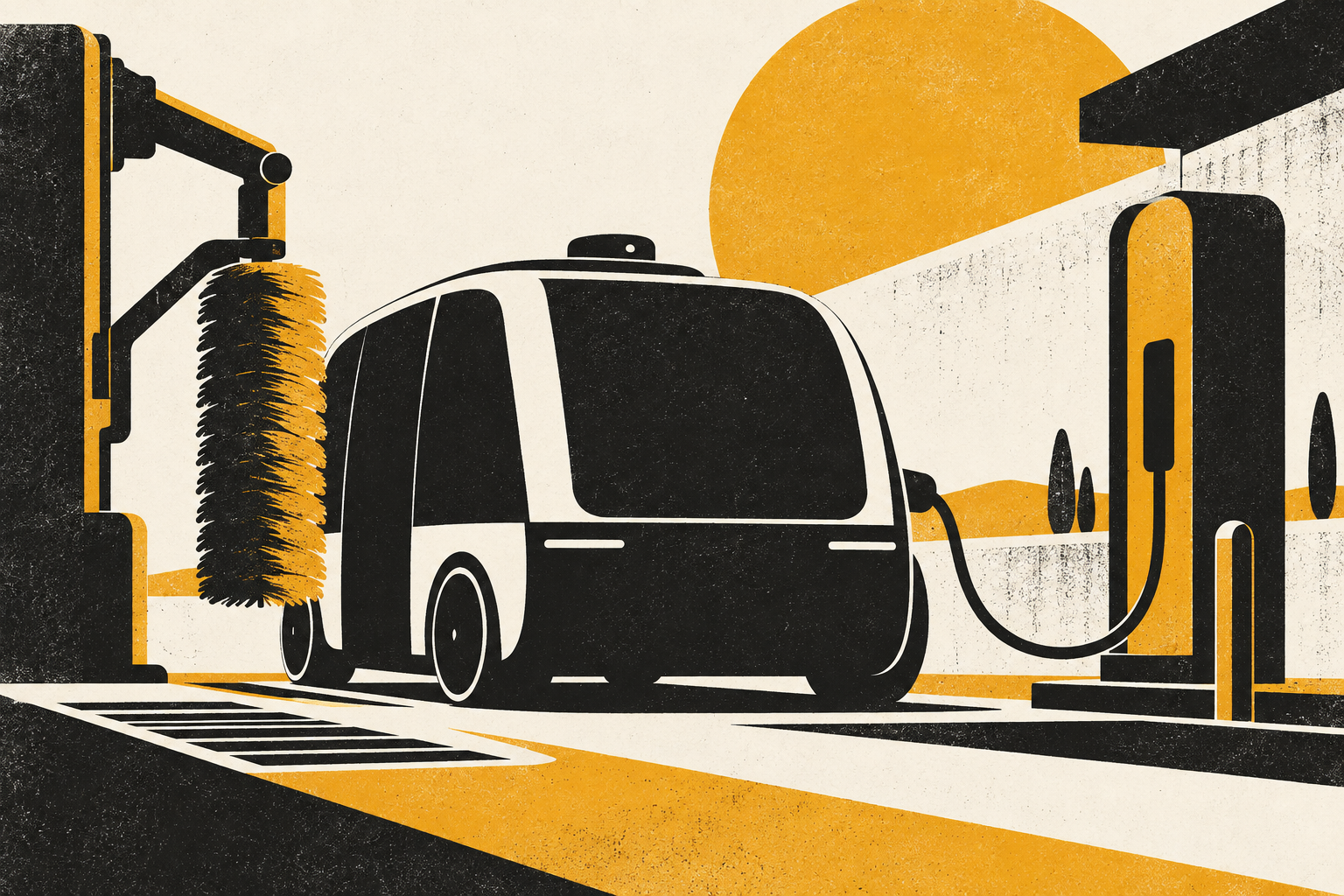
Tesla's Cybercab is shaped around what happens after a passenger leaves: a rear charging port, a 572-liter trunk rated for 100 kg, and a cabin designed to take a folded wheelchair. ifanr reports that its seat height is close to a wheelchair seat, while Braille appears on door handles and overhead controls.
Those details point beyond the usual driverless-car image. geekpark describes butterfly doors opened from an in-car button and a tall rear trunk able to take a small bicycle or wheelchair; it also notes Braille on the hazard-light and door-opening buttons. The vehicle's design treats boarding, cargo and charging as recurring fleet tasks. That is the useful frame for judging autonomy: not the disappearance of a driver, but the operational handoffs and recovery work that remain.
A vehicle designed for fleet turnover
Cybercab treats the cabin as a space that must reset for its next passenger. Its 572-liter rear trunk has a maximum load capacity of 100 kg, according to ifanr. geekpark describes a vertical rectangular opening sized for bulky cargo, including a small bicycle or wheelchair. That capacity matters to fleet turnover: luggage need not occupy the passenger area or force a vehicle out of service for a different trip type.
- October 2024Tesla unveils a Cybercab prototype at a Los Angeles film studio
- June 2025Tesla launches a small Robotaxi pilot program in Austin, Texas
- June 2026NHTSA proposes rules removing manual-pedal requirements for autonomous systems
- September 2026Tesla releases Cybercab for Robotaxi service
Accessibility is also built into the physical layout.
ifanr reports that the trunk can take a folded wheelchair and that the seat sits close to wheelchair-seat height. Braille appears on door handles and overhead buttons; geekpark also identifies Braille on the hazard-light and door-opening controls. The butterfly doors open diagonally upward through an in-car button, according to geekpark. These are vehicle details, but they reduce the operational dependence on a passenger arriving with a companion or needing ad hoc assistance.
Cleaning has been framed as a repeatable station task rather than a manual interior check. Tesla has shown a robotic arm using a high-suction vacuum on seats and floor, while a separate cleaning head handles the central screen, geekpark reports. The charging design has also changed: ifanr says Cybercab now has a rear charging port after earlier descriptions focused only on wireless charging.
Tesla claims 673 km of range and official energy consumption of 10.2 degrees per 100 km, according to geekpark. Those figures support an asset built around utilization, though real fleet results depend on operating conditions. On the factory side, the Unboxed process makes subassemblies in parallel before final assembly. Tesla expects a 5-second production cadence, versus more than 30 seconds at its Shanghai Gigafactory, geekpark reports.
Cybercab vehicle design, Tesla's early Robotaxi operations, and Waymo's service model
| Cybercab | Tesla Robotaxi service | Waymo service | |
|---|---|---|---|
| Human driving interface | No steering wheel, accelerator pedal, brake pedal, or rear-view mirrors | not covered | not covered |
| Autonomy approach | Eight cameras and the AI 4 computing platform; front-wheel drive | Tesla's FSD V14 and V15 use an end-to-end neural-network approach from perception to control with one model | Argues that safe large-scale autonomy requires cameras, lidar, and millimeter-wave radar together |
| Remote and human exception handling | not covered | At least two Robotaxi crashes occurred while vehicles were under remote operation; a driver stopped an FSD v14.3.7 vehicle at a railroad crossing | not covered |
| Cleaning and turnover design | Tesla has shown robotic arms vacuuming seats and floors and cleaning the central screen | not covered | not covered |
| Accessibility provisions | Trunk accommodates a folded wheelchair; seat height is close to a wheelchair seat; controls include Braille | not covered | not covered |
| Passenger capacity and cabin | Two seats and a 22-inch central display | not covered | not covered |
| Texas fleet record | 45 Cybercabs authorized for autonomous operations | 420 Robotaxis listed in Texas autonomous-vehicle records, including 375 Model Ys and 45 Cybercabs | 988 vehicles registered in Texas |
| Service footprint | Has begun carrying passengers in Austin, Texas | Launched in Austin and expanded to several other cities in Texas and Florida | Autonomous driving services in 14 cities |
| Rider-facing reliability evidence | not covered | Reuters reported unsuccessful orders and drop-offs requiring passengers to walk about 15 minutes | not covered |
| Vehicle purchase and operating economics | Price, operating cost, and private-fleet participation details not disclosed in sources | not covered | not covered |
The driverless cabin still has human handoffs
When steering controls are removed, the work does not disappear. It moves into a service workflow: remote assistance when a ride cannot proceed, cleaning between passengers, charging, maintenance, roadside recovery, and passenger escalation when an automated trip goes wrong.
In Austin, users can book Cybercab rides through Tesla's Robotaxi app, according to geekpark. The cabin also contains a front-facing in-cabin camera, while ifanr reports that Tesla fitted eight exterior cameras and uses the AI 4 computing platform found in current Model 3 and Model Y vehicles. Those sensors may support vehicle operation and oversight, but the available evidence does not explain who can access cabin footage.
Nor does it state how long footage is retained or what opt-out terms passengers receive.
Tesla has shown a robotic arm using high-suction vacuuming on Cybercab seats and floors, with another cleaning head for the central screen, geekpark reports. That demonstration identifies a possible turnover task, not the staffing model behind it. The available evidence does not disclose the human-to-vehicle ratio, intervention rate, or downtime associated with cleaning, charging, maintenance, and recovery. ifanr also reports that Tesla has not disclosed Cybercab's price, operating cost, or terms for privately owned vehicles joining the fleet.
Remote help is an operating dependency with consequences. National Highway Traffic Safety Administration records show at least two Tesla Robotaxi crashes during remote operation, according to ifanr. Separately, a Tesla on FSD v14.3.7 failed to stop at a railroad crossing despite warning lights and an approaching train last month; the driver stopped it by braking. Human handoffs therefore need clear authority and recovery paths, rather than being treated as a leftover from the driver-controlled car.
Availability is narrower than the platform story
The platform argument is much larger than a robotaxi route. The woshipm author frames Cybercab as an attempt to control human travel demand through a closed "interaction field": a system that receives demand, fulfills it, and closes the loop under a shared set of rules and services. In that view, Tesla is moving beyond selling smart cars or supplying rides. It aims to control the scenarios in which travel is requested and delivered.
That ambition does not describe availability yet.
As of September 3, Tesla had registered 420 vehicles for autonomous operations in Texas, according to geekpark. Only 45 were Cybercabs authorized for autonomous operation. geekpark also says several Cybercabs were running on Austin roads, while the fleet remained below Tesla's expected scale of 1,000 vehicles. A closed demand system needs enough vehicles in enough places to make its promise feel ordinary, rather than conditional on a narrow operating zone.
The regulatory path also limits how quickly a purpose-built vehicle can become commonplace. geekpark notes that the National Highway Traffic Safety Administration can exempt vehicles that do not fully meet current rules, but exempted vehicles are capped at 2,500 units per year. That is a route to operation, not proof of broad deployment.
Service boundaries are visible to riders. ifanr reports that Reuters reporters repeatedly could not obtain Tesla Robotaxi rides in Dallas and Houston. Three successful orders did not reach downtown destinations, leaving passengers to walk about 15 minutes after drop-off. By comparison, Waymo operates autonomous services in 14 cities and has registered 988 vehicles in Texas. The gap matters because a travel platform is judged at the edge of the service area, where a rider needs the system to complete the trip rather than merely start it.
Range and safety need an operating context
Tesla presents Cybercab with a claimed range of 673 km, while U.S. Environmental Protection Agency filings record 418.2 miles in the unadjusted combined SAE J1634 multi-cycle test. Those figures need operating context before they become a fleet promise. One is Tesla's claim in kilometres; the other is an unadjusted test result in miles. Neither figure alone describes how much productive service a vehicle can deliver between charging, cleaning, maintenance, or a disruption.
Tesla also lists energy consumption at 10.2 degrees per 100 km.
The safety context is equally consequential. Tesla's FSD V14 and V15 use an end-to-end neural-network model intended to cover perception through vehicle control. That design follows Tesla's rejection of lidar: Musk called it a doomed endeavor in 2019, while Tesla removed millimeter-wave radar in 2021 and ultrasonic sensors in 2022. By contrast, according to geekpark, Waymo argues that cameras, lidar, and millimeter-wave radar are all necessary for safe large-scale full autonomy.
The records show why architecture claims must be tested against exception handling. National Highway Traffic Safety Administration records include at least two Tesla Robotaxi crashes during remote operation. In a separate FSD v14.3.7 incident last month, a Tesla approached a railroad crossing with warning lights active and a train approaching; the driver stopped it by braking. These events do not establish a single cause, but they show that range and safety depend on the operating system around the vehicle, including how quickly a human can detect and recover from failure.
Design autonomy around the service loop, not the driver's absence
- A vehicle or automated service must turn over quickly between users. Design cleaning into the operating workflow from the start. Tesla has shown a robotic arm using high-suction vacuum cleaning for Cybercab seats and floor, plus a separate cleaning head for its central screen; this is a more useful automation target than treating post-trip cleaning as an afterthought.
- The service needs to accommodate luggage, wheelchairs, and riders who cannot rely on a conventional driving interface. Make physical accessibility part of the standard vehicle design. Cybercab's trunk can accommodate a folded wheelchair, its seat height is close to that of a wheelchair seat, and its door handles and overhead buttons include Braille.
- A team is deciding whether autonomous operation means removing humans from the workflow. Keep explicit human exception paths. National Highway Traffic Safety Administration records show that at least two Tesla Robotaxi crashes occurred while the vehicles were under remote operation, and a Tesla running FSD v14.3.7 was stopped by a driver after it failed to stop at a railroad crossing with activated warning lights and an approaching train.
- An automated fleet is expanding beyond a tightly controlled pilot. Treat service coverage and recovery as product requirements, not mere operations details. Reuters reported in May that its reporters repeatedly failed to obtain Tesla Robotaxi rides in Dallas and Houston, while three successful orders did not reach downtown destinations and required passengers to walk about 15 minutes after drop-off.
- A fleet operator is choosing where to focus engineering effort. Optimize the whole operating system-vehicle energy use, manufacturing, charging, cleaning, dispatch, and recovery-rather than autonomy software alone. Cybercab uses Tesla's Unboxed manufacturing process, and Tesla has stated that its paint process is completed together with automotive-component manufacturing; however, the sources do not disclose the Cybercab's operating cost.
Measure the recovery path, not the vanished interface
A vanished interface is not the same as a vanished job. Tesla has shown Cybercab cleaning through a robotic arm: a high-suction vacuum handles seats and floor, while another cleaning head handles the central screen, according to geekpark. That demonstration makes the relevant unit of analysis a completed ride cycle, rather than the absence of a driver or a visible control panel.
For an AI agent, use the same test: count the task only when its result is accepted and the system is ready for the next request.
That means pricing an unattended workflow after monitoring, cleanup, permissions, unusual inputs, failed handoffs, recovery, and escalation have been included. A system that completes routine work cheaply but requires human intervention when access changes or a request falls outside policy has shifted labour into an exception queue. Its apparent automation rate can conceal the actual operating burden.
Tesla expects Cybercab to reach $0.2 per mile, or 0.84 yuan per km, in the future, geekpark reports. But ifanr notes that Tesla has not disclosed the vehicle's price, operating cost, or the terms for privately owned vehicles joining its fleet. The gap matters: a target cost is useful only alongside the work required to keep vehicles available between rides.
The same discipline applies to AI operations. Measure recovery time, the share of work needing review, and the cost of restoring a failed task to a usable state. woshipm's author argues that durable differentiation comes from proprietary, closed-loop, iteratable interaction fields. In practice, that means designing handoffs so each exception improves the next run, rather than treating human rescue as evidence that the interface has disappeared.
Set an operating target before removing the visible human step. Track cost and reliability for each completed task, then inspect the exceptions that prevent work from reaching that finish line.
Tesla's future target of $0.2 per mile, alongside a claimed 10.2 degrees per 100 km, makes the hidden operating model measurable, according to geekpark. Apply that discipline to an agent: assign ownership for monitoring, cleanup, permissions, recovery and escalation. Test whether the workflow can absorb demand rather than merely complete a demonstration. Cybercab's Unboxed process assembles parallel subassemblies at once, while Tesla expects a 5-second production cadence; your automation should likewise have defined handoffs when one component fails or waits for approval. Watch scale closely: geekpark reports Austin's fleet remains below 1,000 vehicles.
For readers outside China
- Availability: Cybercab has begun carrying passengers in Austin, Texas, in the United States, where users can book rides through Tesla's Robotaxi ride-hailing app. Tesla launched a small Robotaxi pilot program in Austin, Texas in June 2025 and has since expanded the service to several other cities in Texas and Florida. The source material does not cover availability outside the United States. Tesla has not opened Cybercab sales to customers, but it has posted a form for prospective Cybercab fleet buyers.
- Pricing: Tesla has not disclosed the Cybercab's price or operating cost. Tesla expects Cybercab to cost $0.2 per mile in the future, equivalent to 0.84 yuan per km; this is an expectation rather than a published rider fare or vehicle price.
- Closest Western equivalents: Waymo's autonomous ride-hailing service, which operates in 14 U.S. cities with about 4,000 autonomous vehicles.; Tesla's own Robotaxi ride-hailing app in Austin, Texas.
- Data residency: Not disclosed in sources. The source material does not cover where Cybercab, Tesla Robotaxi app, in-cabin camera, or remote-operation data is stored or processed.
Sources
- geekpark 我坐进特斯拉 Cybercab,吃下马斯克 Robotaxi 的「新饼」 https://geekpark.net/news/370412
- geekpark 没有方向盘、没有踏板、没有后视镜:特斯拉最疯狂的车来了 https://geekpark.net/news/370425
- woshipm 马斯克砸1000亿,赌的根本不是无人驾驶出租车 https://woshipm.com/share/6460691.html
- ifanr 特斯拉新车发布!Cybercab 正式投入运营,马斯克开始接单了 https://ifanr.com/1678435
The evidence: 49 facts from 3 Chinese articles
Each line below was extracted from the article it sits under, in Chinese, before any of this was written. The writing is done from these and never from the source prose - that separation is structural, not a promise. How we work.
geekpark没有方向盘、没有踏板、没有后视镜:特斯拉最疯狂的车来了
- Tesla held a Cybercab launch event on September 3 without a livestream and with only a small number of invited attendees.
- Tesla's Cybercab has no steering wheel, pedals, or conventional side rear-view mirrors.
- X user Kyle Conner posted on-site photos and technical details of Cybercab after Tesla's launch event.
- Cybercab uses brake-by-wire technology with an independent actuator on each wheel.
- Cybercab uses front-wheel drive, 4680 battery cells, and a 48V low-voltage electrical architecture.
- Tesla has not opened Cybercab sales to customers but has posted a form on its website to collect contact information from prospective Cybercab fleet buyers.
- Users in Austin can book rides in Cybercab through Tesla's Robotaxi ride-hailing app, which launched last year.
- Tesla unveiled a Cybercab prototype at an event at a Los Angeles film studio in October 2024.
- As of September 3, Tesla had registered 420 vehicles for autonomous operations in Texas, including 45 Cybercab vehicles authorized for autonomous operations in the state.
- Waymo operates Robotaxi services in 14 U.S. cities with about 4,000 autonomous vehicles.
- Waymo's Vice President of Onboard Software Srikanth Thirumalai published a blog post on August 26 titled "10 AI Lessons From Over 200 Million Fully Autonomous Miles."
- Elon Musk called lidar a "doomed endeavor" in 2019, and Tesla removed millimeter-wave radar in 2021 and ultrasonic sensors in 2022.
- Tesla's FSD V14 and V15 use an end-to-end neural-network approach intended to handle the full process from perception to control with one model.
- Tesla launched a small Robotaxi pilot program in Austin, Texas in June 2025 and has since expanded the service to several other cities in Texas and Florida.
- The National Highway Traffic Safety Administration proposed new rules in June 2026 that would remove the requirement for autonomous-driving systems to have manual pedals.
- The National Highway Traffic Safety Administration can grant automakers exemptions to sell vehicles that do not fully comply with current rules, but such exempted vehicles are limited to 2,500 units per year.
geekpark我坐进特斯拉 Cybercab,吃下马斯克 Robotaxi 的「新饼」
- Tesla released the Cybercab, an autonomous electric vehicle intended for Robotaxi service, in September 2026.
- Cybercab has begun carrying passengers in Austin, Texas, in the United States.
- Cybercab has no steering wheel, accelerator pedal, brake pedal, or rear-view mirrors.
- Cybercab is a 4.4-meter-long two-seat vehicle.
- Cybercab uses butterfly doors that open diagonally upward through an in-car button.
- Cybercab has a vertical rectangular rear trunk that can hold large items such as a small bicycle or a wheelchair.
- Cybercab uses front-wheel drive, unlike the rear-wheel-drive Model vehicles currently on sale.
- Cybercab's cabin has a 22-inch central screen, two window switches, and two USB-C charging ports.
- Cybercab's hazard-light and door-opening buttons are fitted with Braille.
- Cybercab has an in-cabin camera at the front of the passenger compartment.
- Tesla has shown a video in which a robotic arm with a high-suction vacuum cleans Cybercab's seats and floor, and a different cleaning head cleans its central screen.
- Cybercab is equipped with a 163 kW electric motor rated at 219 horsepower.
- Cybercab uses a 47.6-degree battery, weighs 1412 kg, and has a drag coefficient below 0.2.
- Cybercab uses Tesla's Unboxed manufacturing process, in which components are produced in parallel as subassemblies and then assembled at once.
- Several Cybercabs are operating on roads in Austin, Texas, but the fleet remains below Tesla's expected scale of 1,000 vehicles.
ifanr特斯拉新车发布!Cybercab 正式投入运营,马斯克开始接单了
- Tesla officially launched the production version of the Cybercab autonomous electric vehicle in Austin, Texas, in the United States.
- Tesla deployed 20 Cybercabs and 30 Model Ys to transport guests at a Warner Bros. studio event in October 2024.
- Tesla began Cybercab production at its Texas Gigafactory in April this year.
- Tesla has not disclosed the Cybercab's price, operating cost, or details on allowing privately owned vehicles to join its fleet.
- The Cybercab, previously described as supporting only wireless charging, now has a charging port at its rear.
- Tesla has 420 Robotaxis listed in Texas autonomous-vehicle records, including 375 Model Ys and 45 Cybercabs.
- The Cybercab has no rear-view mirrors, steering wheel, or pedals, and its cabin contains two seats and a 22-inch central display.
- The Cybercab's 22-inch central display is Tesla's largest in-vehicle screen.
- Tesla installed eight cameras around the Cybercab, and the vehicle uses the AI 4 computing platform also used in current Model 3 and Model Y vehicles.
- U.S. Environmental Protection Agency filings list the Cybercab as a single-motor front-wheel-drive vehicle with maximum power of 163 kW, a curb weight of about 1.41 tonnes, and a 326V, 146Ah battery.
- The Cybercab achieved an unadjusted combined range of 418.2 miles in the SAE J1634 multi-cycle test.
- The Cybercab has a 572-liter trunk with a maximum load capacity of 100 kg.
- The Cybercab's trunk can accommodate a folded wheelchair, its seat height is close to that of a wheelchair seat, and its door handles and overhead buttons include Braille.
- Tesla launched a Cybercab purchase-interest form that lets users select interest in buying a Cybercab, building mobility hubs, or participating in event partnerships, and submit a phone number.
- National Highway Traffic Safety Administration records show that at least two Tesla Robotaxi crashes occurred while the vehicles were under remote operation.
- A Tesla running FSD v14.3.7 approached a railroad crossing last month, failed to stop despite activated warning lights and an approaching train, and was stopped by the driver braking.
- Reuters reported in May that its reporters repeatedly failed to obtain Tesla Robotaxi rides in Dallas and Houston, and that three successful orders did not reach downtown destinations and required passengers to walk about 15 minutes after drop-off.
- Waymo provides autonomous driving services in 14 cities and has registered 988 vehicles in Texas.